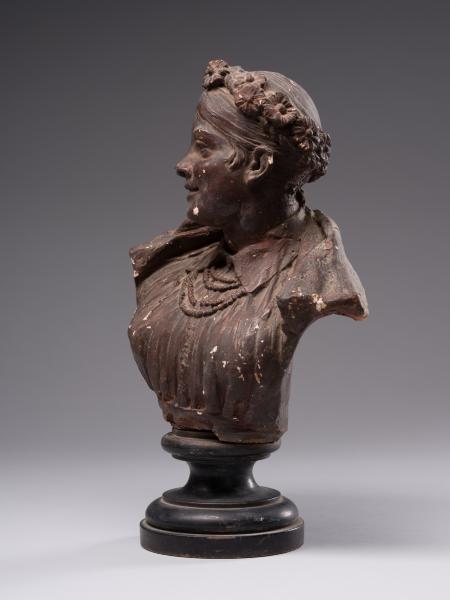
Bust of a Woman

Antoni Popiel
  • Bust of a Woman 2
  • Bust of a Woman 3
  • Bust of a Woman 4
  • Bust of a Woman 5
  • Bust of a Woman 6
  • Bust of a Woman 7
  • Bust of a Woman 8
  • Bust of a Woman 9
Basic information
ID
С-I-1880
Author
Antoni Popiel
Name
Bust of a Woman
Date of creation
1891
Country
Austro-Hungarian Empire
Culture
Contemporary times
Technique
moulding polychrome
Material
plaster
Dimensions (height x width x depth, cm)
35.4 x 23.3 x 15
Information about author
Author
Antoni Popiel
Artist's lifetime
1865–1910
Country
Austrian Empire, Austro-Hungarian Empire
Biography
Antoni Popiel (13 June 1865, Szczakowa – 7 July 1910, Velykyi Liubin) was one of the leading Lviv sculptors of the late nineteenth and early twentieth centuries. He came from a noble family of the Sulima coat of arms. The sculptor's mother, Antonina, belonged to the Staniček family. His father, Anton-Jozef Popiel, was a government official at the customs in various Galician towns, including Brody and Zolochiv, and a well-known public figure. Between 1895 and 1897, he published the "Gazeta Brodzka" newspaper at his own expense. The future artist spent his youth in Brody and considered the town, as well as Lviv, to be his home. He studied at gymnasiums in Brody and Lviv. He received his professional training at the Krakow School of Fine Arts (1882–1884) under Izydor Jablonski, Wladyslaw Luszczkiewicz and Walery Gadomski, and at the Vienna Academy of Fine Arts (1885–1888) under the professors of sculpture Edmund von Hellmer and Otto König. In 1888, he completed his studies at the Academy of Fine Arts in Florence under the sculptors Augusto Passaglia, Emilio Mancini, and Augusto Rivalta, the author of Veristic Monuments. Influenced by the "Neo-Baroque academism" popular then, he became interested in monumental and decorative sculpture. He returned to Lviv in 1889. He opened his first studio in an outbuilding in the courtyard of the Branytskyi house at 3 Mariiska Square (now Adam Mickiewicz Square). Later, he moved to a studio on the premises of the Benedictine Monastery (now Vicheva Street). The young sculptor was noticed by Leonard Marconi, who offered him a position as his assistant at the Department of Sculpture and Ornamental Drawing at the Lviv Polytechnic and as a member of his workshop. Subsequently, A. Popiel assisted L. Marconi in numerous monumental and decorative works of the 1890s. In December 1894, Popiel married Marconi's daughter Maria. After the death of L. Marconi in 1901, he became an associate professor at the Department of Sculpture and Ornamental Drawing and, in 1905 – an honorary professor. The artist had a studio in Lviv where Kazimiera Malaczynska-Pajzderska, Luna Amalia Drexler, Mykhailo Paraschuk and others received their first artistic training. In 1897, together with the sculptor Edmund Plaszewski, he organised a company specialising in the decoration of houses. From 1895 to 1896, Popiel worked with I. Levytskyi, and in 1900, he took over the artistic direction of his building materials factory. Monumental and decorative compositions, decorations of private houses and public buildings, especially the Lviv City Theatre (now the Lviv Opera and Ballet Theatre), for which the master created 1900 sculptures (1907), form a powerful layer of the artist's work. A. Popiel is the author of numerous monuments, the most famous of which is dedicated to Adam Mickiewicz in Lviv (1904), memorial plaques, commemorative plunges, and easel genre compositions. Popiel's oeuvre, especially monumental and decorative sculpture, is prevailed by the inspiration of Viennese Neo-Baroque, manifested in the figures' energetic modelling and dynamic movement. Several works show the influence of French sculpture and the Neo-Renaissance style, as in the decoration of the railway station and the Lviv City Theatre. A. Popiel's portrait busts are characterised by the accuracy and detail of the reproduction of individual features. The sculptor created several portraits in the 1890s under the influence of Viennese Neo-Baroque, which is reflected in the expressive modelling, the dynamic of the silhouettes, and the theatricality of the head turns. Painterly texture, Neo-Baroque allegory, dynamism and sometimes the integration of symbolic imagery are characteristic of Popiel's easel compositions from the turn of the 19th and 20th centuries. Popiel died at the age of 45 after a severe illness. He was buried in the Lychakiv cemetery. In the autumn of 1910, within the framework of the General Regional Exhibition, a posthumous exhibition of the master's works was opened, which included more than 50 sculptures.
Object description
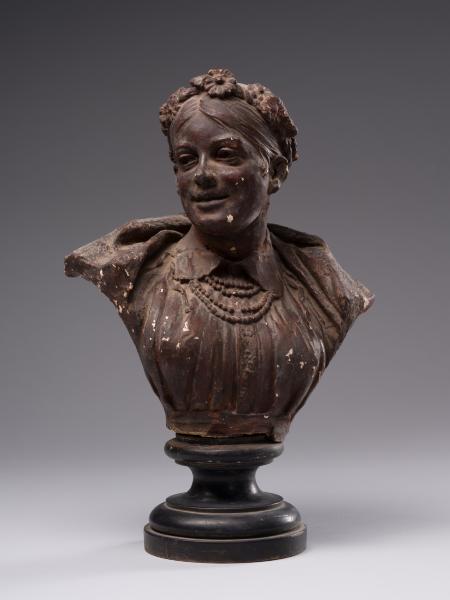
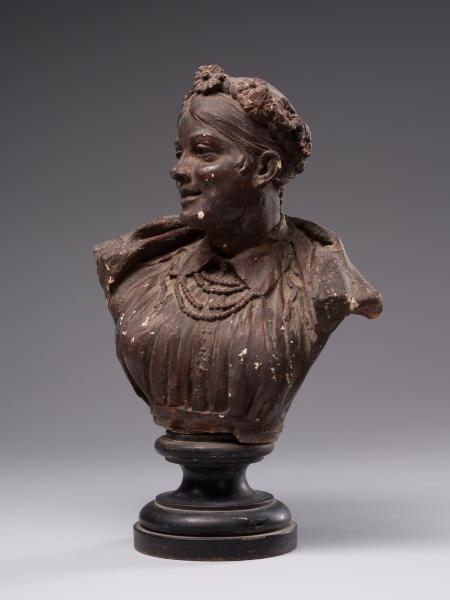
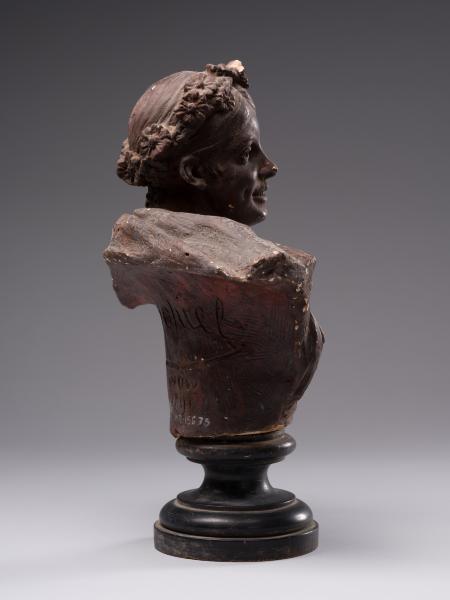
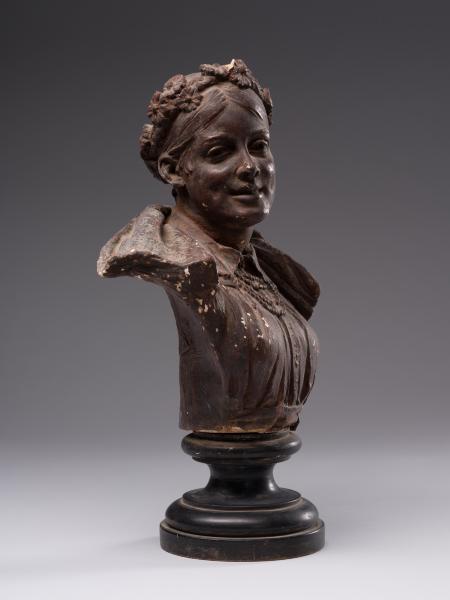
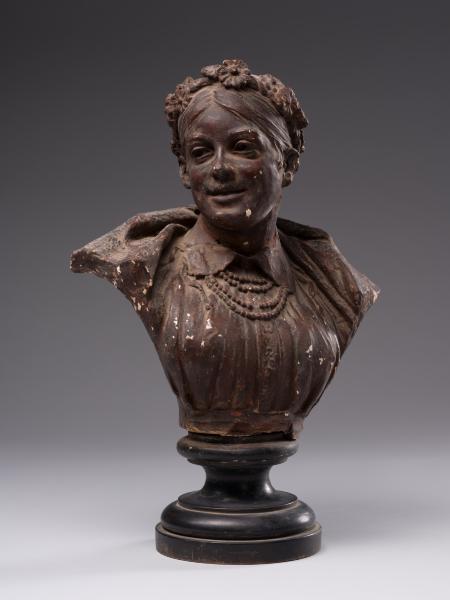
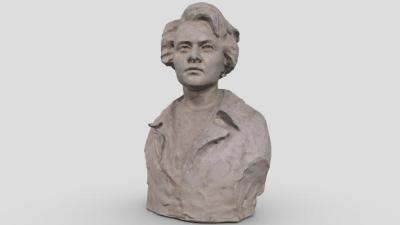
The figurative solution of the "Bust of a Woman" (1891) was inspired by the Romantic idea of renewing culture by turning to folk sources and the aestheticisation of the folk, its perception as a fascinating artistic theme in the art of the turn of the 19th and 20th centuries. The development of ethnography, especially its Lviv community, contributed to the birth of interest in folk life, where the first ethnological centre for studying the ethnic culture of the western regions was founded with the participation of prominent scholars and cultural figures – Kh. Vovk, V. Hnatiuk, M. Hrushevskyi, F. Kolessa, Z. Kuzela, D. Lepkyi and Ivan Franko – and the "Ethnographic Collection" publication began. In the 1860s, Polish researcher O. Kolberg systematically collected ethnographic material from Ukrainian territory. At the end of the nineteenth century, the development of the "Zakopane style" and the customary artists' trips to the village of Zakopane near Krakow contributed to the interest in folk themes. A. Popiel's "Bust of a Woman" is full of lively ethnographic interest in the reproduction of the female folk type and the regional folk system. The picture is characterised by a generalised reflection of an abstract state of happiness and characteristic folk anthropological features. The careful reproduction of the wreath, necklace and other details of folk symbols determines the task of embodying the folk type. Despite its schematic nature, the bust is full of expression, which can be seen in the active, expressive silhouette, the head turning, and the outfit's modelling. The work is probably paired with the "Bust of a Man" (1891). It resonates with other works of folk themes in Lviv sculpture of the turn of the nineteenth and twentieth centuries, in particular by T. Baracz ("Bust of a Peasant", 1879), W. Brzega ("A Man from Verkhovyna", 1901), K. Laszczka ("Bust of a Man from Verkhovyna", 1900), and M. Tarczynowski ("Bust of an Older Man", 1888). The interest in the folk theme in painting can be seen in the works by W. Wodzinowski, A. Grottger, A. Jegerski, A. Kozakiewicz, K. Pochwalski, W. Tetmajer, and W. Szymanowski.
Inscriptions
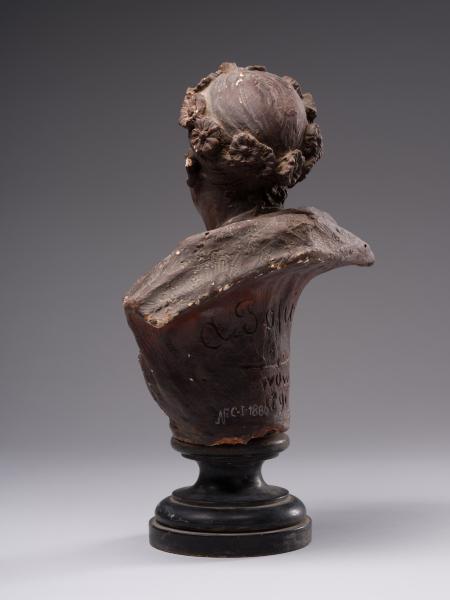
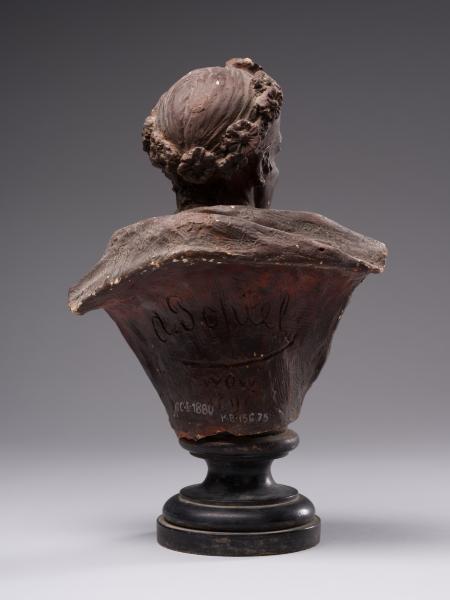
Signed and dated on the back: "A. Popiel / Lwów 1891".
Legal regulation
Borys Voznytskyi Lviv National Art Gallery