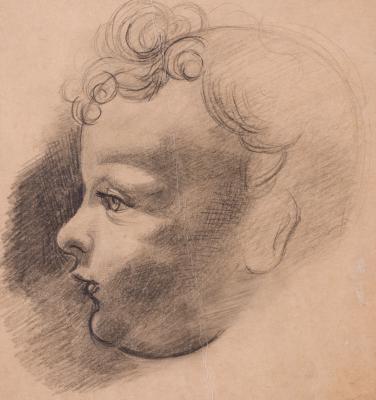
Drawing of a Man's Bust
Yulian Zaiats


Basic information
- ID
- Ф-З-Арх-ЛГМ-5/22
- Author
- Yulian Zaiats
- Name
- Drawing of a Man's Bust
- Date of creation
- 25.01.1919
- Country
- Austro-Hungarian Empire (?)
- Technique
- drawing
- Material
- paper Indian ink
- Dimensions (height x width, cm)
- 11.8 x 9.4
Additionally
- Type
- graphic art
- Genre
- portraiture
- Plot
- Portrait
- Provenance
- Received from Nina Zaiats
Information about author
Object description
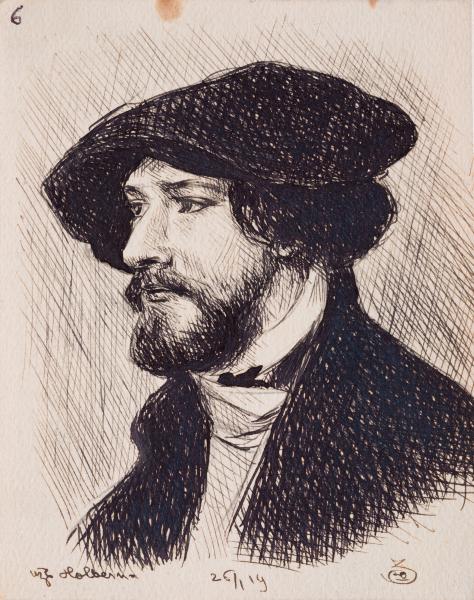
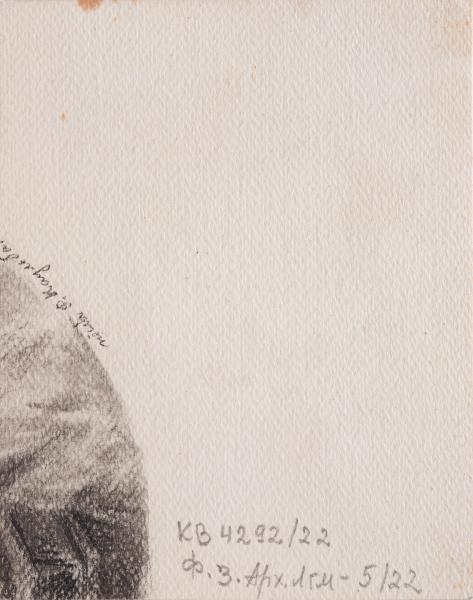
The sheet features an ink and pen copy of the iconic portrait of Bonifacius Amerbach by Hans Holbein the Younger, created in 1519. The original is an example of Renaissance portrait realism, which combines the laconicism of composition, the restrained dignity of the model, and exceptional attention to physiognomic expressiveness. The study copy preserves the general proportions and compositional system: the model is depicted in three-quarters, in dark clothes, with a characteristic massive headdress that balances the silhouette and forms a clear geometric volume of the background. The contours and tonal gradations are reproduced with a pen using different densities of strokes. The light and shadows in the areas of the face and clothing are conveyed through cross-hatching, which gives the portrait internal plasticity. Particular attention was paid to the eyes, eyebrow line, and lips, the areas where the psychological tension of the image is revealed. The contour lines in the shoulder area and headdress are more rigid, which allows for modelling the volume and conveying physicality. The copy retains the restrained intellectual mood of the original: Bonifacius Amerbach, a prominent humanist and jurist, appears as the personification of a new man of the Reformation, internally focused, restrained, with a clear and penetrating gaze. This original by Hans Holbein is renowned for its exceptional sophistication in capturing portrait authenticity and psychological state, as well as for the balance between linear accuracy and soft modelling of forms, which makes such portraits valuable material for educational imitation. At the beginning of the twentieth century, pen-and-ink copies and sketches were part of the standard curriculum in both academic and private art schools. This practice not only disciplined the hand, developed coordination and precision, but also shaped the ability to read the original analytically, distinguish between artistic means, and study compositional construction. Copying Holbein's portraits was valuable due to the exceptional clarity of the drawing, the accuracy of proportions, and the rhythm of lines, which enabled future artists to study the model and reveal the essence of the image in a two-dimensional form, both in terms of visual similarity and psychology. Thus, this study copy is not just an imitation, but a gesture of continuing the dialogue with the Renaissance, with its idea of man as a carrier of reason, dignity, and inner integrity. On the back of the work, we can see the lower fragment of an unidentified pencil drawing, also by Yulian Zaiats, but the signature of the original copy is illegible. The fragment is difficult to identify without additional information.
Inscriptions
Inscription "изъ Holbeina"; "25/1 19"; Yulian Zaiats' signature. Indistinct inscription on the reverse.
Portrayed person
- The name of the person portrayed
- Bonifacius Amerbach
- Lifetime of the person portrayed
- 1495–1562
Legal regulation
Borys Voznytskyi Lviv National Art Gallery