Drawings of the Head and Bust of a Man and a Woman
Yulian Zaiats


Basic information
- ID
- Ф-З-Арх-ЛГМ-5/16
- Author
- Yulian Zaiats
- Name
- Drawings of the Head and Bust of a Man and a Woman
- Country
- German Empire (?)
- Technique
- drawing
- Material
- paper pencil
- Dimensions (height x width, cm)
- 29.4 x 20.9
Additionally
- Type
- graphic art
- Genre
- portraiture
- Plot
- Portrait
- Provenance
- Received from Nina Zaiats
Information about author
Object description
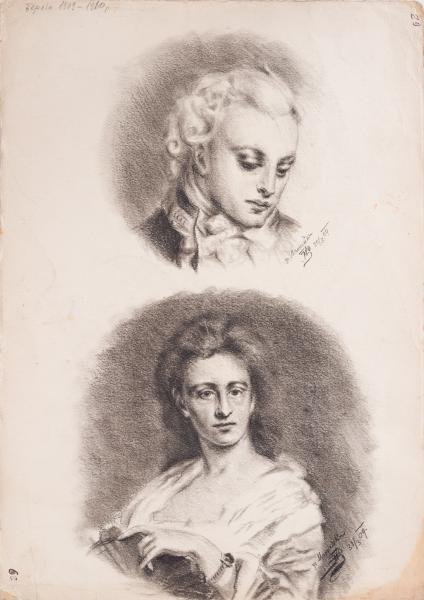
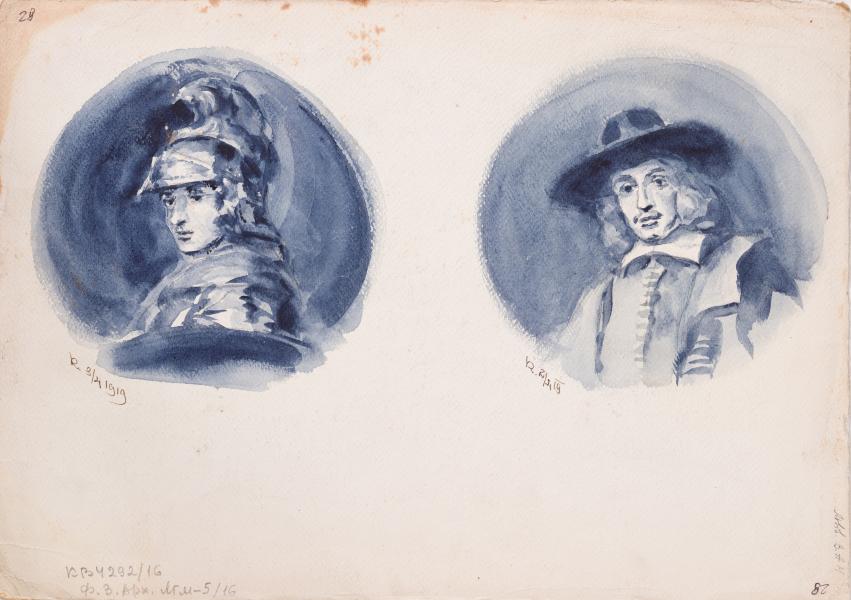
The front side of the sheet features two drawings based on the work of Jan Matejko: a portrait of the head of Stanisław Szczęsny Potocki, based on a fragment of his monumental painting Rejtan, or the Fall of Poland (Rejtan at the Sejm in 1773) (1866), and a female portrait, also reproduced from the original by the Polish artist. Both images were created in soft pencil, with an emphasis on studying the pictorial prototype through the graphic language of academic drawing. Stanisław Potocki's head is presented in a three-quarter turn with a slight downward tilt, which preserves the psychological tension characteristic of Jan Matejko's composition, although somewhat generalised. Despite the simplified interpretation of the details, the drawing captures key emotional traits, such as restraint, alienation, and demonstrative dignity, which, in the context of the original, acquire a political connotation. The image is based on a fragment of a painting that is conditional and not entirely historically accurate: Jan Matejko's depiction of Stanisław Potocki is more a generalised representation of the collaborative position of the Polish nobility during the partition of the Polish-Lithuanian Commonwealth than a life-size portrait. This gives the drawing a double meaning: both a study of Jan Matejko's style and an attempt to comprehend the visual code of a certain historical narrative. Next to it is a female portrait, also painted after Jan Matejko. It is distinguished by its expressive structure and restrained gradation of light and shade, which helps to emphasise the nobility of the features and inner concentration of the character. Both drawings demonstrate a careful study of Jan Matejko's signature style, characterised by meticulous elaboration of faces, typification, and subtle manipulation of light volume. On the back of the letter are two copies of Rembrandt van Rijn's watercolour paintings: "Athena Pallas" (1655) and "Portrait of Jan Six" (1654). Both images are distinguished by a gradation of tonal transitions achieved through transparent layering of paint with gradual complication of the shape. In the case of Athena, the allegorical solemnity of the image is preserved: a massive helmet and expressive lighting of the face – all this is reproduced in the copy, albeit adapted to the limitations of the watercolour technique. The female figure is calmly balanced, surrounded by a soft penumbra that creates the effect of depth. The portrait of the Dutch statesman and art lover Jan Six is a more intimate, chamber image. The watercolour copy preserves the main elements of the Rembrandt style: soft light modelling of facial features, expressive gaze, and calm confidence in posture. The copy artist focused not only on the external similarity but also on conveying the model's inner state, which is especially important in Rembrandt's studios. Both works on the reverse side demonstrate an interest in psychological depth, light and shadow saturation, and a harmonious combination of formal and emotional elements in the image, features that were crucial to Dutch Baroque art. In general, the works demonstrate a systematic approach to studying stylistic differences in European painting of the seventeenth and nineteenth centuries through academic graphic practice.
Inscriptions
On the front, from top to bottom, from left to right: inscription "after Matejko"; signature of Yulian Zaiats; "30/3/09". The inscription "after Matejko"; signature of Yulian Zaiats; "31/3/09". On the reverse side, from top left to bottom right: signature of Yulian Zaiats; "3/4 1919". Signature of Yulian Zaiats; "2/4 1919".
Portrayed person
- The name of the person portrayed
- Stanislaw Szczesny Potocki (20.02.1752–14/15.03.1805). On the reverse: Jan Six (14.01.1618–28.05.1700).
Legal regulation
Borys Voznytskyi Lviv National Art Gallery