Two Drawings of Knights on Horses
Yulian Zaiats


Basic information
- ID
- Ф-З-Арх-ЛГМ-7/8
- Author
- Yulian Zaiats
- Name
- Two Drawings of Knights on Horses
- Date of creation
- 26.04.1962–01.05.1962
- Country
- the Ukrainian SSR
- Technique
- watercolour
- Material
- paper pencil watercolour
- Dimensions (height x width, cm)
- 20.4 x 28.5
Additionally
- Type
- painting
- Genre
- symbolic art
- Plot
- Portrait
- Provenance
- Received from Nina Zaiats
Information about author
Object description
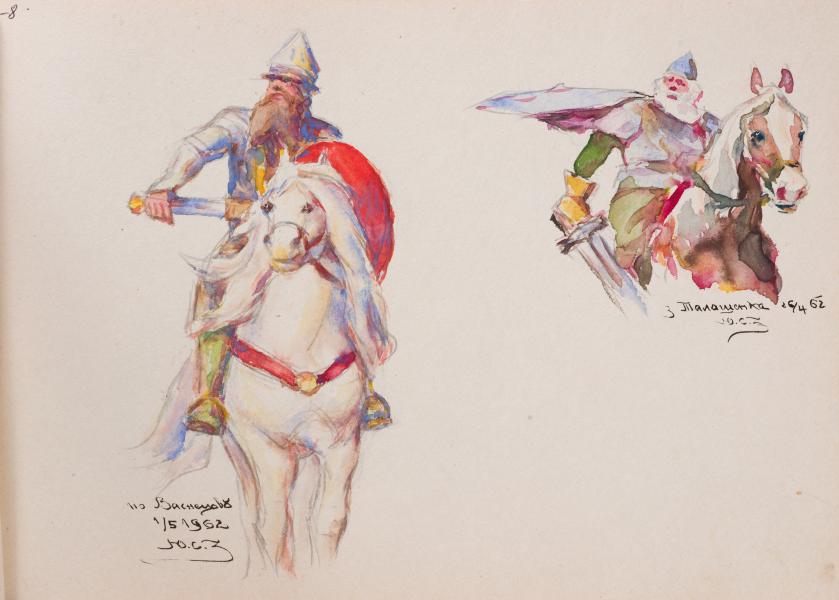
The sheet features two figures of knights-bogatyrs, executed in watercolour using a limited, balanced palette with separate colour-saturated sections of red, yellow, and brown. The work belongs to the period of the author's mature experience (1960s), when visual studies of classical models were combined with elements of interpretation and compositional variation. The first figure is a fairly accurate copy of the left character from Viktor Vasnietsov's famous work "Bogatyrs" (1898), Dobrynia Mykytych. The knight is depicted on horseback, in a characteristic pose, firmly seated, with a straight posture and a sideways glance. With his right hand, the man holds the hilt of his sword, and with his left, a bright shield. Characteristic elements of armour are reproduced, including a long chain mail hood, a cone-shaped helmet, and a red shield on the left hand. The watercolour technique allows the artist to convey the volume and overall atmosphere of the image without excessive detail, while maintaining the monumental calmness and balance of the figure. The colour scheme is balanced, which enhances the impression of epic restraint. Next to him is another figure of a bogatyr, executed in the same style, but without direct identification with a specific source. Most likely, this is the author's fantasy reconstruction of the image in the spirit of romanticised heroic painting of the second half of the 19th – early 20th centuries. The figure is depicted from the hips up, with powerful shoulders, a flowing cape, a helmet, and a massive fantasy sword, the shape of which goes beyond historical accuracy. Unlike Dobrynia, this figure is less recognisable but no less expressive: his gaze is directed to the side, his face is modelled energetically, with light brushstrokes that convey the features of a strong-willed, focused character. The placement of the figures on the sheet is not accidental: the author deliberately contrasts the canonical image, fixed in visual memory (Dobrynia Mykytych), with an experimental variation of the type as an attempt to reinterpret the heroic image in his own manner. This juxtaposition indicates not just a copying approach, but a desire to enter into the structure of the classical image, to understand its internal rhythm, compositional principles, and psychological load, and then to create a new one based on the same visual and emotional patterns. Thus, this watercolour work can be an example of the research practice of an artist in his mature period, combining a deep knowledge of classical painting, a respectful attitude toward sources, and an appeal to the imagery of the epic tradition.
Inscriptions
In the centre, under the images, there are inscriptions: "After Vasnietsov"; "1/5 1962"; Yulian Zaiats' signature; "From Talashska (?)"; "26/4 1962"; Yulian Zaiats' signature.
Legal regulation
Borys Voznytskyi Lviv National Art Gallery