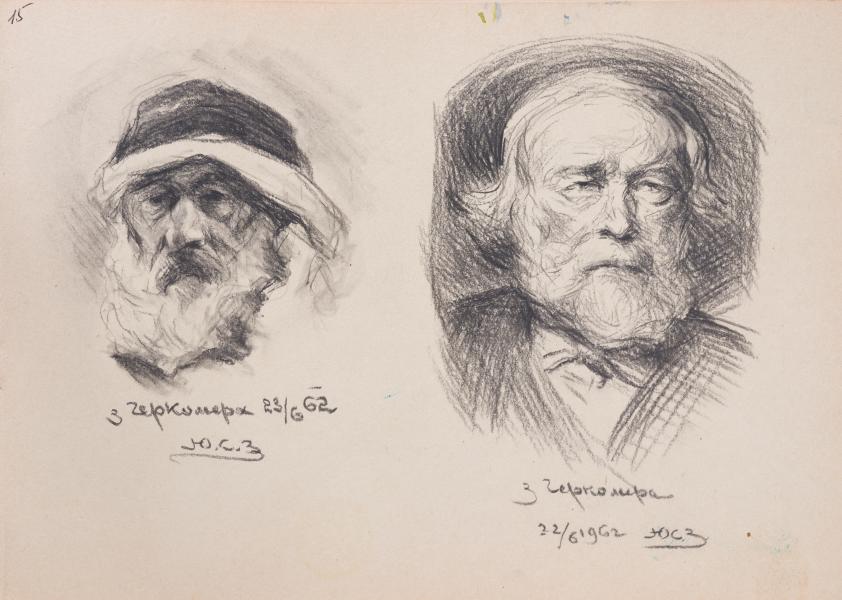
Portrait Drawings of Two Men
Yulian Zaiats


Basic information
- ID
- Ф-З-Арх-ЛГМ-7/15
- Author
- Yulian Zaiats
- Name
- Portrait Drawings of Two Men
- Date of creation
- 22.06.1962–23.06.1962
- Country
- the Ukrainian SSR
- Technique
- drawing
- Material
- paper pencil
- Dimensions (height x width, cm)
- 20.4 x 28.5
Additionally
- Type
- graphic art
- Genre
- portraiture
- Provenance
- Received from Nina Zaiats
Information about author
Object description
The sheet contains copies of drawings based on works by Hubert von Herkomer, including a study of the head of an Arab and a full-length portrait of an elderly man with a medium-length grey beard. Both are examples of careful and profound analytical work that goes beyond a simple educational exercise. Both images are executed in the spirit of portrait realism of the second half of the 19th century, with characteristic attention to psychological expressiveness and subtle plastic development of the face. The author of the copies strives not only to reproduce the images with technical accuracy, but also to connect with H. Herkomer's style, which combines the rigour of academic drawing with emotional intensity and a deep humanistic vision. The first study, featuring a man of Arab origin, attracts attention with its calm dignity and strength of character. The face is depicted almost in profile, with a slight turn, which allows for the conveyance of the volume and depth of the modelling. The author of the drawing meticulously outlines the features: dark eyes, clearly defined eyebrows, a textured skin surface, and a traditional headdress framing the face. This image is not just an ethnographic sketch, but an attempt to convey the integrity of the individual, inner concentration, and a sense of dignity that is characteristic of Herkomer himself. The second portrait is of an elderly man with a distinctive medium-length grey beard, wearing a classic suit with a white shirt and a woven bow tie. He is also shown in profile, with a slight asymmetry in the turn of his head. The artist emphasises the soft rendering of volume, using subtle transitions of light and shadow, which allows for a sense of presence. The forehead is high, the eyes are focused, and the gaze is calm. The face does not exhibit excessive expression, and the chosen angle and compositional solution enable us to reveal not only the appearance, but also a certain philosophy inherent in the portrait image, which was characteristic of Herkomer as an artist. Hubert von Herkomer is known for his deeply psychological portraits, which combined social sensitivity with the skill of academic drawing. His manner is characterised by a plastic balance, meticulous study of the model, subtle chiaroscuro modelling, and attention to human individuality, regardless of the origin, profession, or social status of those depicted. Herkomer often focused on figures who embodied dignity in simplicity, inner strength, and often the quiet heroism of ordinary life. The copies in question are clearly not the result of academic interest, but part of a deeper investigation by the artist. The artist who executed them sought not only to replicate Herkomer's mastery, but also to comprehend it in the context of his own creative exploration. Such a study, especially of faces from different cultural and age groups, could serve as the basis for building a personal iconography in his own practice. Thus, these drawings serve as a form of "initial research" for the author's future system of images, where the portrait becomes not so much a fixation of appearance as a carrier of experience, character, and time.
Inscriptions
From left to right: "From Herkomer"; "23/6 62"; Yulian Zaiats' signature; "From Herkomer"; "23/6 1962"; Yulian Zaiats' signature.
Legal regulation
Borys Voznytskyi Lviv National Art Gallery