Last Supper
unknown



Basic information
Additionally
- Type
- icon
- Genre
- religious
- Provenance
- Zaraiske village, Sambir district, Lviv region
Information about author
Object description
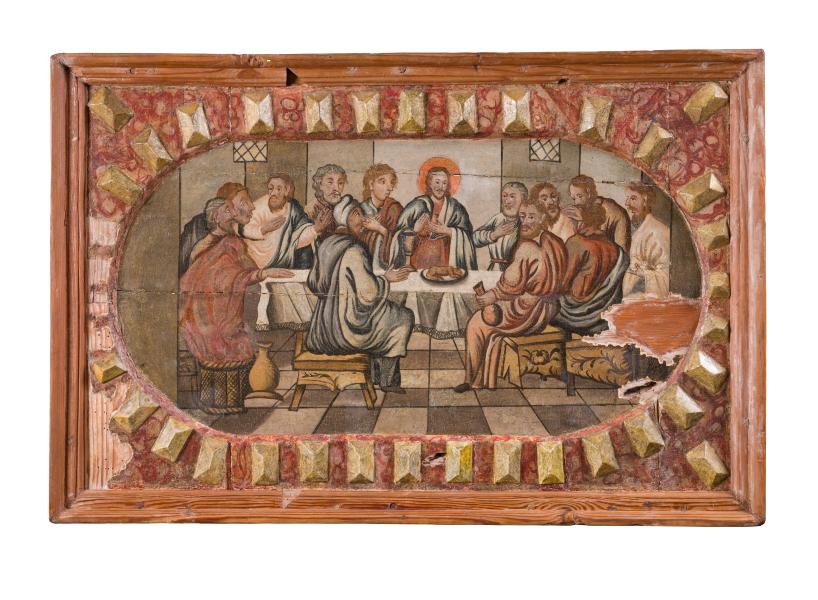
The icon from the church in the village of Zaraiske illustrates the last Easter meal of the Saviour with his disciples before the crucifixion, one of the key Gospel scenes often depicted in Ukrainian sacred art. In the composition, the central figure of Christ occupies a dominant position. He is the only one depicted with a halo above his head. Jesus is dressed in a red chiton and a blue himation. He holds broken bread in his hands, and a chalice stands on the table. In the centre of the table, on a large platter, you can recognise the sacrificial lamb, which was eaten on Easter according to Jewish custom. The apostles are placed on both sides, forming a semicircle. The figures are rendered plainly, each with individual features. The poses and gestures of the apostles are evidence of their lively reaction to the event and convey the inner drama. The tilts of their heads and facial expressions reproduce emotions: surprise, confusion, questions, anxiety – everything that reflects the moment when Christ speaks of the traitor among them. The image of Judas stands out from the other apostles because he is holding a bag of money. The influence of Western art is evident in the reproduction of interior elements. The scene of the Last Supper is inscribed in a horizontal oval framed by voluminous elements in the form of pyramidal projections. The colour scheme of the icon is quite limited, with the icon painter using a small number of warm shades: ochre and gray-blue. The painter's professionalism is evident in the harmonious combination of rhythms and forms of colour spots, as well as in the compositional solution. The icon is an example of a folk interpretation of a biblical scene with deep emotional content and decorative power. It combines sacredness, a naive style, and symbolism that is close to the hearts of simple believers.
Legal regulation
Borys Voznytskyi Lviv National Art Gallery