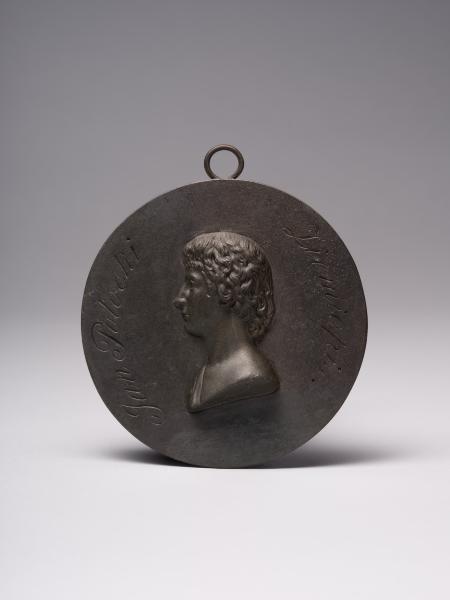
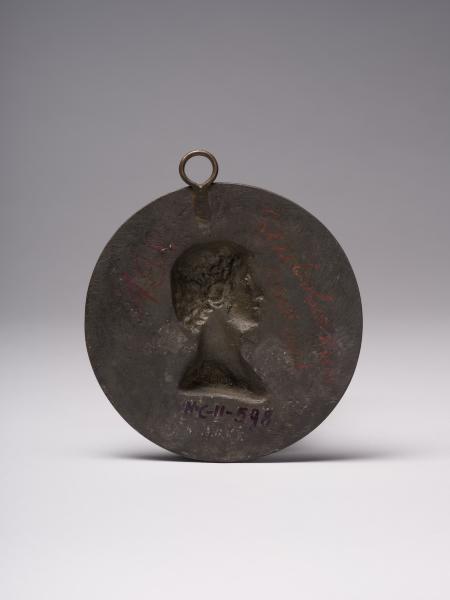
Medal “Jan Potocki”
Aleksander Ziebowski


Basic information
- ID
- С-II-598
- Author
- Aleksander Ziebowski
- Name
- Medal “Jan Potocki”
- Country
- Kingdom of Poland
- Culture
- Modern times
- Technique
- casting
- Material
- iron
- Dimensions (diameter, cm)
- 12.1
Additionally
- Type
- sculpture (relief)
- Genre
- portraiture
- Plot
- Portrait
- Provenance
- the Dzieduszycki collection
Information about author
Object description
Jan Potocki (March 8, 1761 – December 23, 1815) – Polish novelist and playwright, historian, ethnographer, archaeologist, geographer, sociologist, publicist, editor, publisher, bibliographer, traveler across Europe and Asia. Son of Count Józef Potocki (1735–1802), Crown Chamberlain, and Anna Teresa Ossolińska (1746–1810). In 1773–1776, together with his brother Seweryn, he studied at schools in Lausanne and Geneva. From 1778, he traveled extensively throughout the East and Europe, including Turkey and Egypt (1784), the Netherlands (1787), Spain and Morocco (1791), Lower Saxony (1794), and the Caucasus (1797–1798). In 1778, he served in the Austrian army and fought as a knight of the Order of Malta (1779–1780) against Barbary pirates in the Mediterranean Sea. In 1783, he married Julia Teresa Lubomirska (1767–1794), daughter of the Grand Marshal of the Crown. They had two sons: Alfred Potocki (1786–1862) and Arthur Stanislaus Potocki (1787–1832). The marriage was not a happy one; Julia pursued her own interests and died of tuberculosis in 1794. In 1785, he made a sea voyage from Kherson via Istanbul to Egypt and then to Venice. In 1785–1787, he stayed in Paris, where he visited the salon of the widow Helvetia, befriended Constantin François Volney, and actively supported the socio-political aspirations of the French bourgeoisie. In the fall of 1787, he traveled to the Netherlands, where he witnessed the civil war. In March 1788, he returned to Poland and, a few months later, became a deputy of the Four-Year Sejm from the Poznań Voivodeship. In September 1788, he founded the Free Printing House, which published the Journal Hebdomadaire de la Diète (Weekly Diet Journal) with weekly reports on parliamentary debates. On May 14, 1790, in Warsaw, he accompanied the pioneer of ballooning, Jean Blanchard (1753–1809), on a hot air balloon flight, becoming the first Pole in history to take to the skies. In 1792, he wrote a drama in the style of commedia dell'arte, "Collection of Parades." In 1797, the first chapters of J. N. Potocki's French-language adventure-mystery novel "Manuscript Found in Saragossa" were published. He was the author of about 30 other works written exclusively in French. J. N. Potocki was one of the first researchers of Slavic history and archaeology, author of "Research on Sarmatia" (1789–1792) in 5 volumes and "Primitive History." In 1799, he married his cousin Constance Potocki (1781–1852) and had three children. In 1803, he became a member of the Warsaw Society of Friends of Science. In 1808, J. N. Potocki's wife filed for divorce, which was granted a year later. In 1815, overcome by melancholy, he committed suicide.
Inscriptions
"Jan Potocki".
Portrayed person
- The name of the person portrayed
- Jan Potocki
- Lifetime of the person portrayed
- 08.03.1761–23.12.1815
Legal regulation
Borys Voznytskyi Lviv National Art Gallery