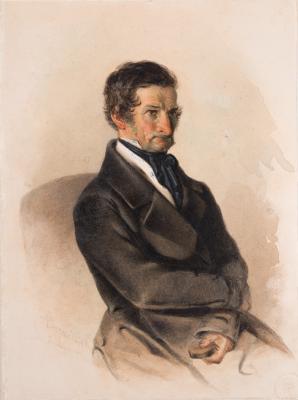
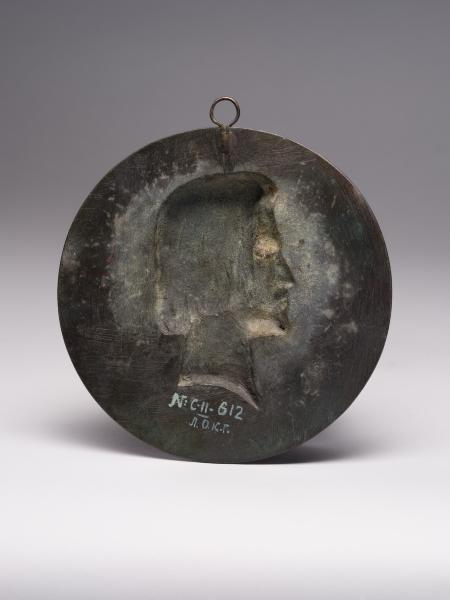
Medal "Portrait of an Unknown Man – Franz Liszt?"
I. D.


Basic information
- ID
- С-II-612
- Author
- I. D.
- Name
- Medal "Portrait of an Unknown Man – Franz Liszt?"
- Culture
- Modern times
- Technique
- moulding
- Material
- bronze
- Dimensions (diameter, cm)
- 19
Additionally
- Type
- sculpture (relief)
- Genre
- portraiture
- Plot
- Portrait
- Provenance
- the Dzieduszycki collection
Information about author
Object description
Franz Liszt (22 October 1811 – 31 July 1886) was a Hungarian composer, pianist, teacher, conductor, publicist, representative of musical romanticism, and founder of the Hungarian school of composition. He was born on 22 October 1811 in Raiding, Kingdom of Hungary, Austrian Empire. His parents were Anna and Adam Liszt. His father played the piano, violin, cello, and guitar and was personally acquainted with Haydn and Beethoven. Franz received his first piano lessons from his father and wrote his first musical works at the age of eight. Thanks to the support of patrons, he continued his studies in Vienna, where he made his successful debut as a performer on 1 December 1822. After his father's death in 1827, he moved to Paris. To earn a living, he gave lessons in piano and composition. He met Victor Hugo and Heinrich Heine. The works of Hector Berlioz and Frédéric Chopin made a strong impression on the young man. In February 1847, he performed in Kyiv, where he met the Polish religious thinker and writer Carolyne Wittgenstein (1819–1887), who convinced Liszt to give up performing and focus on composition. In the early 1860s, he moved to Rome and, under Carolyne's influence, took minor vows. In 1866, he travelled to Weimar, where his "second Weimar period" began. He lived in a modest house belonging to his former gardener. In 1875, he was in Hungary, where he was elected president of the newly established Higher School of Music. He died on 31 July 1886.
Portrayed person
- The name of the person portrayed
- Franz Liszt (?)
- Lifetime of the person portrayed
- 22.10.1811–31.07.1886 (?)
Legal regulation
Borys Voznytskyi Lviv National Art Gallery