St. Sebastian
Circle of Caravaggio


Basic information
- ID
- Ж-3608
- Author
- Circle of Caravaggio
- Name
- St. Sebastian
- Date of creation
- early 17th c.
- Technique
- oil painting
- Material
- canvas oil
- Dimensions (height x width, cm)
- 103.5 x 93.5
Additionally
- Type
- painting
- Genre
- religious
- Plot
- Saint Sebastian
- Provenance
- Purchased by the Lviv Regional Department of Culture from Y.M. Lempert for the Lviv State Art Gallery, 1957
- Exposition
- Potocki Palace
Information about author
Object description
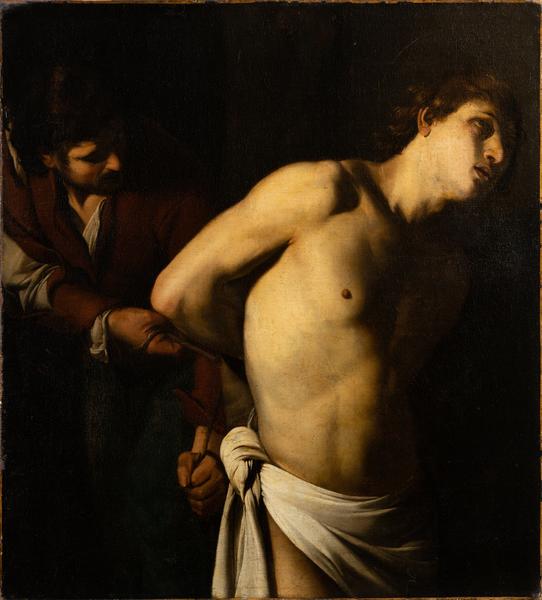
The painting from the collection of Borys Voznytskyi Lviv National Art Gallery depicts the well-known and iconographically differentiated plot of St. Sebastian's martyrdom. According to the hagiographical tradition, Sebastian was born around 265 in Narbonne (France). He was chief of the court guard during the reign of the co-emperors Diocletian and Maximian. Being brave, wise, and just, Sebastian was an absolute authority for soldiers and courtiers. Hiding his Christian identity, he helped his brothers in faith and converted many others to Christianity. When Emperor Diocletian learned of that, he interrogated Sebastian. To ensure the firmness of his beliefs, the ruler sentenced the saint to death. Sebastian was taken outside the city, tied to a tree, and shot with arrows. When the widow of the official Castulus, Irene, arrived late at night to retrieve his body to bury it, she found he was still alive. She took him to her lodgings, where he miraculously recovered from the wounds. Sebastian's friends begged him to leave Rome, but he refused. Once, he saw Diocletian and Maximian near the pagan temple and publicly accused them of their persecution and cruel treatment of Christians. Diocletian ordered Sebastian to be taken to the hippodrome, where he was beaten to death with clubs and then thrown into the Cloaca Maxima, the great sewer of ancient Rome. The night after his demise, the saint appeared in a vision of a Christian woman named Lucina and asked her to take his body and bury it. The pious Roman woman fulfilled his will: she rescued and buried the body in the catacombs near the Appian Way. In the fourth century, the church of San Sebastiano fuori le Mura was built above the saint's grave. In the "St. Sebastian" painting from the Gallery's collection, an unknown artist of the early 17th century reproduced the given theme using the figurative and plastic principles of Caravaggism. Thus, the dramatic colouring of the image, typical of Caravaggio, is noticeable in the choice and interpretation of the hagiographic plot. Typically Caravaggesque is the interpretation of the painting theme. Extending beyond the traditional iconography, artistic and intellectual traditions, it is filtered through the prism of an "open" unmediated vision of the world – the prism of life. The anti-traditional Carravagist model is confirmed by the emphasis on the capture of St. Sebastian and the binding of his hands rather than the execution itself. As a result, it not only makes the composition close to real life but also provides it with temporal duration, given that the tragic culmination of the story and its denouement are known to the viewer. The temporal "openness" of the canvas resonates with the spatial one, as the saint's gaze is directed to the heights of transcendence. The dramatic tension is intensified by the "compression" of the intra-picture space, large-scale figures, their sculptural modelling, and approach to the viewer, characteristic of Caravaggism. The juxtaposition of diagonals – one outlined by the inclined figure of the executioner and the second by the saint's gaze – adds dynamism, drama, and symbolic depth to the work. The contrasts of light and shadow (chiaroscuro), tenebrism, due to which the perfect and brightly illuminated body of St. Sebastian seems to emerge from the darkness of the world, and the images of the idealised martyr and an ordinary guard – all symbolise the opposition of Good and Evil. The red vestment of the satrap on a black background is associated with the sacrificially shed blood and the darkness of death.
Legal regulation
Borys Voznytskyi Lviv National Art Gallery