Portrait of Magdalena Morska
Alojzy Reichan


Basic information
- ID
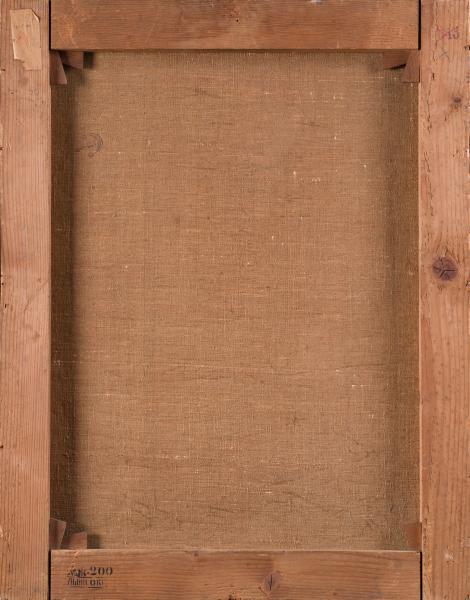
- Ж-200
- Author
- Alojzy Reichan
- Name
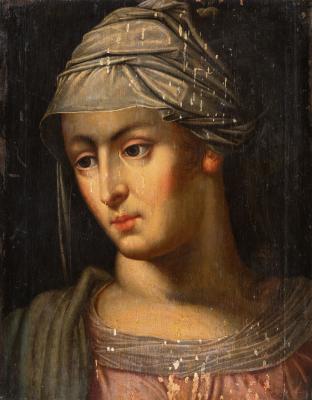
- Portrait of Magdalena Morska
- Date of creation
- c. 1835
- Country
- Austrian Empire
- Culture
- Modern times
- Technique
- oil painting
- Material
- canvas oil
- Dimensions (height x width, cm)
- 82.5 x 64.5
Additionally
- Type
- painting
- Genre
- portraiture
- Plot
- Portrait
- Provenance
- the Dzieduszycki collection
Information about author
Object description
Magdalena Katarzyna Morska, née Dzieduszycka (1762–1847) – countess, one of the most prominent women of her time. Her extraordinary artistic sensitivity and passion for architecture and gardening left a significant mark on history. Magdalena Morska was born on 1 April 1762 into the family of Tadeusz Gervasius Dzieduszycki and Salomea, née Trembińska. She was one of thirteen siblings, eight of whom reached adulthood (Walerian , Antoni, Laurentius, Józef, Ludwika, Helena, Justyna, and Paula). She received a thorough education at her parents' home, typical for young aristocrats of the 18th and 19th centuries. She was fluent in several foreign languages, primarily French and German, was well-versed in European literature and culture, and had a vivid artistic talent. She was distinguished by her extraordinary aesthetic sensitivity and breadth of intellectual interests, which she developed during her numerous travels. In 1783, she married her cousin, the wealthy landowner Ignacy Morski. Initially, the couple lived in Lviv and Prukhnyk, and later in Zarichchia, where one of the most beautiful landscape parks in Galicia and a magnificent palace designed by Chrystian Piotr Aigner were built between 1807 and 1812. M. Morska's residence became a cultural centre, frequented by writers, artists, politicians, and public figures. Magdalena and Ignacy's marriage was unhappy and ended in divorce in 1800. From 1819, Magdalena settled in Zarichchia, devoting her later years to its development. During this time, the countess designed furniture, wallpaper, interior items, and an improved English garden. In 1831, after the defeat of the November Uprising, the countess renounced secular life, stopped holding Sunday receptions, and devoted the rest of her life to charity. In 1836, an album entitled "A Collection of Drawings Illustrating the Best Buildings in the Village of Uzhupis in Galicia, Przemysl Region, Some Taken from Life or from a Project, with a Description of Dutch and English Rural Architecture and General Ideas for the Decoration of Rural Houses" was published in Vienna. The first part of the publication contains an introduction and six chapters devoted to the buildings of the residence, the basic principles of garden design, and the plants that should be planted on the estate. The second part contains fifty engravings: forty depict the palace and garden complex in Zarichchia, and ten show bouquets arranged according to the flowering seasons of the plants. The illustrative material was created by three artists, likely inspired by Magdalena Morska's drawings from previous years. The panoramas of Zarichchia and the architectural designs were created by Polish landscape painter, portraitist, and lithographer Józef Ferdynand Tabaczyński, while the drawings of ten bouquets were created by Franciszek Blascheck, who specialised in depicting plants. The engravings for both artists were made by the Viennese engraver Anton Tepplar. In 1842, at the age of 80, Magdalena travelled through Austria and Italy, and two years later through Germany, France, England, the Netherlands, and Austria. She then began construction of a new church, designed by Chrystian Piotr Aigner in the classical style, but her deteriorating health prevented her from completing the project. Magdalena Morska died on 11 May 1847 in her beloved Zarichchia, where she is buried in the family crypt in the Church of St. Michael the Archangel.
Portrayed person
- The name of the person portrayed
- Magdalena Katarzyna Morska
- Lifetime of the person portrayed
- 1762–1847
Legal regulation
Borys Voznytskyi Lviv National Art Gallery