Collection of Ethnographic Drawings
Kajetan Kielisinski

Basic information
- ID
- Г-V-424_131
- Author
- Kajetan Kielisinski
- Name
- Collection of Ethnographic Drawings
- Country
- Kingdom of Poland
- Culture
- Modern times
- Technique
- drawing
- Material
- pencil
Additionally
- Type
- graphic art
- Genre
- genre art
- Provenance
- the Dzieduszycki collection
Information about author
Object description
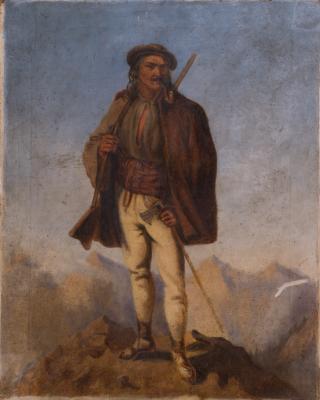
Kajetan Wincenty Kielisiński created numerous etchings and drawings devoted to folklore, life in Polish villages and towns, historical monuments, and landscapes. He was one of the first to develop bookplates in Poland. During his travels to various locations, he collected graphic materials for the publications "Polish Antiquities" and "Folk Costumes". In 1855, Poznań publisher Jan Konstanty Żupanski published "Kielisiński's Album", which collected the artist's scattered works. Kielisiński's graphic works, drawings, sketchbooks, and correspondence were kept in the Kórnik Library of the Polish Academy of Sciences, as well as in national museums (Kraków, Poznań, Warsaw) and renowned libraries (Jagiellonian University, Ossolineum, Warsaw University). The picture shows two men with shovels. Both are wearing hats; the man on the right is wearing a jacket with large buttons, his right hand is in his pocket, and his left hand is resting on a shovel. He is younger and his gaze is directed into the distance. The man on the left appears a bit older and looks more tired; his face is thin and seems exhausted. He's holding a shovel over his shoulder with his left hand and a closed basket or box in his right hand. He is dressed in a long cloak or kaftan. It is characteristic that the man on the left is barefoot, while the other is wearing shoes. The headgear is also different: the man on the left has a hat similar to a straw hat with a straight brim, as worn by peasants, while the other has a dark headdress, probably made of thick fabric with curved brims. The background on which the figures are depicted is rendered schematically, clearly representing a rural landscape. The figures stand on the ground, with bushes and trees visible behind them, and the outline of a peasant's hut is visible among the leaves on the right. We can assume that this is a farmer with a servant or hired worker, returning from some kind of work. The image has a calm, harmonious character. The lines are clear, the detail is moderate; we can see the folds of clothing and facial features. The drawing's background is minimalist. The graphic drawing has undeniable historical and cultural value, as it is a precise and careful reproduction of folk clothing. Since the drawing accurately reflects and conveys the details and features of the folk clothing of a particular region, it has a pronounced ethnographic, historical, and cultural value. Its artistic significance lies in the accurate and detailed reproduction of folk costumes, making it a valuable source for research and study of traditional culture. From an aesthetic point of view, we are dealing with a realistic drawing, with a special emphasis on its documentary nature.
Legal regulation
Borys Voznytskyi Lviv National Art Gallery