Collection of Ethnographic Drawings
Kajetan Kielisinski

Basic information
- ID
- Г-V-424_132
- Author
- Kajetan Kielisinski
- Name
- Collection of Ethnographic Drawings
- Country
- Kingdom of Poland
- Culture
- Modern times
- Technique
- drawing
- Material
- pencil
Additionally
- Type
- graphic art
- Genre
- genre art
- Provenance
- the Dzieduszycki collection
Information about author
Object description
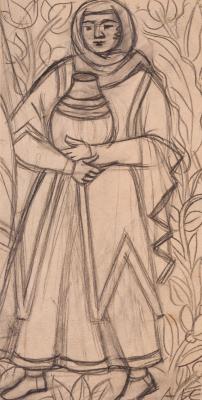
Kajetan Wincenty Kielisiński created numerous etchings and drawings devoted to folklore, life in Polish villages and towns, historical monuments, and landscapes. He was one of the first to develop bookplates in Poland. During his travels to various locations, he collected graphic materials for the publications "Polish Antiquities" and "Folk Costumes". In 1855, Poznań publisher Jan Konstanty Żupanski published "Kielisiński's Album", which collected the artist's scattered works. Kielisiński's graphic works, drawings, sketchbooks, and correspondence were kept in the Kórnik Library of the Polish Academy of Sciences, as well as in national museums (Kraków, Poznań, Warsaw) and renowned libraries (Jagiellonian University, Ossolineum, Warsaw University). The picture shows a young man standing in full height against the backdrop of a mountain landscape, surrounded by rocks and bushes. This scene can obviously be considered a documentary sketch from the author's expeditions. The young man is dressed in simple travelling clothes of that time: a wide-brimmed hat, a jacket, trousers, and shoes with buckles, girded with a wide belt. Behind him, on a stick supported by his right hand, he carries folded clothes or a knapsack, and a bag hangs over his shoulder. In his left arm, bent at the elbow, he holds a pipe of a characteristic Hutsul shape. His figure is calm and confident, his face smiling, creating the image of a carefree and free traveller. The character's posture indicates that he is in motion, walking along his route, and the author has captured this very moment. The image is executed using the technique of pencil on paper in graphic art. The artist skilfully conveyed the texture of clothing, fabric folds, facial expressions, and details of the natural environment. The composition is balanced, emphasising the figure of the traveller as the main character of the image. The artistic value lies in the realistic yet romanticised image of the traveller as a symbol of freedom, global knowledge, and worldview searches. The drawing has documentary significance, as it conveys the features of travelling clothes and attributes of travellers of that time, as well as aesthetic value thanks to the clarity of lines, proportionality, and atmosphere.
Legal regulation
Borys Voznytskyi Lviv National Art Gallery