Collection of Ethnographic Drawings
Kajetan Kielisinski

Basic information
- ID
- Г-V-424_357
- Author
- Kajetan Kielisinski
- Name
- Collection of Ethnographic Drawings
- Country
- Kingdom of Poland
- Culture
- Modern times
- Technique
- drawing
- Material
- pencil
Additionally
- Type
- graphic art
- Genre
- genre art
- Provenance
- the Dzieduszycki collection
Information about author
Object description
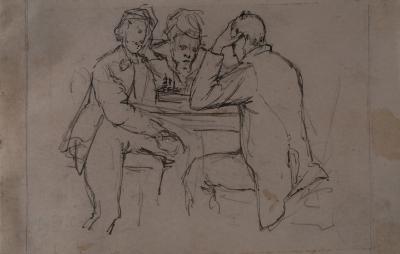
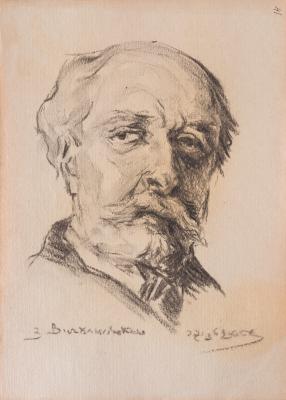
Kajetan Wincenty Kielisiński created numerous etchings and drawings devoted to folklore, life in Polish villages and towns, historical monuments, and landscapes. He was one of the first to develop bookplates in Poland. During his travels to various locations, he collected graphic materials for the publications "Polish Antiquities" and "Folk Costumes". In 1855, Poznań publisher Jan Konstanty Żupanski published "Kielisiński's Album", which collected the artist's scattered works. Kielisiński's graphic works, drawings, sketchbooks, and correspondence were kept in the Kórnik Library of the Polish Academy of Sciences, as well as in national museums (Kraków, Poznań, Warsaw) and renowned libraries (Jagiellonian University, Ossolineum, Warsaw University). The image shows a man who probably belongs to a higher social class – perhaps a nobleman, judge, or other influential figure from the Renaissance or late Middle Ages. The man is standing in profile, slightly turned to the left. His right hand rests on his chin – a classic pose of thoughtfulness or reflection. His left hand rests on a railing, likely part of a balustrade or podium, suggesting a solemn or formal setting. His clothing is very rich and characteristic of high social status, in particular, a long, floor-length, lush mantle or cloak with large folds of fabric. The mantle has a fur trim, indicating wealth and status. The shoulders and chest are covered with thick fabric, possibly velvet or wool, and the sleeves are wide and long. Underneath the mantle, the inner clothing or lining can be seen, appearing voluminous and likely lined for warmth or luxury. The collar is high, fits tightly around the neck, and has fur trim. The man's hair is cut short and neatly combed, his face is adorned with a moustache and possibly a trim beard – a typical feature of the appearance of educated or influential men of that era. In the background, architectural elements of a stone wall and part of an interior with a balustrade are visible, emphasising the scene's formality and significance. It could be a courtroom, a palace, or a city council. The man depicted is most likely a high-ranking official, judge, or scholar from the late Middle Ages or Renaissance. His clothing indicates high status, and his posture indicates intellectual or political significance. The depiction is restrained yet detailed, focusing on the social status of the person. The artistic significance lies in the accurate and detailed reproduction of historical costume, making it a valuable source for researching and studying traditional culture. From an aesthetic point of view, we are dealing with a realistic drawing, with a special emphasis on its documentary nature.
Legal regulation
Borys Voznytskyi Lviv National Art Gallery