Milon. Declaration of Love
Daniel Chodowiecki
Basic information
- ID
- Г-IV-2713
- Author
- Daniel Chodowiecki
- Name
- Milon. Declaration of Love
- Country
- Germany
- Technique
- etching
- Material
- paper on cardboard
- Dimensions
- 8.5 x 5 cm (height x width)
Additionally
- Type
- graphic art
- Genre
- pastoral
- Provenance
- Purchased from O. Bushel, 1977
Information about author
Object description
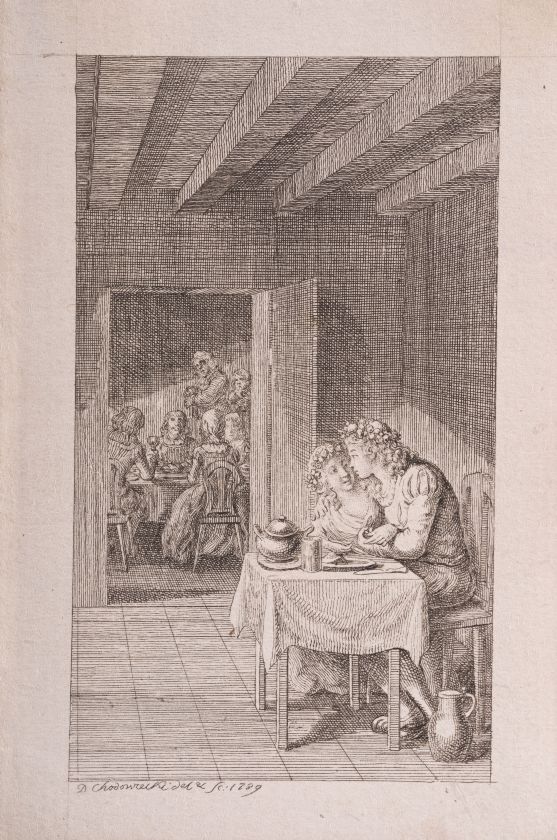
The print was created for the Berlin pocket "Genealogischer Calender" for the year 1773. The scene illustrates a pastoral idyll by the Swiss poet and artist Salomon Gessner (1730–1788). "Idylls" ("Idyllen", 1770–1772) became the most famous poetry collection by this author. Daniel Chodowiecki later illustrated several of them.
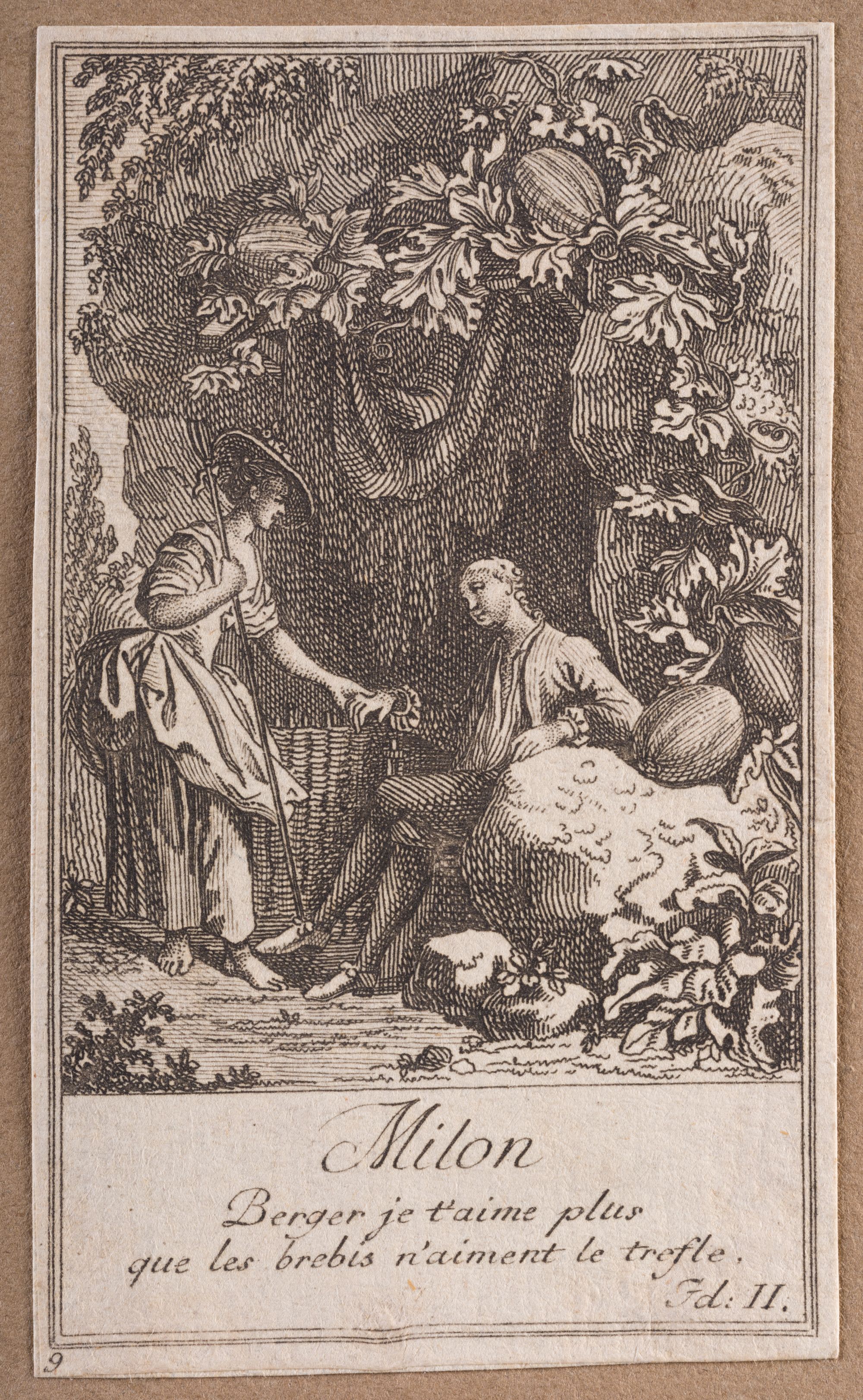
A young shepherd sits, immersed in melancholy, near a cave covered in foliage and large fruits. A shepherdess with a long staff in her hand approaches him. She is elegantly dressed in a long gown and a wide-brimmed hat. The girl touches the hand of the young man named Milon and speaks the words inscribed below the image: "Milon: Berger je t'aime plus / que les brebis n'aiment le trèfle" – [Shepherd, I love you more than sheep love clover]. These words carry a sense of irony, which permeates most of the artist's compositions.
A young shepherd sits, immersed in melancholy, near a cave covered in foliage and large fruits. A shepherdess with a long staff in her hand approaches him. She is elegantly dressed in a long gown and a wide-brimmed hat. The girl touches the hand of the young man named Milon and speaks the words inscribed below the image: "Milon: Berger je t'aime plus / que les brebis n'aiment le trèfle" – [Shepherd, I love you more than sheep love clover]. These words carry a sense of irony, which permeates most of the artist's compositions.
Inscriptions
Below the image, on the left, the number "9" is engraved. On the reverse of the cardboard mount – the inventory number of the Lviv Picture Gallery written in pencil. Below on the right, the idyll number: "Id. II".
Legal regulation
Borys Voznytskyi Lviv National Art Gallery