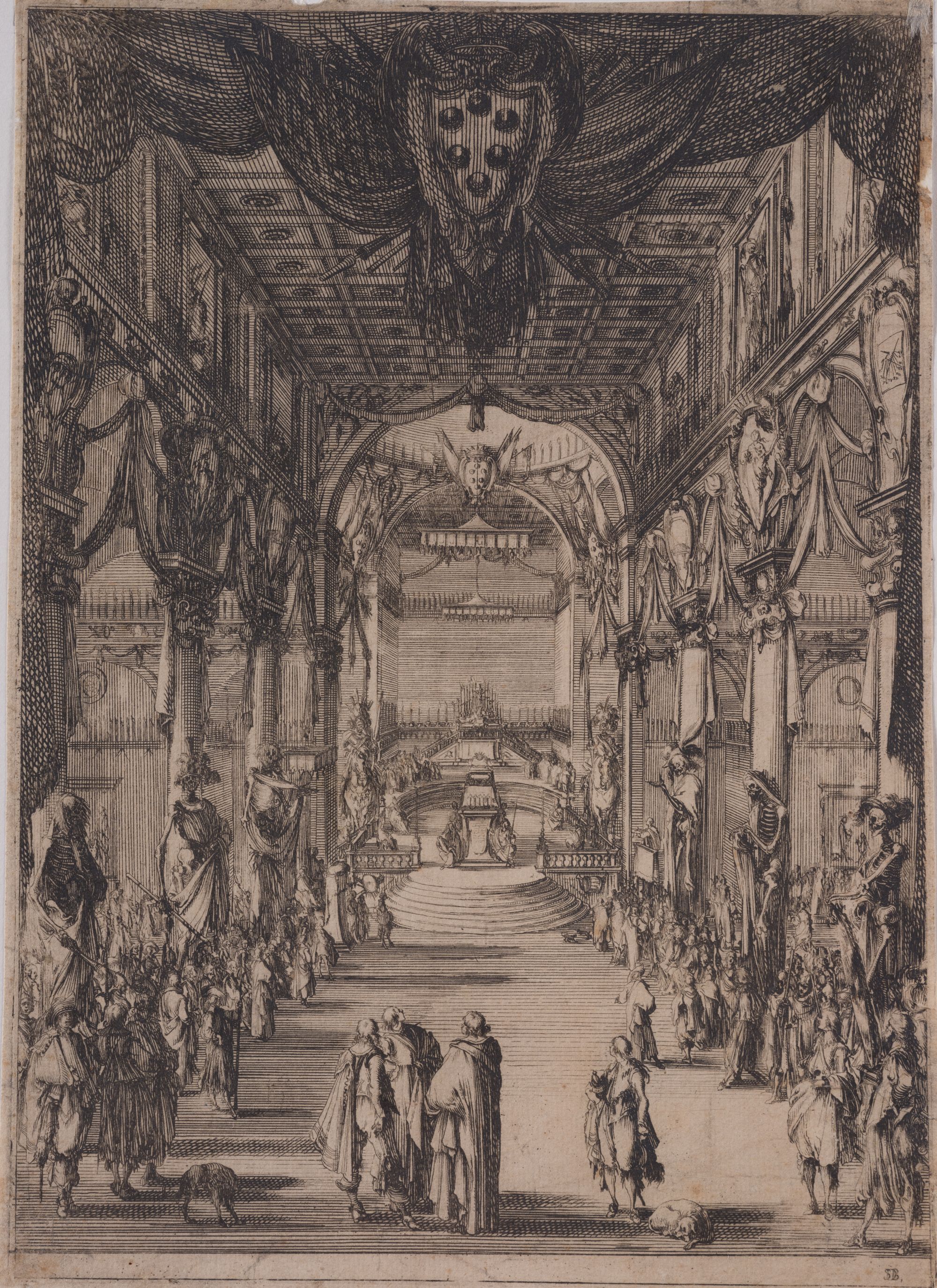
Funeral of Prince Francesco de' Medici
Stefano della Bella
Basic information
- ID
- Г-IV-857
- Author
- Stefano della Bella
- Name
- Funeral of Prince Francesco de' Medici
- Country
- Italy
- Technique
- etching
- Material
- paper on cardboard
- Dimensions
- 29.2 x 21 cm (height x width)
Additionally
- Type
- graphic art
- Genre
- history painting
- Provenance
- Received from the Lviv Historical Museum, 1954
Information about author
Object description
The artwork is dedicated to the solemn funeral of the young Tuscan Prince Francesco de' Medici (1614–1634), who died of the plague during the siege of an enemy city during the Thirty Years' War. As the war prevented his body from being immediately transported to Florence, a symbolic yet official funeral was held in the Church of Saint Lawrence (Basilica of San Lorenzo).
The interior of the nave was completely transfigured. Each column was adorned with monumental figures of skeletons as symbols of death and the transience of time. Near the altar, a complex architectural structure was erected – a sarcophagus-cenotaph surrounded by hundreds of candles, alongside religious and military attributes. To honour the memory of his brother's funeral, Grand Duke of Tuscany Ferdinand II ordered the publication of a special commemorative mourning book titled "Esequie del Serenissimo Principe Francesco, celebrate in Fiorenza dal Serenissimo Ferdinando II Granduca di Toscana suo fratello" – [Funeral of His Serene Highness Prince Francesco, Celebrated in Florence by His Serene Highness Ferdinand II, Grand Duke of Tuscany, His Brother]. The text was authored by Andrea Cavalcanti. Stefano della Bella created a series of detailed engravings that documented the appearance of this ceremony and served as illustrations for the book.
This engraving depicts the interior of Basilica of San Lorenzo from an elevated perspective, overlooking the symbolic tomb. The Medici family coat of arms is featured at the top centre. Walls and every column are adorned with draped sculptures and skeletal figures. Flanking the nave, a large procession composed of Tuscan nobility and clergy moves towards the sarcophagus. The foreground centre depicts three figures viewing the interior with astonishment. Nearby, a female figure and two dogs are visible near the entrance. Subsequently, the remains of Prince Francesco were laid to rest in the family sepulchre – the Medici Chapel, which is located within the same Basilica of San Lorenzo.
Inscriptions
The author's initials at the bottom right of the sheet, underneath the print: "SDB" (D encompasses the letters on both sides). On the backing cardboard, underneath the sheet on the left, there is a label with a seal of Lviv Historical Museum and a numbered stamp; above it, Lviv National Art Gallery inventory number in pencil: "№ Г-IV-857/ ЛДКГ".
Legal regulation
Borys Voznytskyi Lviv National Art Gallery