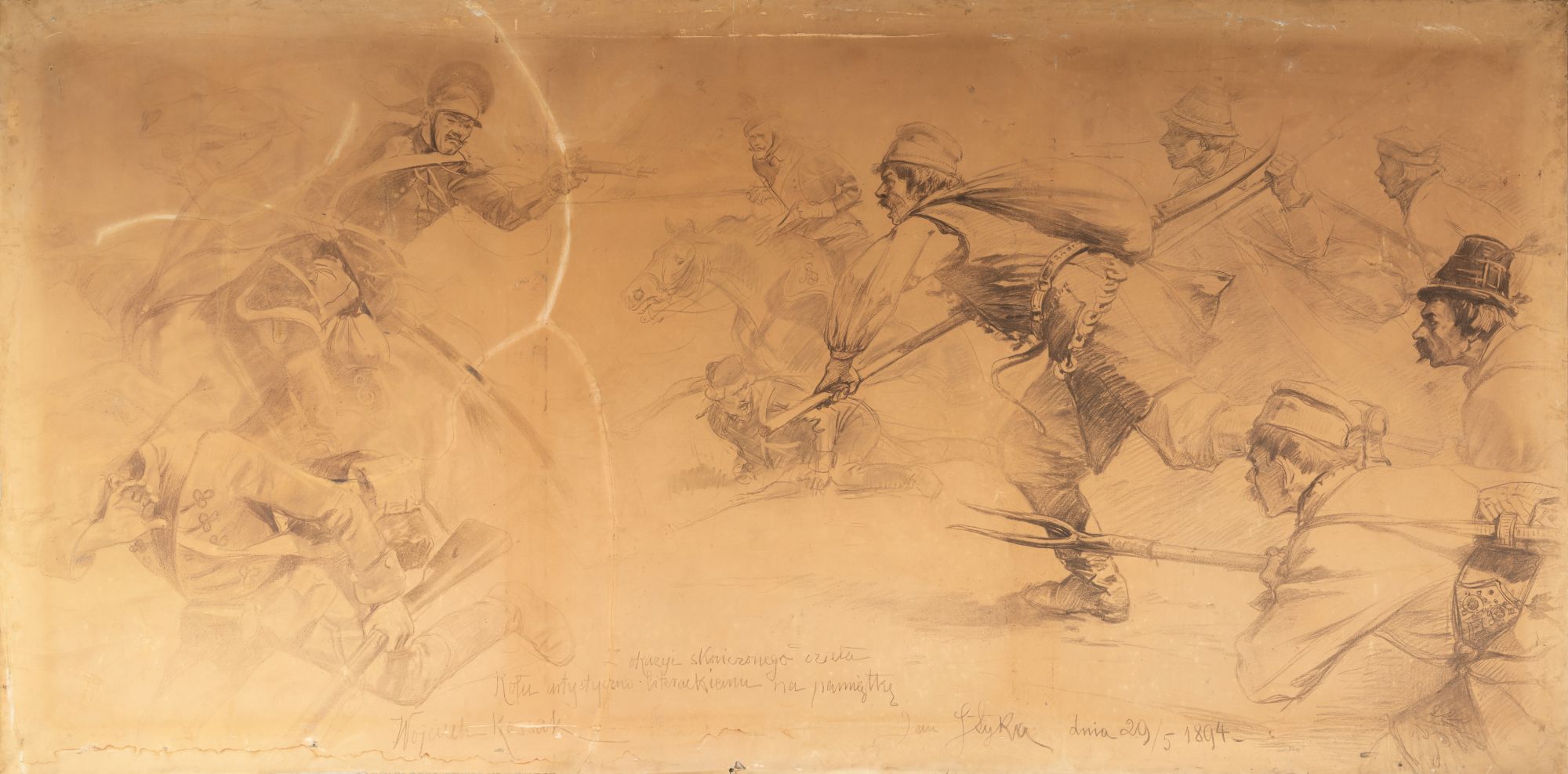
Sketch for the Raclawice Panorama
Wojciech Kossak, Jan Styka
Basic information
- ID
- Г-V-60
- Author
- Wojciech Kossak Jan Styka
- Name
- Sketch for the Raclawice Panorama
- Technique
- drawing
- Material
- paper on canvas charcoal
- Dimensions
- 152 x 303 cm (height x width)
Additionally
- Type
- graphic art
- Genre
- battle painting
- Plot
- Battle
Information about author
Information about author
Object description
The artists Wojciech Kossak and Jan Styka executed this sketch between January and April 1893. Following this, the creators transitioned directly to working on the "Raclawice Panorama". The opening of the panorama took place on 5 June 1894 in the rotunda of Stryiskyi Park during the General Provincial Exhibition. At that time, both artists signed the sketch as a gift to the Literary and Artistic Circle (Koło Artystyczno-Literackie) in Lviv, whose members had actively participated in the creation of the work by providing advice and observations. From 1894 to 1939, the sketch was preserved in the building of this society at 13 Akademichna Street (currently – T. Shevchenko Avenue).
The Battle of Racławice took place in April 1794 between the Polish insurgent army led by Tadeusz Kościuszko and russian regular troops. It was one of the first battles of this uprising that ended in a victory for the Poles. A significant role in this triumph was played by detachments of scythemen (kosynieri) – peasants led by Bartosz Głowacki who used scythes modified into pikes as weapons.
This sketch offers a detailed study of the figures from one of the panorama's most critical episodes – the assault on a russian artillery battery by Polish peasant scythemen. On the right, scythemen are depicted in traditional peasant sukmanas (woollen coats) with scythes converted into pikes, moving swiftly towards the enemy. In the bottom right corner, a scytheman with a pitchfork is shown; in the final panorama, this character is positioned directly next to the cannons captured from the Russian forces.
On the left, a russian officer on horseback is depicted firing back, while a peasant charges at him with a raised scythe ready to strike. Below, another officer with a musket is shown fleeing, covering his face with his hand. In the upper right section, the figure of a horseman wearing a rogatywka (konfederatka) – the traditional headgear of the Polish insurgents – is outlined, with an enemy soldier fallen beneath his horse's hooves. The principal characters presented in this sketch were fully transferred into the final panoramic composition.
Inscriptions
In the bottom centre, the inscription: "Z okazyi skończonego dzieła/ Kołu artystyczno-literackiemu na pamiątkę". Below left, the signature: "Wojciech Kossak", right: "Jan Styka dnia 29/5 1894".
Legal regulation
Borys Voznytskyi Lviv National Art Gallery