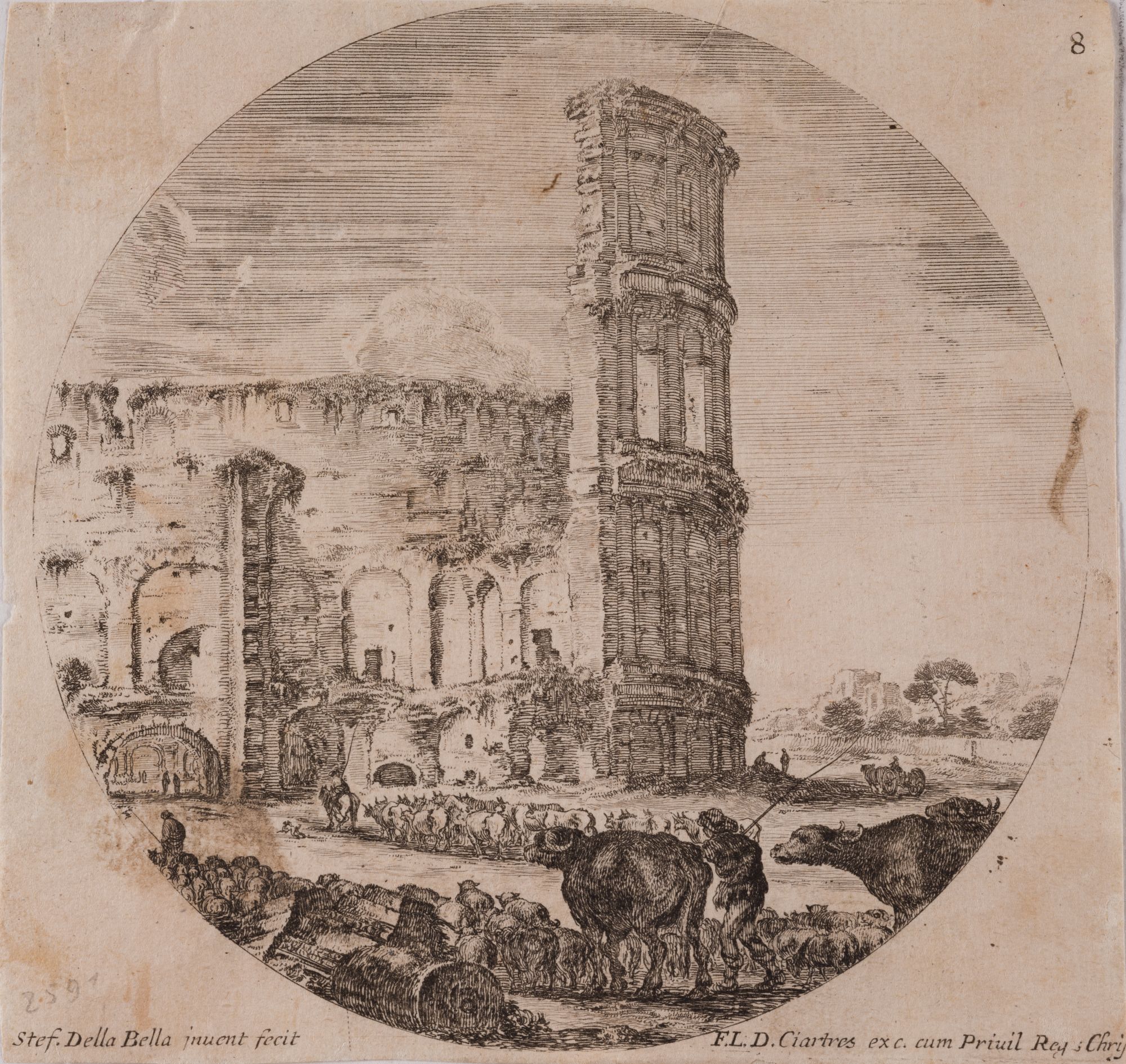
Colosseum. From the "Round Landscapes" or "Roman Landscapes and Ruins" Series, Plate 8
Stefano della Bella
Basic information
- ID
- Г-IV-920
- Author
- Stefano della Bella
- Name
- Colosseum. From the "Round Landscapes" or "Roman Landscapes and Ruins" Series, Plate 8
- Country
- France
- Technique
- etching
- Material
- paper
- Dimensions
- 13.5 x 13.5 cm (height x width)
Additionally
- Type
- graphic art
- Genre
- architectural landscape
- Provenance
- Received from the Lviv Historical Museum, 1954
Information about author
Object description
The work comes from the "Round Landscapes" series, created by the artist in Paris around 1646. The series consists of 13 prints. In many catalogued descriptions, the work appears as a piece from the "Roman Landscapes and Ruins" ("Paysages et ruines de Rome") series, plate 8. The publisher of this series of prints was François Langlois (1589–1647), known as Ciartres or Chartres. He is considered the first prominent publisher of the French Baroque era.
The compositional dominance of the print is the ancient Roman Colosseum (the Flavian Amphitheatre), which was completely abandoned after the earthquake of 1349 and from then on served as a source of building material.
The artist focuses attention on the preserved southern fragment of the amphitheatre with its arcade. In the middle of the structure is a huge crater through which internal ruin is visible. The walls are overgrown with wild plants, highlighting the theme of the relentless passage of time and the decay of former imperial grandeur. In the lower part of the tondo, a herd of cows, sheep and buffaloes is depicted in the foreground on the right. Shepherds are driving a large herd past the majestic ruin. During this period, the area around the Colosseum and the Roman Forum was used as a pasture – it was even called "Campo Vaccino", meaning "Cow Field".
To the far right, a panoramic view opens up of 17th-century Roman structures melting into the haze beyond a low city wall. Behind it, broad crowns of trees also spread out.
Using fine hatching and stippled accents, the artist flawlessly conveys various textures: the roughness of ancient travertine, the softness of wool, the lightness of clouds in the sky and the thickness of grass. The contrast between the deep shadows inside the arched openings of the Colosseum and the sun-drenched open areas creates a sense of three-dimensional space.
Inscriptions
At the bottom of the print on the left: "Stef. Della Bella inuent. fecit", on the right: "F. L. D. Ciartres exc. cum Privil. Regis Chris" – [François Langlois, known as Ciartres, published with Royal privilege]. Top right: "8". On the mounting cardboard on the left under the sheet, there is a sticker with the stamp of Lviv Historical Museum and the former inventory number of the engraving in ink: "Г-4690/63", above it in pencil, the current gallery collection number: "№ Г-IV-920/ ЛДКГ". Pencil marks on the mounting cardboard: on the left near the bottom corner of the engraving sheet – "95", on the right – "66".
Legal regulation
Borys Voznytskyi Lviv National Art Gallery