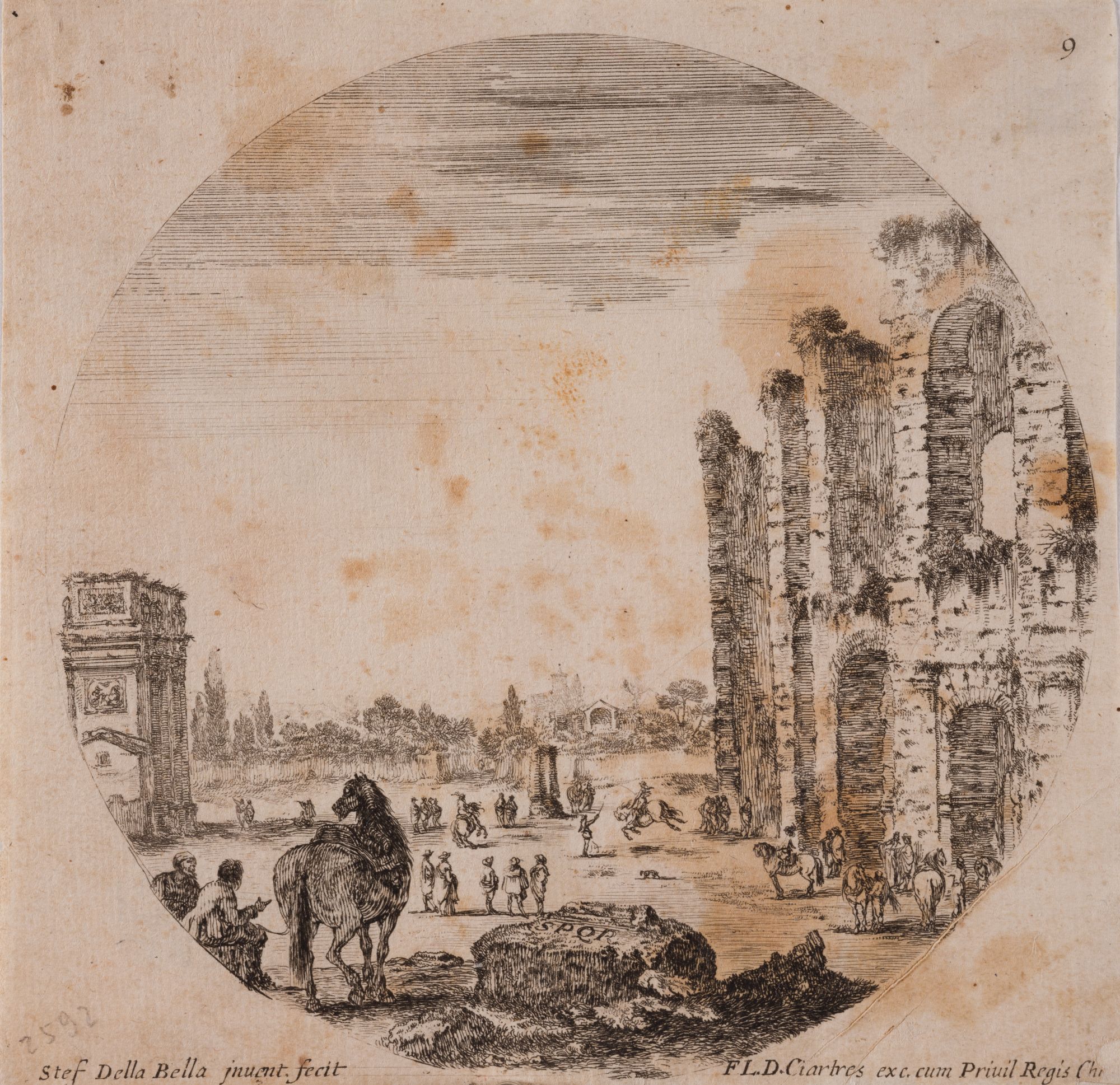
Wasteland Between the Colosseum and the Arch of Constantine. From the "Round Landscapes" or "Roman Landscapes and Ruins" Series, Plate 9
Stefano della Bella
Basic information
- ID
- Г-IV-921
- Author
- Stefano della Bella
- Name
- Wasteland Between the Colosseum and the Arch of Constantine. From the "Round Landscapes" or "Roman Landscapes and Ruins" Series, Plate 9
- Country
- France
- Technique
- etching
- Material
- paper
- Dimensions
- 13.5 x 13.5 cm (height x width)
Additionally
- Type
- graphic art
- Genre
- architectural landscape
- Plot
- Landscape
- Provenance
- Received from the Lviv Historical Museum, 1954
Information about author
Object description
The work comes from the "Round Landscapes" series, created by the artist in Paris around 1646. The series consists of 13 prints. In many catalogued descriptions, the work appears as a piece from the "Roman Landscapes and Ruins" ("Paysages et ruines de Rome") series, plate 9. The publisher of this series of prints was François Langlois (1589–1647), known as Ciartres or Chartres. He is considered the first prominent publisher of the French Baroque era.
The print has the shape of a tondo – an experimental format characteristic of della Bella.
In the middle ground, the area of the former forum is depicted, filled with aristocrats on foot and on horseback. It is flanked on the right by the ruins of the Colosseum and on the left by the Arch of Constantine, preserved in its authentic form since the time of its construction (315 AD). The artist masterfully uses massive architectural objects on both sides as wings. They frame the space and direct the eye deep inside – towards the bright horizon and the small figures of people in the centre. In the foreground on the left, from the back, a man is depicted sitting in contemplation, holding his horse by the reins.
On the right, emphasis is placed on a stone preserved from antiquity, on which the letters "SPQR" are visible – an abbreviation for the words "Senatus Populusque Romanus" (The Senate and People of Rome). This Latin phrase was the state motto of the Roman Empire. The artist highlighted these letters on the stone as a classical symbol of Rome's former grandeur.
The sky and distant grounds are executed in fine parallel lines, which creates a sense of aerial space and bright daylight. In contrast, the ruins of the Colosseum on the right are detailed with deep, dark hatching that conveys the materiality of the stone, the texture of cracks and thick shadow.
Inscriptions
At the bottom of the print on the left: "Stef. Della Bella inuent. fecit", on the right: "F. L. D. Ciartres exc. cum Privil. Regis Chr" – [François Langlois, known as Ciartres, published with Royal privilege]. Top right: "9". On the mounting cardboard on the left under the sheet, there is a sticker with the stamp of Lviv Historical Museum and the former inventory number of the engraving in ink: "Г-4690/66", above it in pencil, the current gallery collection number: "№ Г-IV-921/ ЛДКГ". Pencil marks on the mounting cardboard: on the left near the bottom corner of the engraving sheet – "96", on the right – "67".
Legal regulation
Borys Voznytskyi Lviv National Art Gallery