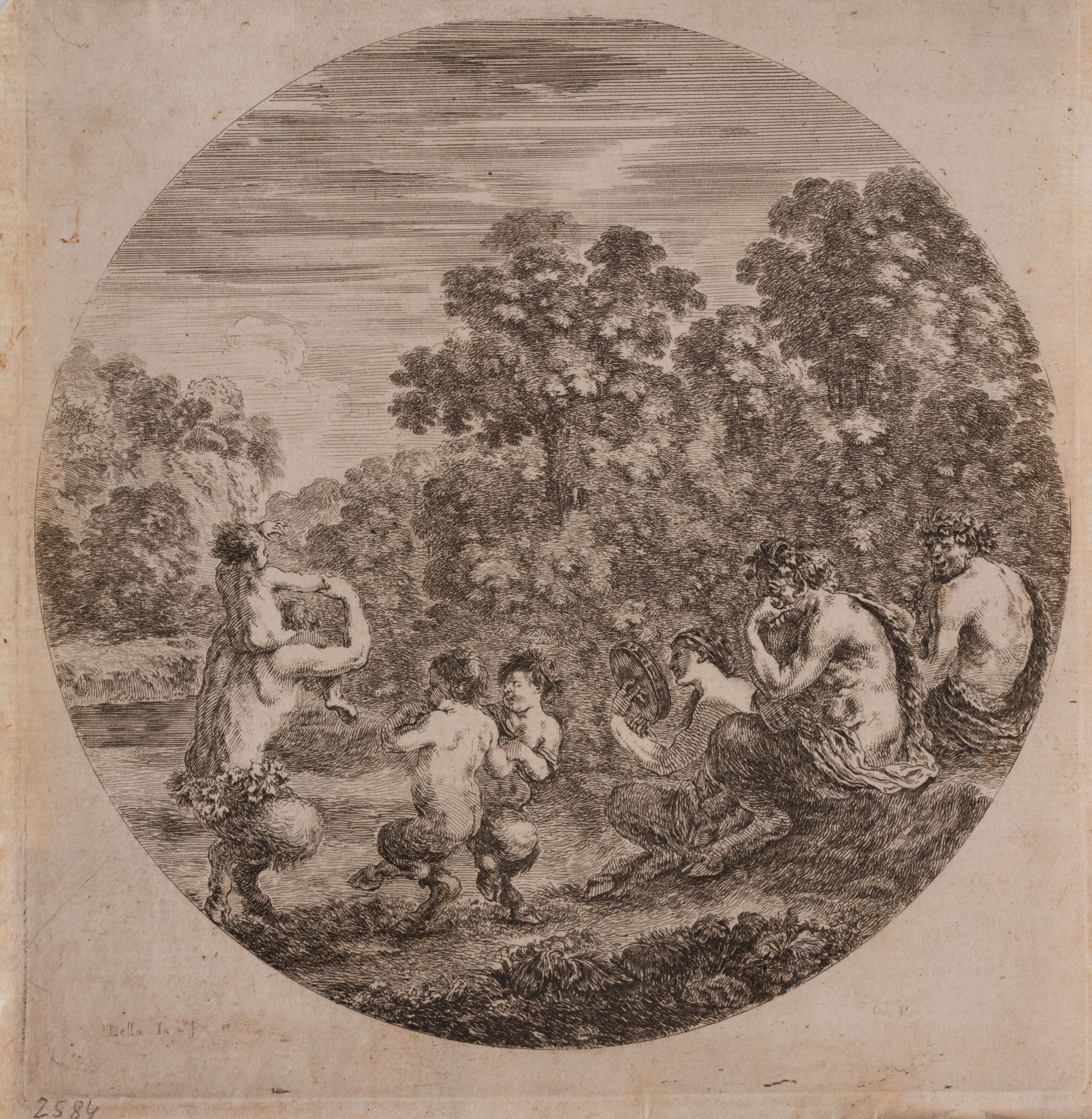
Satyrs and a Female Faun. From the "Six Animal Subjects" Series
Stefano della Bella
Basic information
- ID
- Г-IV-982
- Author
- Stefano della Bella
- Name
- Satyrs and a Female Faun. From the "Six Animal Subjects" Series
- Date of creation
- c. 1646
- Country
- France
- Technique
- etching
- Material
- paper
- Dimensions
- 14.8 x 14.8 cm (height x width)
Additionally
- Type
- graphic art
- Genre
- mythological painting pastoral
- Provenance
- Received from the Lviv Historical Museum, 1954
Information about author
Object description
Stefano della Bella created a series of etchings titled "Six Animal Subjects" ("Six sujets d'animaux") in Paris approximately between 1643–1648. These are circular or rectangular compositions depicting animals, shepherds, peasants, and mythological creatures.
The artwork is executed in the form of a tondo. The composition is dedicated to a classical mythological subject – a bacchanalia – the relaxation and merriment of sylvan characters in nature. To the right, under the shade of dense trees, three adult mythical creatures are resting. In the centre, slightly in the distance, a female faun is shown half-reclining in profile, holding a tambourine and smilingly watching the dance of little satyrs. To her right in the foreground sit two elderly bearded satyrs with their inherent zoomorphic features – horns, pointed ears, shaggy legs, and hooves. Floral wreaths adorn their heads. The one sitting on the left thoughtfully rests his chin on his hand, intently watching the little dancers. These are two hornless children-satyrs dancing while holding hands. On the left, an adult satyr is depicted from the back in a three-quarter view to the right, carrying a naked putto without mythological attributes on his shoulders. The scene unfolds in a clearing of a dense forest. The artist, with his characteristic jeweller-like precision of line, conveys the texture of tree crowns, lush foliage, and clouds in the sky, creating a profound atmosphere of connection between the characters and wild nature. On the left in the middle ground, a fragment of a forest lake is depicted.
The work demonstrates the author's virtuosic command of the etching technique. Thanks to fine cross-hatching, the artist achieves soft chiaroscuro transitions, the volume of figures, and the pronounced plasticity of bodily movements during the dance.
Inscriptions
Beneath the image on the bottom left of the sheet, the engraved artist's signature is faintly legible: "...Bella. In...f...". Pencilled on the sheet below the print: "2584". Pencil marks on the backing cardboard indicate the gallery inventory number "Г-IV-982", as well as other numbers: "102", "59".
Legal regulation
Borys Voznytskyi Lviv National Art Gallery