Head of an Angel
unknown

Basic information
Additionally
- Type
- sculpture 3D
- Genre
- religious
- Plot
- Cherub
- Provenance
- Palykorovy village, Brody district, Lviv region
Information about author
Object description
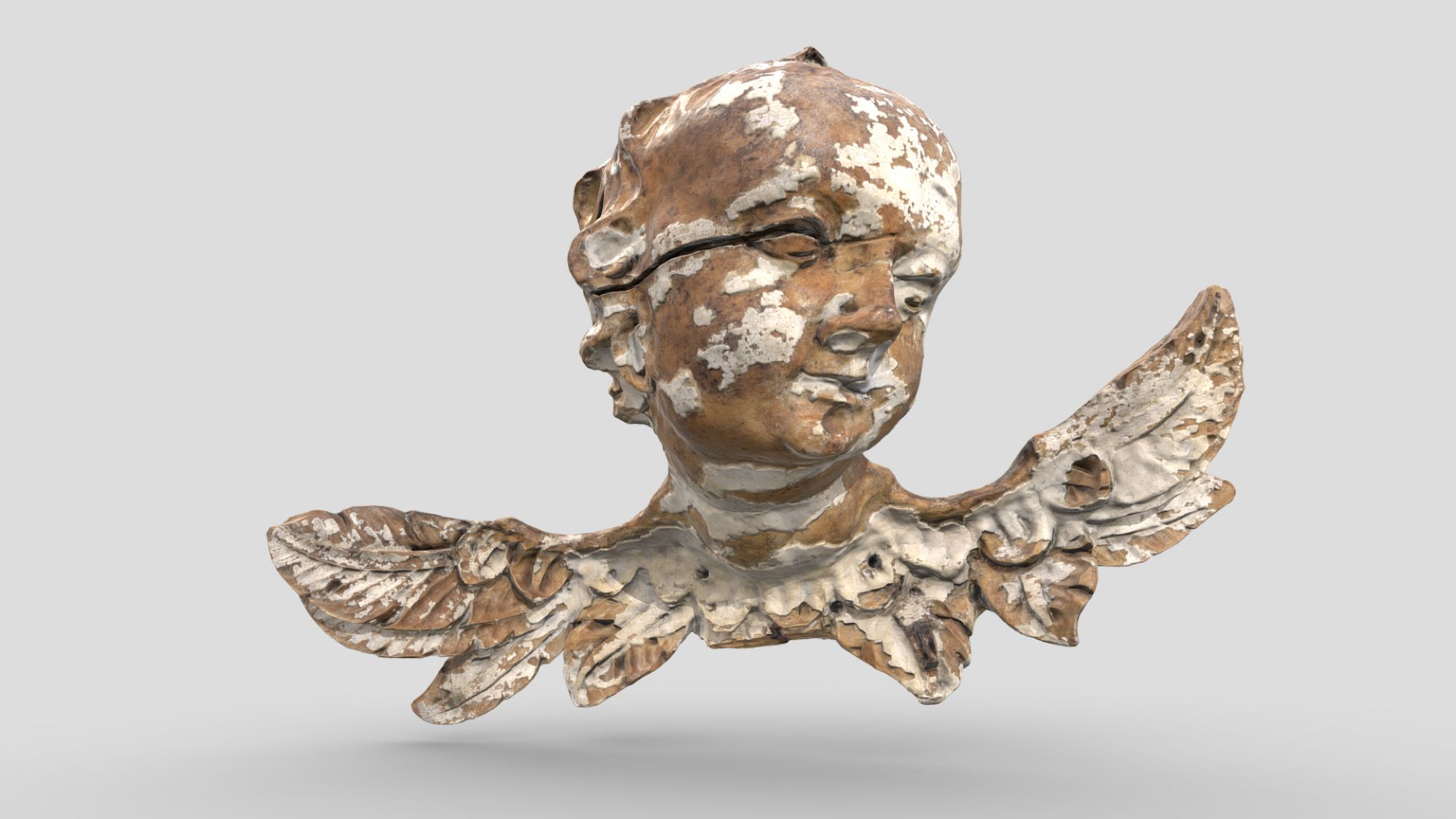
The carved wooden depiction of an angel's head probably served as an addition to the decorative embellishment of a church interior, altar, or iconostas composition. The cherubim has been a widespread image in European sacred plastic art since the Renaissance and a rather popular motif during the Baroque period. In the Christian tradition, a cherubim is an angelic being of the highest order. However, in Baroque art, the image was transformed: instead of the formidable six-winged fiery seraphim and cherubim of the Holy Scriptures, a delicate angelic head with small wings appeared. It personifies a bodiless child's face, symbolising the presence of the heavenly world, purity, and glorification.
The angel's head is presented turned slightly towards the left shoulder, with a gentle tilt that creates a sense of motion and simultaneous stillness. Two wings diverge symmetrically from the neck, forming the horizontal axis of the composition, designed to be viewed from below and from the front. The rounded shape of the head with a high open forehead is characteristic of Baroque images of cherubims. The volumes are soft, with an emphasis on the cheeks and chin. The hair framing the head is rendered not in detailed strands but as a generalised mass defined by subtle incised lines. The cherubim's facial features are gentle and contemplative. Slightly lowered eyelids create an impression of concentration and quiet prayerful contemplation. The snub nose and lips are modelled softly, without sharp transitions. A detached gaze gives the image an intimate and profound spirituality. The cherubim's wings are treated in fan-shaped groups with distinct stylisation, indicating the influence of Late Baroque ornament, where the wing often becomes an independent decorative element. The transition from the neck to the wings creates a unique artistic knot that unites individual parts into a single structure – a technique characteristic of skilled masters. The angel's head is a fine example of Baroque sacred carving, where the traditions of Western European art merged with local authenticity.
The angel's head is presented turned slightly towards the left shoulder, with a gentle tilt that creates a sense of motion and simultaneous stillness. Two wings diverge symmetrically from the neck, forming the horizontal axis of the composition, designed to be viewed from below and from the front. The rounded shape of the head with a high open forehead is characteristic of Baroque images of cherubims. The volumes are soft, with an emphasis on the cheeks and chin. The hair framing the head is rendered not in detailed strands but as a generalised mass defined by subtle incised lines. The cherubim's facial features are gentle and contemplative. Slightly lowered eyelids create an impression of concentration and quiet prayerful contemplation. The snub nose and lips are modelled softly, without sharp transitions. A detached gaze gives the image an intimate and profound spirituality. The cherubim's wings are treated in fan-shaped groups with distinct stylisation, indicating the influence of Late Baroque ornament, where the wing often becomes an independent decorative element. The transition from the neck to the wings creates a unique artistic knot that unites individual parts into a single structure – a technique characteristic of skilled masters. The angel's head is a fine example of Baroque sacred carving, where the traditions of Western European art merged with local authenticity.
Legal regulation
Borys Voznytskyi Lviv National Art Gallery