Head of an Angel
unknown

Basic information
Additionally
- Type
- sculpture 3D
- Genre
- religious
- Plot
- Cherub
- Provenance
- Chyshky village, Pustomyty district, Lviv region, Church of St. Nicholas
Information about author
Object description
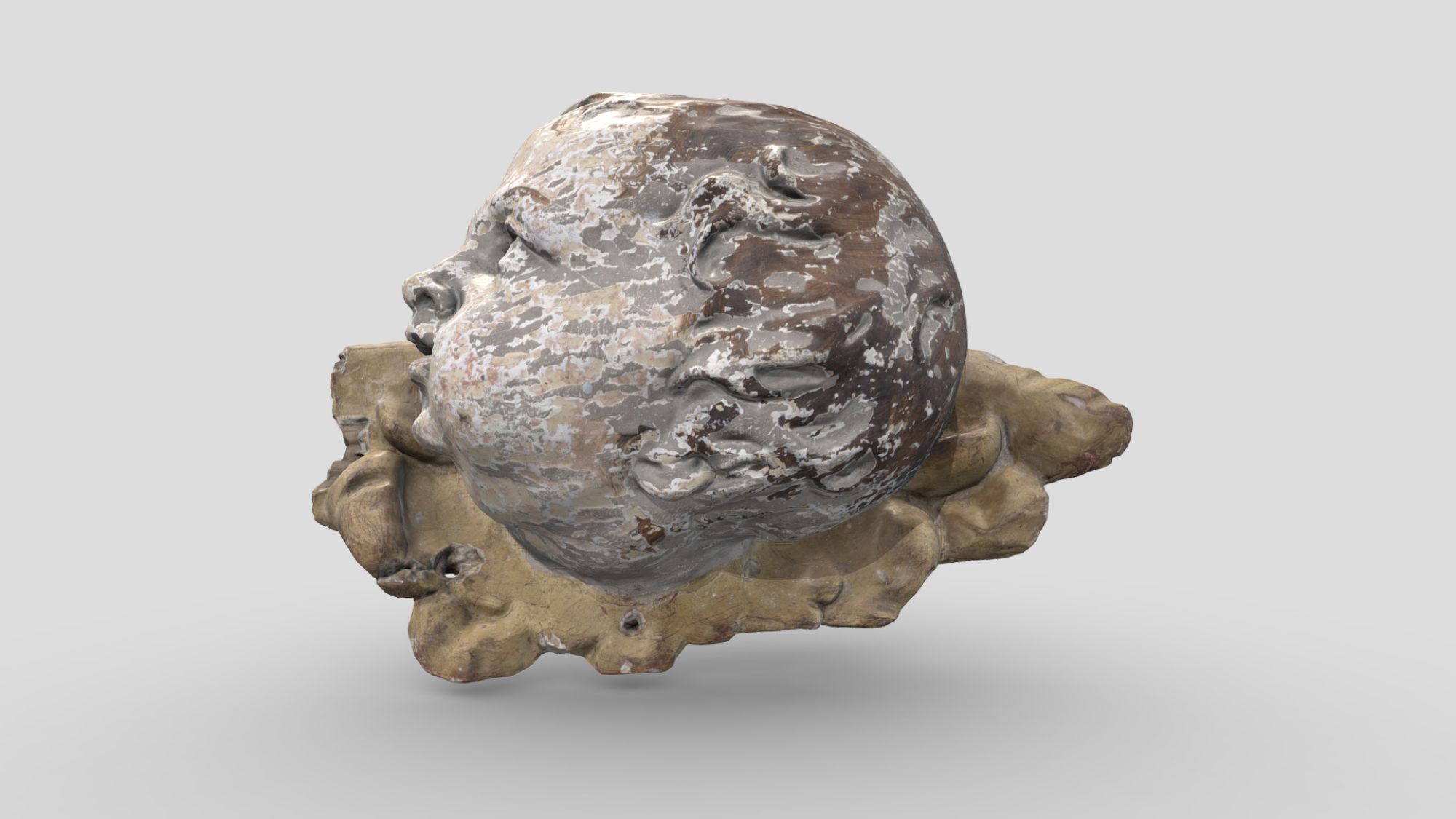
The carved wooden image of an angel's head probably served as an addition to the decorative embellishment of an altar composition or the church interior of the Roman Catholic church in the village of Chyshky. The cherub has been a widespread image in European sacred sculpture since the Renaissance and a rather popular motif during the Baroque period. This iconographical type represents a bodiless child's face framed by a pair of wings, which was sometimes placed on clouds. Such depictions symbolised the presence of heavenly powers within the liturgical space. In Holy Scripture, cherubim act as guardians of Divine majesty, and their golden wings in the interiors of sacred buildings embody the invisible presence of God among people. In church tradition, the eyes of cherubim were believed to remind of divine wisdom that sees everything, from which nothing can be hidden.
The work is characterised by an almost spherical head of an angel with a distinct, full oval of a child's face. The soft sculpting is expressed through a minimal number of planes, which was inherent to the Baroque ideal of childish beauty. The cherub is set upon small, stylised wings defined by sculptural contour lines. The head is turned sharply towards the right wing, which, combined with the diagonal composition of the wings, creates the illusion of flight. Small, almond-shaped eyes with heavy, lowered eyelids emphasised by an arch create an effect of contemplation. The image is further defined by faintly marked eyebrows on a high, open forehead, the smooth line of which transitions into a turned-up nose, a small mouth with half-open lips, and full cheeks with remnants of pink blush and light carnation. The soft carving of the hair is treated flatly, without fine detailing. Despite the severe loss of polychromy, the image of the cherub retains a touching expressiveness. The slightly closed eyes and soft line of the face create a sense of silence, contemplation, and, at the same time, gentle melancholy.
Similar images were in high demand in western Ukrainian regions during the 17th–18th centuries, where the traditions of Latin Baroque merged with local trends. Cherub heads adorned the altars of Roman Catholic and Greek Catholic churches, iconostases, shrines, and pulpits. The presented piece is a characteristic example of decorative sacred sculpture from the Baroque era. Its high artistic quality, alongside the partially preserved polychromy and gilding, testifies to the work of a professional workshop.
Legal regulation
Borys Voznytskyi Lviv National Art Gallery