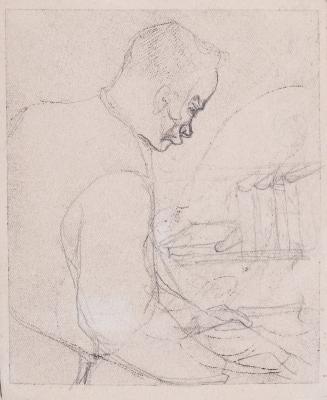
Drill
Leopold Levytskyi

Basic information
- ID
- Г-IV-3026
- Author
- Leopold Levytskyi
- Name
- Drill
- Date of creation
- 1930
- Country
- Poland
- Technique
- printmaking etching drypoint
- Material
- imprint on paper
- Dimensions (height x width, cm)
- 16.6 x 7.5
Additionally
- Type
- graphic art printmaking
- Genre
- grotesque narrative art
- Provenance
- Purchased from Henia Levytska
Information about author
Object description
While studying at the Academy of Fine Arts in Krakow between 1926 and 1932, as well as in Paris between 1929 and 1931, Leopold Levytskyi, a member of the Krakow Group (1932–1937), was influenced by the avant-garde artistic trends, which affected his later creative work. The artist's oeuvre is dominated by two figurative themes, namely, an individual and a city. These two principles, the humanistic and the urban, are conceptually complementary and interdependent. The images of a man and a city accompanied the artist from the beginning of his career, namely from the 1930s. Modern artistic tendencies are clearly traced in his compositions of this time. The artist's creative interest in avant-garde artistic methods, fascination with late Cubism and Expressionism, and active socio-political activities and his position determined the thematic range of images. Despite the dominant industrial-urban plot of the works, inspired by the fascination with the plasticity of Futurism and Cubo-Futurism, the image of a person was essential for the artist, as is evident from his portraiture, full-length images, and genre painting. Social issues were the central theme of the artist's early period works. Given that the artist depicted large social groups, ranging from the poor, underprivileged, and workers to the representatives of the political elite, he focused on the psychological traits of the portrayed people to emphasise social contrasts.
Legal regulation
Borys Voznytskyi Lviv National Art Gallery