Back

Sketch for a Mural

Vasyl Poliovyi

  • Sketch for a Mural 2
  • Sketch for a Mural 3
Basic information
ID
Ж-8204
Author
Vasyl Poliovyi
Name
Sketch for a Mural
Date of creation
1970s (?)
Country
the USSR
Culture
Ukrainian art of the Soviet period
Technique
original technique
Material
fibreboard mixed media
Dimensions (height x width, cm)
31 x 125.5
Information about author
Author
Vasyl Poliovyi
Artist's lifetime
b.1936
Country
the USSR, the USA
Biography
Vasyl Poliovyi is a Ukrainian painter and graphic artist, one of the leading authors of Soviet Nonconformist art. He was born on April 22, 1936, in Kryvyi Rih city. The artist's father, Petro Poliovyi, worked as an engineer, and his mother, Oleksandra, was a mathematics teacher. With the start of hostilities on the territory of the USSR on June 22, 1941, the family was evacuated to the Sverdlovsk region (RSFSR). There Vasyl Poliovyi studied in school, and after completing his education in 1954, he entered an art school in Yelets. However, the artist later transferred to the Tavricheskaya Art School (Leningrad, RSFSR) and then to the Higher School of Industrial Art named after Vera Mukhina. After completing his studies, he moved to Moscow, where he worked at an art collective with his wife, artist Yuliia Podohova. He focused mainly on the monumental and decorative design of the interiors and the exteriors of public buildings and governmental institutions. At the same time, he was involved in the circle of nonconformist artists in Moscow and Leningrad, including Dmytro Krasnopevtsev, Anatolii Zverev, Mykhailo Shemiakin, Oleh Tselkov, Eduard Steinberg, Volodymyr Sterlihov, and the Lianozovo Group, as well as writers like Serhii Dovlatov, Yurii Mamleev, and Vladlen Gavrilchik. He participated in unofficial exhibitions, including those in the Federal Republic of Germany, France, Italy, and Czechoslovakia. In 1965, while visiting his brother, the researcher and inventor Renat Poliovyi, the artist created a large cycle of thematic works about Ukraine. Some of them were exhibited in Moscow. Later he joined the Artists' Union of the USSR. In 1972, Vasyl Poliovyi moved to Lviv, where he worked on monumental and easel paintings. During this period, he interacted with the local art community, including Valerii Shalenko, Mykhailo Steinberg, Yurii Sokolov, Okhrim Kravchenko, Margit and Roman Selsky, Anatolii Semahin, art critics Hryhorii Ostrovskyi and Dmytro Shelest, and writer Ihor Klekh. In 1976, Vasyl Poliovyi was expelled from the Artists' Union, which made his professional activity practically impossible. As a result, the artist decided to emigrate from the Soviet Union to the United States, where he still lives and works in Greenville, South Carolina.
Object description
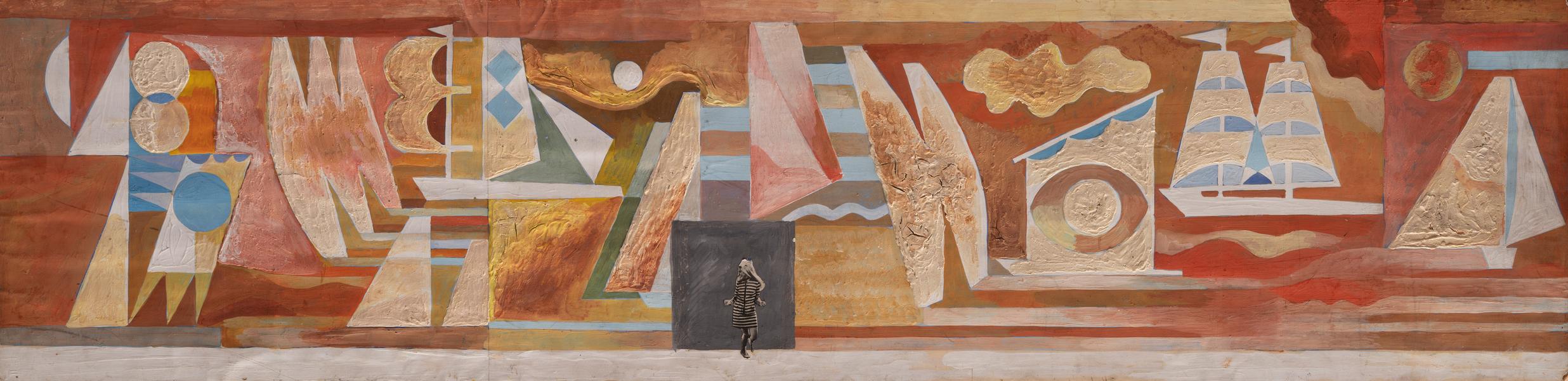
The sketch is a variation of a design on ancient and modern sailing history. The decorative approach to interpreting certain sailing ships and boats, the elevation of certain elements into high textured relief, and the scale (which can be easily determined by the size of the portal and the figure of a person placed on it to establish proportion) allow the viewer to feel immersed inside something comparable to a massive diorama. The artist's colour and tonal approach to the composition ensures the integrity of the imagery, even in the chronological and regional distance between the depicted objects. However, there is a possibility that, for example, the archaic Egyptian sailing ship is the Ra boat from the project of the renowned Norwegian explorer Thor Heyerdahl (1969–1970). The famous Soviet doctor, journalist, and traveller Yurii Senkevych participated in those expeditions. Since the sea (ocean) and the skyline are painted in warm ochre and carmine colours, a specific tone of detachment appears, making it difficult to tell whether the sailboats are flying among the clouds or floating on the water. Additionally, the composition progresses from geometric abstraction (in the left part) to the distinct silhouettes of different sailing ships, transitioning from abstract figures to recognisable objects. The dominant optimistic mood and the whimsical lightness, where fantasy becomes almost fairytale-like, likely indicate the recreational purpose of the building where the mural was to be executed.
Legal regulation
Borys Voznytskyi Lviv National Art Gallery