Sketch for the "Three Graces" Mural
Vasyl Poliovyi



Basic information
- ID
- Г-II-343
- Author
- Vasyl Poliovyi
- Name
- Sketch for the "Three Graces" Mural
- Date of creation
- 1970s (?)
- Country
- the USSR
- Culture
- Ukrainian art of the Soviet period
- Technique
- mixed technique
- Material
- cardboard pastel
- Dimensions (height x width, cm)
- 109.5 x 83
Additionally
- Type
- graphic art
- Genre
- symbolic art
- Plot
- Allegory
- Provenance
- Handed over to the museum from Vasyl Poliovyi
Information about author
Object description
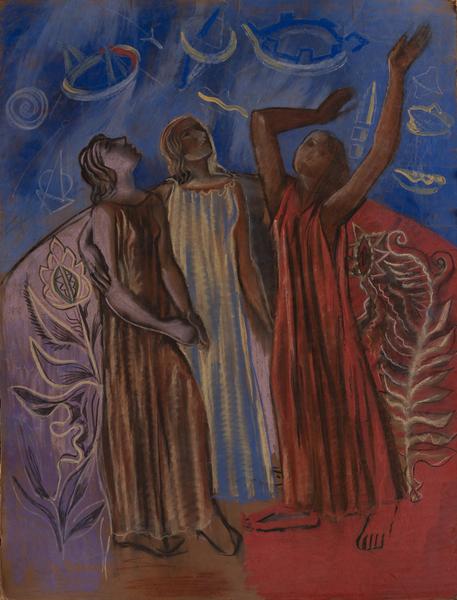
The mural depicts three allegorical female figures with long, loose hair wearing antiqued clothing (tunic-like dresses with characteristic decorative folds) but barefoot. These figures stand on a disc-shaped surface of purple, ochre and carmine shades with a distinctively rounded edge. On both sides, the women are flanked by blossoming plants, resonating with phytomorphic motifs of Ukrainian decorative art. All women are depicted in full-length, with their faces turned towards the sky. The central figure, dressed in light-coloured attire with shades of yellow and ultramarine, embraces the figure on the left, wearing a yellowish-ochre tunic. The woman on the far right, dressed in red, is depicted close to these two characters but without physical contact. Additionally, her hands are raised above her head, and she is actively gesturing. The absence of facial expressions suggests that she is not so much commenting as pointing out what is happening in the sky above them. In the sky above the figures, numerous objects related to space flights and stratospheric exploration are depicted (including carrier rocket "Vostok" and likely the R–5 ballistic missile or a guided aerial bomb), as well as a series of unidentified stylised aircraft (the shapes of the two objects in the sky next to the woman on the right side resemble a bathyscaphe and a submarine). Overall, the composition is symbolically allegorical. In using attributes, it would be possible to interpret these figures as three muses (for example, Urania, Clio and Polyhymnia). However, due to the stylised nature of the images and the absence of additional symbols, they should not be definitively interpreted as muses or even as the Three Graces since a solid connection to scientific and technological progress dominates the narrative. The composition is balanced and monumental, partly reminiscent of the practice of Puvis de Chavannes or European modernists of the interwar period. The colouring is mixed and harmonious, with occasional tonal accents.
Legal regulation
Borys Voznytskyi Lviv National Art Gallery