Sketch for a Mural
Vasyl Poliovyi


Basic information
- ID
- Ж-8208
- Author
- Vasyl Poliovyi
- Name
- Sketch for a Mural
- Date of creation
- 1970s (?)
- Country
- the USSR
- Culture
- Ukrainian art of the Soviet period
- Technique
- original technique
- Material
- fibreboard mixed media
- Dimensions (height x width, cm)
- 70 x 140
Additionally
- Type
- painting
- Genre
- mythological painting
- Plot
- Allegory
- Provenance
- Handed over to the museum from Vasyl Poliovyi
Information about author
Object description
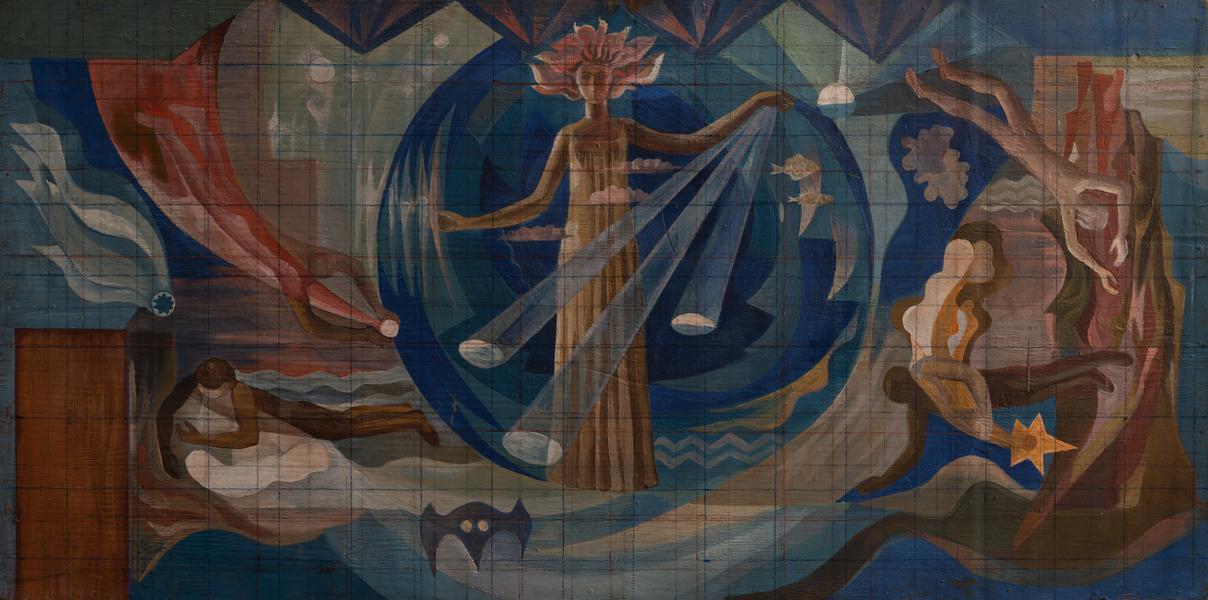
This artwork belongs to a series of sketches for monumental decoration intended for public spaces. Vasyl Poliovyi's way of object stylisation, concise and expressive language, and rich decorative elements are all present in the work, demonstrating an original approach to the task at hand. The colour scheme and palette are cool and focused on nuance, creating a contemplative emotional atmosphere. The composition revolves around a central figure stylised as an ancient deity. It is likely Calliope, the muse of science, bringing the light of knowledge into the space where a symbolic environment is combined from the heavens to the depths of the sea. On both sides of the central figure, in the middle and lower parts of the sketch, there are hierarchically contracted dynamic depictions of four human figures (in pairs on the left and right sides), possibly astronauts and explorers. The artist approached the space in a simultaneous manner. Thus, clouds are depicted next to the stylised fish on the right side of Calliope's figure. Additionally, the device in the sketch's lower part can be interpreted as a fictional spaceship or a bathyscaphe. It is important to note that this particular sketch was likely approved for execution at the site. The image is covered with a grid pattern, which would facilitate scaling for further image transfer onto the wall. The execution style of the left and right parts of the upper section of the sketch, as well as the stylised depiction of the doorway in the lower left part, suggests that the mural was intended to be integrated into the interior of a public space with a specific vault.
Legal regulation
Borys Voznytskyi Lviv National Art Gallery