Old Forest
Karlo Zvirynskyi


Basic information
- ID
- Ж-4150
- Author
- Karlo Zvirynskyi
- Name
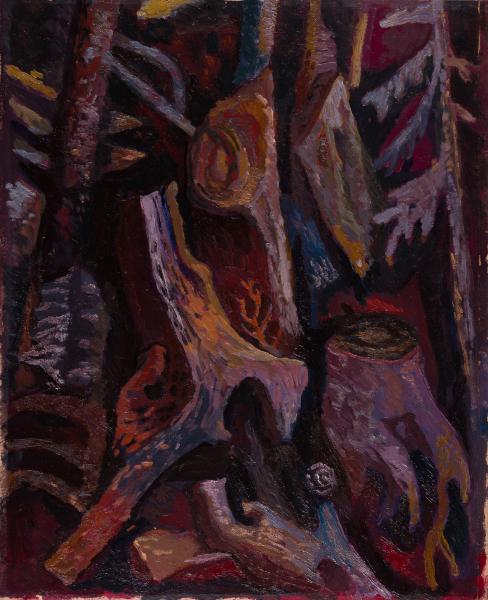
- Old Forest
- Culture
- Contemporary times
- Technique
- oil painting
- Material
- cardboard oil
- Dimensions (height x width, cm)
- 72 x 57
Additionally
- Type
- painting
- Genre
- landscape
- Plot
- Landscape
- Provenance
- Gifted by Karlo Zvirynskyi, 1967
Information about author
Object description
The "Old Forest" composition exemplifies K. Zvirynskyi's appeal to the experience of Post-Impressionism and the actualisation of its plastic and semantic principles. Thus, the Post-Impressionist inspiration of the work is confirmed by the developed symbolic programme, reflecting the fundamental meanings of life in a fragment of nature. The artist's intention to embody the echoes of the Absolute led to the pantheistic nature of the image, the feeling of the presence of the Creator's will in the forest thickets. At the same time, the image reminds us of the ancient Aristotelian concept of "hyle", which associated the forest with matter and signified the original unity of existence. The mysteriousness and secrecy of the forest fragment refer to folklore ideas about the forest as a remote, untamed space, the opposite of home in the archaic opposition "someone else's – one's own". The tension of the landscape is created by the understanding of the forest as a dangerous liminal (transitional) locus associated with obstacles, their overcoming, search, and path. In its existential projection, the work is reminiscent of the lines of Dante's Divine Comedy: "At the midpoint on the journey of life, I found myself in a dark forest, for the clear path was lost". The artistic solution of the landscape is based on the conceptual rejection of three-dimensionality and linear perspective, plastic generalisation and flattening of forms. A restrained colour scheme and a subtle gradation of grey-blue and ochre-brown tones serve as a means of figurative expression. The work is united with the experience of Post-Impressionism by the intrinsic value of the colour surface and the picture plane accentuated by dense impasto painting.
Inscriptions
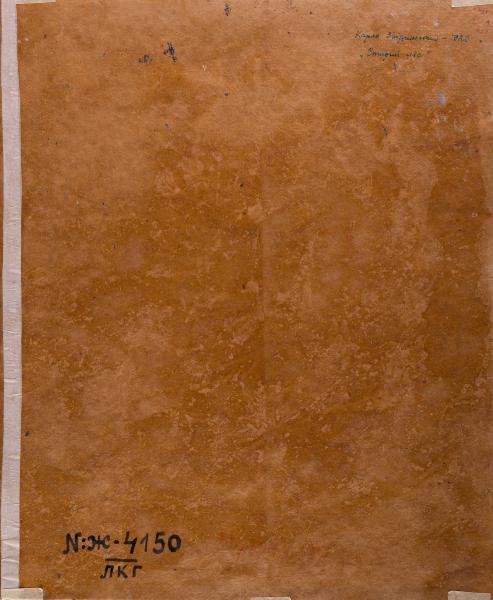
On the back, at the top right, is the inscription: "Karlo Zvirynskyi".
Legal regulation
Borys Voznytskyi Lviv National Art Gallery