Drawing of a Man's Bust
Yulian Zaiats



Basic information
- ID
- Ф-З-Арх-ЛГМ-5/21
- Author
- Yulian Zaiats
- Name
- Drawing of a Man's Bust
- Date of creation
- 04.11.1909
- Country
- Austro-Hungarian Empire (?)
- Technique
- watercolour
- Material
- paper watercolour
- Dimensions (height x width, cm)
- 12.5 x 10.2
Additionally
- Type
- painting
- Genre
- portraiture
- Plot
- Portrait
- Provenance
- Received from Nina Zaiats
Information about author
Object description
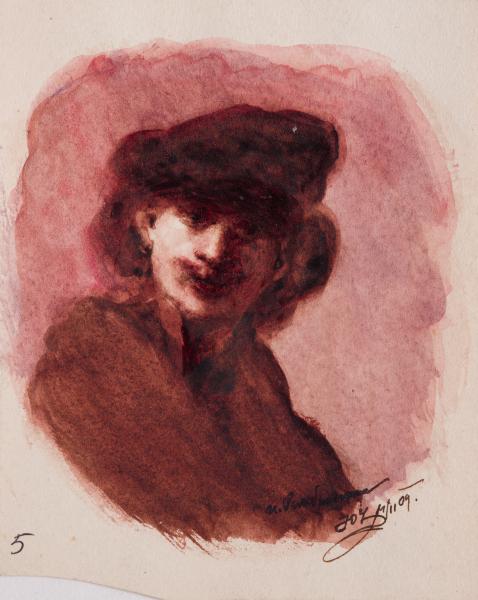
The sheet features a watercolour work executed in a close but complexly organised warm range that varies between rich ocher and muted brown tones. The work is a loose interpretation of Rembrandt van Rijn's 1634 self-portrait, in which the artist is depicted wearing a dark beret and a rich suit, corresponding to the artist's self-representation and social status at the time. Despite the monotony of the palette, the author managed to convey the depth, light, and shadow dramaturgy of the image, preserving the sense of facial relief, fabric textures, and background density. The watercolour technique is applied with a high degree of control: translucent layers of paint are applied thinly, preserving the paper's structure, while accents in the areas of the eyes, nose, and cheekbones are enhanced with richer strokes. The composition corresponds to the original, but does not copy it mechanically: an individual interpretation of the face is noticeable, perhaps with a slightly softer emotional tone. The image is full of inner composure and dignity, which were characteristic of numerous self-portraits in which Rembrandt appears not only as an artist but also as an actor of his own destiny. The rejection of full-colour modelling in favor of a complicated monochrome gives the copy a sketchy quality, emphasising the plasticity of the original sample's form. This practice of copying was widespread among art school students and private studio artists in the early twentieth century, serving not only as a means of learning technical skills, but also as a way to join the great traditions of European painting. Rembrandt, like some other masters of the “golden age of painting,” was considered a standard in his ability to convey the inner state of the model, the depth of psychology, and the subtlety of working with tone and chiaroscuro. Imitating such examples allowed future artists to master the complex elements of pictorial thinking, develop a sense of composition, rhythm, and harmony of volumes, and study the nature of interpreting texture, light, and air. Thus, this copy is not just an exercise, but a link in the chain between the past and the present, a testament to the dialogue between generations of artists and the educational process.
Inscriptions
Inscription: "Mr. Rembrandt";
Yulian Zaiats' signature;
"4/11 1909".
Portrayed person
- The name of the person portrayed
- Rembrandt Harmenszoon van Rijn
- Lifetime of the person portrayed
- 15.07.1606–04.10.1669
Legal regulation
Borys Voznytskyi Lviv National Art Gallery