Drawings of Genre Scenes
Yulian Zaiats


Basic information
- ID
- Ф-З-Арх-ЛГМ-7/4
- Author
- Yulian Zaiats
- Name
- Drawings of Genre Scenes
- Date of creation
- 11.04.1962–14.04.1962
- Country
- the Ukrainian SSR
- Technique
- drawing
- Material
- paper pencil Indian ink
- Dimensions (height x width, cm)
- 20.4 x 28.5
Additionally
- Type
- graphic art
- Genre
- genre art
- Provenance
- Received from Nina Zaiats
Information about author
Object description
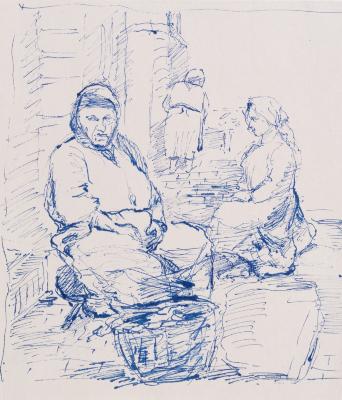
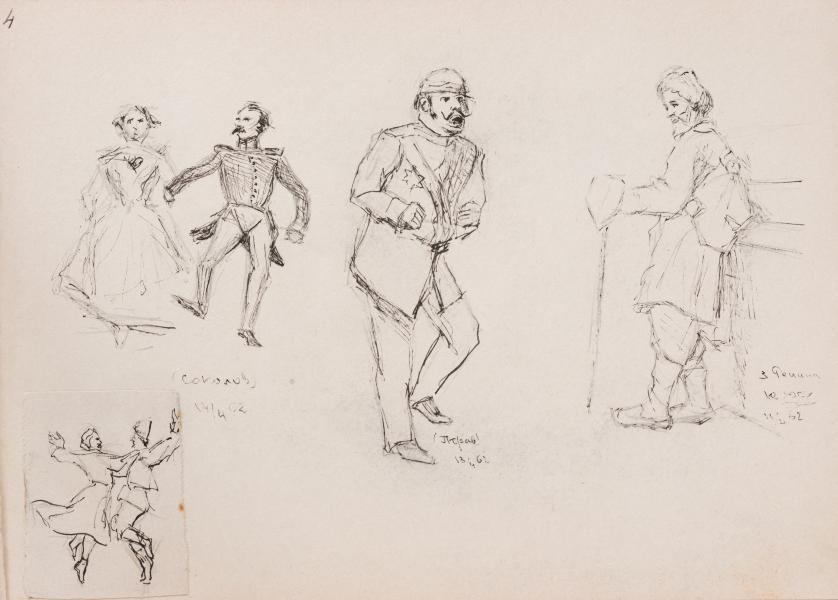
The sheet contains a series of graphic sketches representing characters from the works of Russian painting classics, in particular V. Sokolov, V. Perov, and I. Repin. Placed across the entire surface, these images are interpreted as research studies, the purpose of which was not literal copying, but rather the recording of the characteristic features of the figures, the psychology of the images, and the pictorial structure of the originals. Each of the works is executed in graphite pencil and ink with a high degree of attention to shape and anatomical accuracy. The line is free but confident, with subtle modulation of light and shadow, which allows for the preservation of plastic expressiveness even in fragmentary sketches. The models, mostly male figures, exhibit characteristic ethnographic, social, and emotional features that were key to the painting method employed by the aforementioned authors. In V. Perov's type, one can discern an internally tense character, described sarcastically and ironically, while in I. Repin's example features active facial expressions and lively psychologism, while Sokolov's study conveys the graphic expressiveness of academic drawing with a slight romantic touch. The presence of dates and signatures indicates the deliberate sequence of these exercises, performed over three days in April 1962. This suggests that these were not random attempts, but rather systematic training or post-academic practice, possibly in the context of teacher training or independent study of the masters of the past. The format of the page itself and the manner of composition with indents, balances, and harmonious placement of figures confirm the established artistic culture of the author, who perceives the sheet as a coherent composition. The work demonstrates how, within the graphic language, it is possible to reproduce not only external features, but also the deeper character of the art of the era, attentive to the person, their status, emotional background, and social context. At the same time, it is a manifestation of the author's thinking, as Yulian Zaiats turned to canonical models but sought not only to imitate them but also to comprehend them through drawing as a living analytical tool.
Inscriptions
In the centre, under the images, are the inscriptions: "(Sokolov) 14/4 1962"; "(Perov) 13/4 1962"; "From Repin"; Yulian Zaiats' signature; "11/4 1962".
Legal regulation
Borys Voznytskyi Lviv National Art Gallery