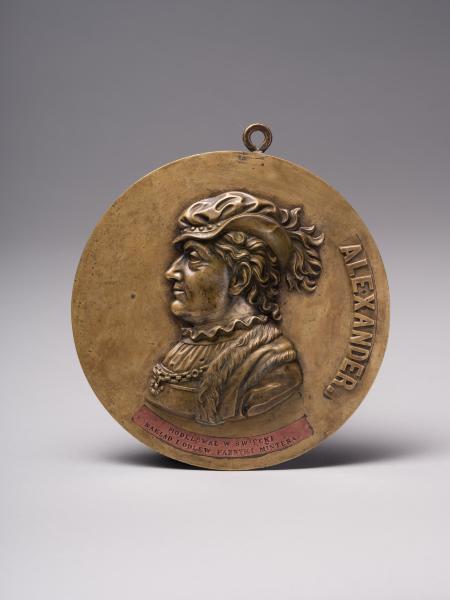
Medal “Aleksander Jagiellonczyk”
Wojciech Swiecki


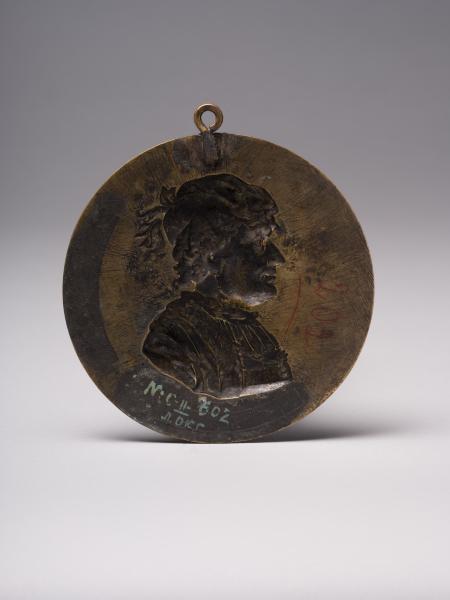
Basic information
- ID
- С-II-602
- Author
- Wojciech Swiecki
- Name
- Medal “Aleksander Jagiellonczyk”
- Date of creation
- after 1860
- Country
- Duchy of Warsaw Kingdom of Poland
- Culture
- Modern times
- Technique
- moulding
- Material
- bronze
- Dimensions (diameter, cm)
- 12.8
Additionally
- Type
- sculpture (relief)
- Genre
- portraiture
- Plot
- Portrait
- Provenance
- the Dzieduszycki collection
Information about author
Object description
Alexander Jagiellon (August 5, 1461 – August 19, 1506) was Grand Duke of Lithuania from 1492 and King of Poland from 1501. He was born on August 5, 1461, in the royal castle of Wawel in Krakow. In 1484, Aleksander Jagiellon's father, Grand Duke of Lithuania and King of Poland Casimir IV, appointed him heir to the throne of the Grand Duchy of Lithuania. In 1492, he was elected Grand Duke of Lithuania at the Sejm in Vilnius, while the Poles elected his older brother, John I Albert, as their king. In 1494, he ended the Lithuanian-Muscovite War, resulting in the Lithuanians losing Vyazma and part of the Verkhovsky principalities. In 1495, the peace treaty was strengthened by Alexander's marriage to Elena, daughter of Grand Duke Ivan III Vasilyevich of Moscow. In 1499, he strengthened the union between Lithuania and the Kingdom of Poland (the so-called Union of Krakow and Vilnius). In 1501, after the death of John I Albert, the Polish Sejm elected Alexander Jagiellon as king. From that time until 1795, a single monarch ruled the Polish crown and the Grand Duchy, and the term “Rzeczpospolita” began to be used in international relations. In 1505, Alexander Jagiellon introduced the Radom Constitution (Nihil Novi), which limited royal power in favor of the magnates. Ukrainian magnates, led by Mykhailo Hlynskyi, had a significant influence on the king's policies. King Alexander Jagiellon was a highly educated man and a patron of science and the arts. He died on August 19, 1506, and was buried in Vilnius.
Inscriptions
"ALEXANDER. / MODELOWAL W ŚWIĘCKI NAKLAD I ODLEW FABRYKI MINTERA".
Portrayed person
- The name of the person portrayed
- Aleksander Jagiellonczyk
- Lifetime of the person portrayed
- 05.08.1461–19.08.1506
Legal regulation
Borys Voznytskyi Lviv National Art Gallery