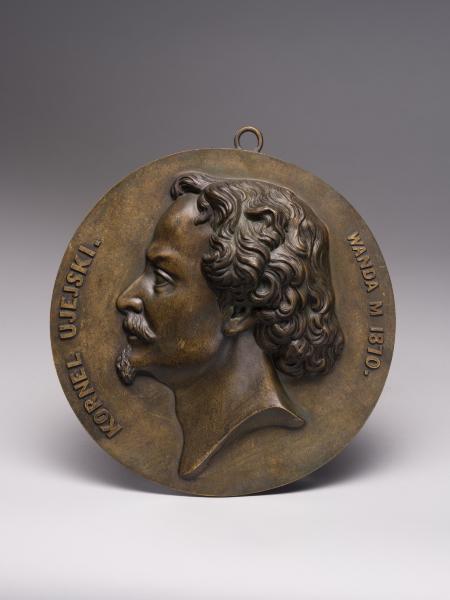
Medal “Kornel Ujejski"
Wanda Mlodnicka



Basic information
- ID
- С-II-606
- Author
- Wanda Mlodnicka
- Name
- Medal “Kornel Ujejski"
- Date of creation
- 1870
- Country
- Kingdom of Poland the Second Polish Republic
- Culture
- Modern times
- Technique
- moulding
- Material
- bronze
- Dimensions (diameter, cm)
- 23
Additionally
- Type
- sculpture (relief)
- Genre
- portraiture
- Plot
- Portrait
- Provenance
- the Dzieduszycki collection
Information about author
Object description
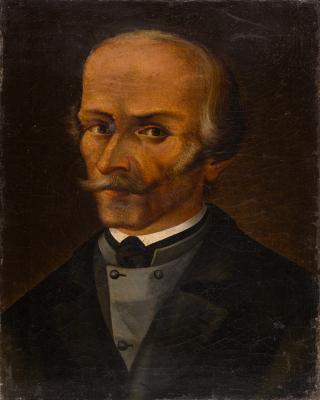
Kornel Ujejski (12 September 1823 – 19 September 1897) was a Polish poet of romanticism, publicist, and social activist, often referred to as "the last great poet of Romanticism" and the most famous Polish poet of Eastern Galicia. He was born on 12 September 1823 in the village of Beremiany (now Ternopil Oblast) into a wealthy noble family. From 1831, he studied at the school and gymnasium of the Basilian monastery in Buchach. According to some sources, he also studied in Kremenets and at the Berezhany Gymnasium. He later moved to Lviv, where he studied at Lviv University. In Lviv, he met the famous writers Leszek Dunin-Borkowski and Wincenty Pol (1807–1872). He became close to literary circles associated with the Ossolineum and the publication "Dziennik Mód Paryskich" (Paris Fashion Journal). It was in this journal that the young writer published his first poems in 1844. In the same year, he travelled to Warsaw with his cousin Wiktor Wiśniewski. In the capital, with the help of August Bielowski, he met Kazimierz Wóycicki, Teofil Lenartowicz, Napoleon Leon Łubieński, and August Wilkoński. In 1845, he made his debut with the poem "Marathon", which he read at one of the literary evenings. That same year, Kornel Ujejski 's poem "Jeremiah's Complaints" appeared in the press, proclaiming a programme of service to the oppressed people. In 1846, he wrote the song "With the Smoke of Fires", stylised as a prayer for grace for the suffering people, which became the unofficial anthem of the January Uprising. Kornel Ujecki's early works, dated 1840–1845, were collected in the anthologies "Flowers Without Scent" (1848) and "Withered Leaves" (1849). In 1847, the writer travelled to Paris via Belgium. In Brussels, he met Joachim Lelewel, and in Paris, he met Józef Bohdan Zaleski, Frédéric Chopin, and Juliusz Słowacki. He attended lectures at the Sorbonne and the Collège de France. In 1848, he took part in the February Revolution in Paris. In May, he returned to his hometown after hearing about the revolutions in Berlin and Vienna. He took part in the events of the "Spring of Nations" in Lviv. In 1849, he married Henrika, née Komorowska. A year later, together with his wife, he financed the erection of a monument in Pawłów to commemorate the abolition of serfdom by the Austrian authorities. In 1856–1860, he published a series of articles entitled "Letters from Lviv", in which he denounced national renegacy and reactionary aristocracy. From 1857, he collaborated with the publication "Literary Figure". In 1860, he took part in an expedition to Iași, where he wrote "Polish March". In 1863, he joined the Galician underground circles, in particular the student self-help organisation "Brotherly Aid". He participated in patriotic ceremonies and gave speeches, including at the funeral of Artur Grottger. In 1874, he headed the Medal Committee established in Lviv. In 1877–1878, he was a member of the State Council in Vienna. In 1880, due to poor health, he left his family estate and moved to Lviv. In 1881, he settled on the estate of his son Kordian in Podillia. The last years of his life were connected with Pawłów, where in 1883 the writer visited his second son, Roman. Kornel Uejski is the author of religious-messianic and visionary poetry, stylised as prayers and biblical psalms. He expressed ideas formed under the influence of the cult Polish mystic Andrzej Towiański, which were an irrational belief deeply rooted in Christian ethics, concerning the salvation of the Polish people amid national uprisings and internal strife. In many poems, including "Song of the Grain", "Three Strings", "The Snow-Covered House", and "At the Service", he depicted the plight of the peasantry, expressed his love for them, and called for a joint struggle with the Poles for liberation from oppression. He died on 19 September 1897 in Pawłów, where, according to his will, he was buried in the local cemetery.
Inscriptions
"KORNEL UJEJSKI. / WANDA M 1870".
Portrayed person
- The name of the person portrayed
- Kornel Ujejski
- Lifetime of the person portrayed
- 12.09.1823–19.09.1897
Legal regulation
Borys Voznytskyi Lviv National Art Gallery