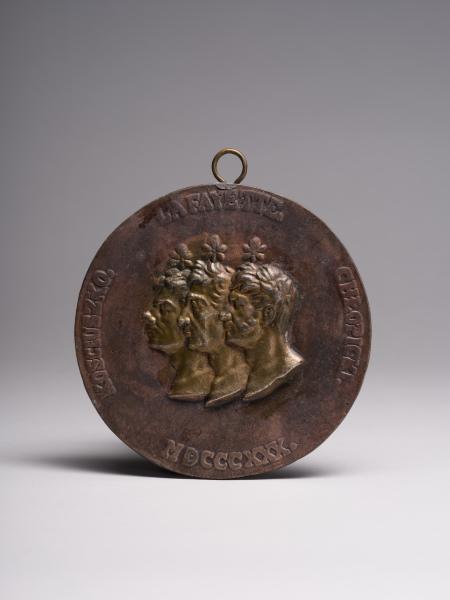
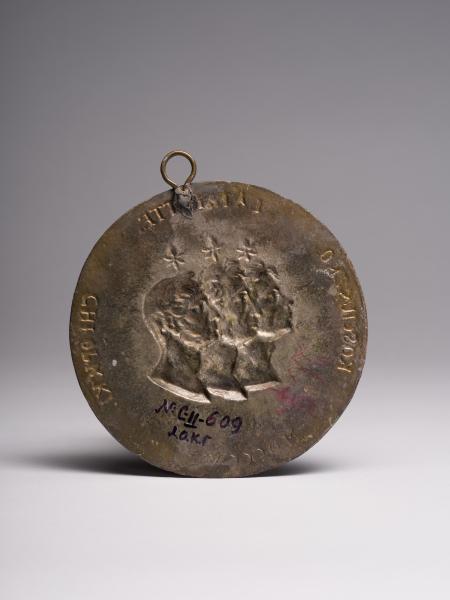
Medal "Kosciuszko, Lafayette, Chlopicki"
Jozef Schmelzer


Basic information
- ID
- С-II-609
- Author
- Jozef Schmelzer
- Name
- Medal "Kosciuszko, Lafayette, Chlopicki"
- Date of creation
- 1830
- Country
- Kingdom of Poland
- Culture
- Modern times
- Technique
- moulding
- Material
- bronze
- Dimensions (diameter, cm)
- 14
Additionally
- Type
- sculpture (relief)
- Genre
- portraiture
- Plot
- Portrait
- Provenance
- the Dzieduszycki collection
Information about author
Object description
Andrzej Tadeusz Bonawentura Kościuszko (04.02.1746–15.10.1817) – Polish military and political figure, participant in the American Revolution and leader of the Polish uprising of 1794. He is considered a national hero of Poland, Belarus, Lithuania, and the United States, and is an honorary citizen of France. He was born into a noble family in February 1746 in the village of Merechivshchyna near the town of Kossovo (now Ivatsevichsky District, Brest Region, Republic of Belarus; at that time part of the Grand Duchy of Lithuania, Polish-Lithuanian Commonwealth). The exact date of his birth is unknown; February 4 and 12 are usually cited. In 1755, he entered the school of the Piarist monastic order in Liubeshiv, where he studied until 1760. In 1765–1769, he studied at the Warsaw Knight School, founded by Stanisław Poniatowski, which was in fact a military academy where officers were trained. He chose to specialise in military engineering and graduated from the school with the rank of captain. In 1768, during the civil war, he left the country. In 1769, he received a royal scholarship and went to Paris to study at the military academy, but due to his lack of French citizenship, he was not admitted and began studying at the Royal Academy of Painting and Sculpture. For five years, he attended lectures and regularly visited the library of the French Military Academy. After travelling to England, Italy, Switzerland, and Germany in the summer of 1774, he returned to Warsaw. Despite excellent recommendations, he was unable to join the Polish army because he could not afford the patent for an officer's rank. He was hired as a teacher in the family of magnate Sosnowski and fell in love with his daughter, Ludwika Sosnowska. Her father prevented the lovers from marrying, and Tadeusz left the country, but he carried his love for Ludwika throughout his life. In June 1776, T. Kosciuszko arrived in North America, where he took part in the American Revolution. For the next eight years, he served as an officer in the American army. He became famous as a brilliant fortifier and engineer. In 1784, he returned to his homeland. Later, he emigrated to France. In March 1794, he returned to Poland. On 24 March, in Krakow, he announced the start of an uprising – the first in a series of liberation movements against the neighbouring states that had occupied the country. On 7 May 1794, he issued the Proclamation of Połaniec – the first legislative act in which Polish peasants were considered citizens. On 10 October, he was seriously wounded in battle with Russian troops, taken prisoner, and imprisoned in the Peter and Paul Fortress. After his release in August 1797, he left for America. In 1798, he returned to Europe. In 1799, he met with Napoleon twice. In 1815, he declined Alexander I's invitation to head the administration of the Kingdom of Poland after learning that Poland would not be restored within the borders of 1772. He died on 15 October 1817 in the Swiss city of Solothurn.
Gilbert de Lafayette (real name – Gilbert du Motier) (6 September 1757 – 20 May 1834) was a French military and political figure who participated in three revolutions: the American War of Independence, the French Revolution, and the July Revolution of 1830. He was born into a noble family; his father was a grenadier colonel. In 1768, he entered one of the most aristocratic educational institutions in France – the Collège de Plessis, which he graduated from in 1772. In 1773, he was appointed commander of the Noailles cavalry regiment. In 1775, he was promoted and transferred to the garrison of Metz with the rank of captain. On 11 April 1774, the Marquis de Lafayette married Adrienne, daughter of the Duke de Noailles. In 1777, he left for America, where he became an aide to George Washington. He participated in the fighting in the American War of Independence. In 1789, he was elected to the States General and, after the storming of the Bastille on 14 July, became commander of the National Guard. He later renounced his liberal constitutional beliefs. On 17 July 1791, during the Varennes crisis, he ordered the shooting of an anti-monarchist demonstration on the Champ de Mars in Paris. In 1792, he was appointed commander of one of the armies and tried to put pressure on the Legislative Assembly. Later, on 19 August 1792, he led troops into revolutionary Paris. While fleeing after his defeat, he was captured by the Austrians. In 1797, he was released and soon returned to France, where he remained until 1814. In 1802, he wrote a letter to Napoleon protesting against the establishment of autocratic rule. During the Hundred Days, he declined Napoleon's offer of a peerage, but entered the Chamber of Deputies and opposed the Bourbon regime. On 29 July 1830, he took command of the National Guard. He remained convinced that establishing a republican system in France was premature because of the strong monarchist sentiment in society. He died on 20 May 1834 in Paris. He is buried in the Picpus Cemetery.
Józef Grzegorz Chłopicki (14 March 1771 – 30 September 1854) was a general in the Polish army and a participant in the Kościuszko Uprising, the Napoleonic Wars, and the November Uprising. He was born in Kapustyn (now Khmelnytskyi Oblast) into a poor noble family. His father, Franciszek Chłopicki of Bratslav, was a cupbearer, and his mother was Marianna Lenkiewicz. He studied at the Basilian schools in Nemyriv, Vinnytsia, and Sharhorod. From an early age, he showed an interest in military affairs. In 1785, he ran away from the monastery school and joined the army. He took part in the campaigns of the Polish-Russian War of 1792. After the second partition of Poland, Józef Grzegorz Chłopicki 's regiment became part of the Russian army. In 1794, after the outbreak of T. Kosciuszko's uprising, he joined the rebel army and fought in A. Poniński's division (1758 or 1759–1816). After the suppression of the uprising and the third partition of Poland in 1795, he emigrated to revolutionary France. On 19 June 1799, he was wounded in the Battle of Trebia. He took part in campaigns in Italy (1805) and the Kingdom of Naples (1806). He was promoted to colonel in the Polish-Italian Legion, created by Napoleon's decree on 6 April 1807 in Silesia. He later headed the "Vistulan Legion," created on its basis, which fought in Spain from 1808 to 1812. He took part in Napoleon's campaign against Russia. On 10 September 1812, he was seriously wounded near Mozhaisk and was unable to take part in further battles. On 31 December 1813, he was sent into retirement, and in 1814, he returned to Poland. That same year, Alexander I appointed him to the Army of the Kingdom of Poland as a lieutenant general. In October 1818, due to conflicts with the tsar's governor in Poland, Grand Duke Constantine, he resigned. During the November Uprising of 1830–1831, he commanded the Polish Army and held the position of "dictator". He died in Krakow on 30 September 1854 and was buried in Krzeszowice.
Inscriptions
"KOSCEUSZKO. LAFAYETTE. CHŁOPICKI. MDCCCXXX".
Portrayed person
- The name of the person portrayed
- Tadeusz Kosciuszko (04.02.1746–15.10.1817), Gilbert de Lafayette (06.09.1757–20.05.1834), Jozef Grzegorz Chlopicki (14.03.1771–30.09.1854)
Legal regulation
Borys Voznytskyi Lviv National Art Gallery