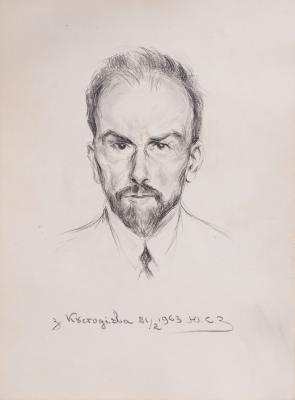
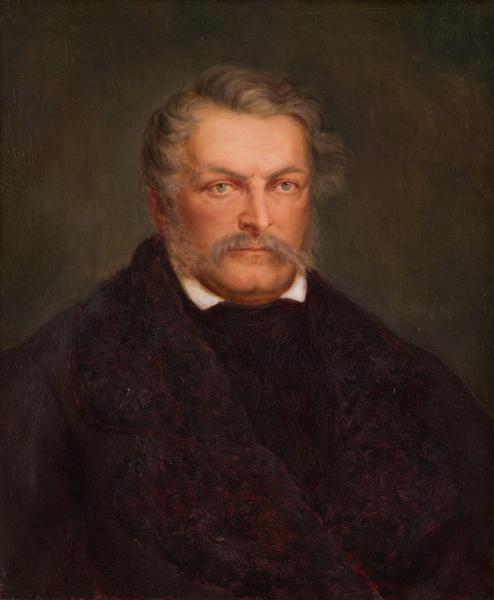
Portrait of Franciszek Duchinski
Franciszek Tepa


Basic information
- ID
- Ж-1105
- Author
- Franciszek Tepa
- Name
- Portrait of Franciszek Duchinski
- Date of creation
- 1861
- Country
- Austrian Empire
- Culture
- Modern times
- Technique
- oil painting
- Material
- canvas oil
- Dimensions (height x width, cm)
- 66.7 x 57
Additionally
- Type
- painting
- Genre
- portraiture
- Plot
- Portrait
- Provenance
- the Dzieduszycki collection
Information about author
Object description
Franciszek Henryk Duchiński (1816–13 July 1893) was a Polish ethnographer, historian, publicist, and social activist. He came from an impoverished noble family and studied at the Carmelite school in Berdychiv, the Basilian college in Uman, and, from 1834, at Kyiv University. He was the author of the theory of the non-Slavic, or Turanian (Mongolian), origin of the Russian nation. He believed that only Poles and Rusyns were true Slavs, and that the cradle of Slavianism was the land between the Vistula and Dnipro rivers. He was a supporter of the restoration of Kyiv Rus and sought a Polish-Lithuanian-Rusyn union. In 1846, Franciszek Henryk Duchiński emigrated to Paris, where he gained the support of Prince Adam Jerzy Czartoryski (1770–1861). He gave a series of lectures at the Historical and Literary Society, where he presented his theory of ethnogenesis. During the Spring of Nations, he joined General Władysław Zamoyski's (1803–1868) Italian Legion and began an anti-Russian propaganda campaign. In Bologna, he published lectures on Slavic literature. In 1849, he founded the magazine "Società per l'Allianza Italo-Slava" in Turin and wrote articles for many French periodicals. Hoping for the outbreak of a Turkish-Russian war, he travelled to Turkey with General W. Zamoyski, where he continued his propaganda activities. During the Crimean War, he gave a series of lectures on Poland's centuries-long civilisational struggle against Moscovia to French, British, and Turkish soldiers. In Istanbul, he published the treatises "The Question of the East" (1853), 2The Great Russian Moscovites..." (1854), and "Moscow and Poland" (1855). From Turkey, he travelled to London, where he published his work "Poles in Turkey" in 1856. From 1860 to 1864, he lived in Paris and was actively involved in journalism. He became vice-president of the French Ethnographic Society and a member of other French scientific societies (anthropological, geographical, and Asian). He taught history at a Polish school in Montparnasse. On 26 November 1864, he married Polish writer, poet, and translator Seweryna Żochowska (1815–1905). In 1871, due to the rapprochement between France and Russia, he was compelled to settle in Switzerland, where he edited the "Revue historique, éthnographique et statistique", one of the most influential journals in world ethnology. In 1872, he became the curator of the Polish National Museum in Rapperswil. He visited Galicia twice. In 1875, he founded the journal "Przegląd Etnograficzny" in Kraków. In 1878, he was one of the founders and president of the Paris Society of Anthropology and Ethnography of Polynesia, as well as co-organiser of the Polish exhibition at the World's Fair in Paris. From 1882, he lived in Paris. In 1885, he celebrated 25 years of scientific work in Lviv. He died on 13 July 1893 and was buried in the Polish cemetery in Montmorency.
Portrayed person
- The name of the person portrayed
- Franciszek Henryk Duchinski
- Lifetime of the person portrayed
- 1816–13.07.1893
Legal regulation
Borys Voznytskyi Lviv National Art Gallery