Ecce Homo
Giovanni Pietro Rizzoli (Giampietrino)


Basic information
- ID
- Ж-1993
- Author
- Giovanni Pietro Rizzoli (Giampietrino)
- Name
- Ecce Homo
- Date of creation
- 16th c.
- Country
- Italy
- Technique
- oil painting
- Material
- wood oil
- Dimensions (height x width, cm)
- 64.5 x 50.5
Additionally
- Type
- painting
- Genre
- religious
- Plot
- Crowning with Thorns Christ before Pilate Ecce homo
- Provenance
- Collection of Leon Pininski
- Exposition
- Potocki Palace
Information about author
Object description
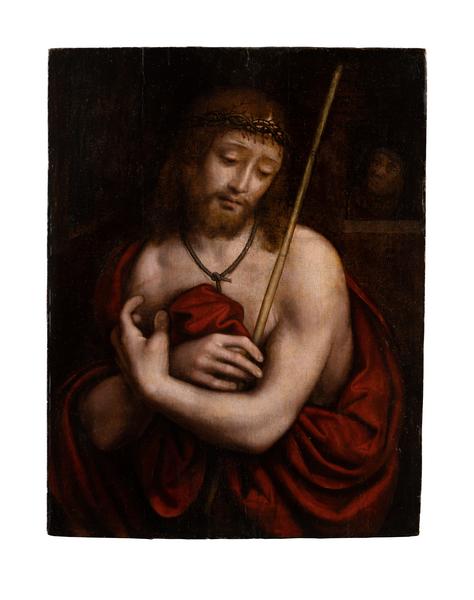
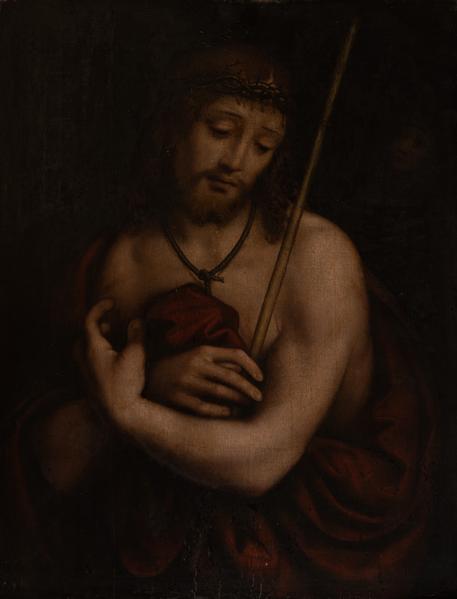
The iconographic basis of the painting from Borys Voznytskyi Lviv National Art Gallery's collection is a type of "Ecce homo" ("behold the man") that was common during the Renaissance period. It got its name from the words of Pontius Pilate, who, according to the Gospel of John (19:5), addressed the Jerusalem crowd after Christ's flagellation to arouse sympathy for Him. The event took place late in the morning on Good Friday in Jerusalem Praetorium, in the vicinity of Antonia Fortress. The phrase gained popularity and was later used to express the need for compassion. According to the iconographic type of "Ecce homo", which is included in the cycle of "The Passion of the Lord", Christ is depicted as suffering and bleeding after the flagellation. He is crowned with thorns and has a red robe draped over his shoulders. His hands are crossed and tied with a rope or chain while holding a branch, a pretended symbol of a sceptre. Paintings on this theme generally conform to one of two types of interpretations in Renaissance art: a multi-figure plot scene with Christ wearing a crown of thorns or an abandoned and lonely half-figure of Jesus. The canvas from the Gallery's collection, which is traditionally attributed to the school of Leonardo da Vinci, belongs to the second type. The intimacy and enlightenment of humble suffering are visualised by the smoothness of the semicircular line of hands and draperies transiting into the tilt of the head. The red robe, which is associated with Christ's blood, adds a tragic tone to the image. A thin sceptre, slightly tilted to the right, contrasts with numerous folds of draperies and provides the plastic perfection of the composition. In the work from the Gallery's collection, the facial expression of the suffering Jesus, which varies in the works of Renaissance artists, is full of tenderness and compassion for the sinful world. Maria's face emerging from the thick darkness adds extra semantic meaning to the work. The completeness and self-sufficiency of the composition, soft modelling of the face, beautiful torso and hands of the Saviour all indicate that the artwork belongs to the school of Leonardo da Vinci. According to the most recent research, it is believed that the work was created by Leonardo da Vinci's student – Giampetrino (Giovanni Pietro Rizzoli) – an adept of the late artistic style of the outstanding master. Giampetrino's creative style is characterised by the depiction of a figure on a dark background with no landscape, which focuses the viewers' attention on the essential. The fact that the image of Christ is most frequently found in the works of this particular student of Leonardo da Vinci also serves as evidence in favour of the attribution. There are unmistakable parallels between the Gallery's canvas and other works by the master, namely "Ecce Homo" (Pinacoteca Ambrosiana), "Carrying the Cross" (National Gallery in London and Galleria Sabauda in Turin), "Christ Crowned with Thorns" (private collection in Milan), "Sorrowful Christ" (Museum of Fine Arts in Nancy), and "Christ at the Pillar of Shame" (Sant Alessandro in Milan). Significantly, all compositions represent the same type of model – with thin facial features, rounded lips, light reddish hair, and specifically pictured curls of wavy brown hair that sometimes fall on the shoulders. The rounded form of bare shoulders as well as muscular hands modelling, particularly a hand with a thickened thumb muscle, is repeated in a number of works. A stream of scattered light falling from above and gaining intensity in key compositional places is typical of Giovanni Pietro Rizzoli's works. The work's association with Giampetrino is indicated by the distinctive arrangement of draperies and chiaroscuro faces modelling with highlighted cheekbones and shaded cheeks, as well as a colour range with a light luminescence found in many of his paintings.
Legal regulation
Borys Voznytskyi Lviv National Art Gallery