Saint Jerome
Jose de Ribera



Basic information
- ID
- Ж-3956
- Author
- Jose de Ribera
- Name
- Saint Jerome
- Date of creation
- 17th c.
- Technique
- oil painting
- Material
- canvas oil
- Dimensions (height x width, cm)
- 121 x 87.5
Additionally
- Type
- painting
- Genre
- religious
- Plot
- Saint Jerome
- Provenance
- Handed over from the collection of A. Braslawski, 1963
- Exposition
- Potocki Palace
Information about author
Object description
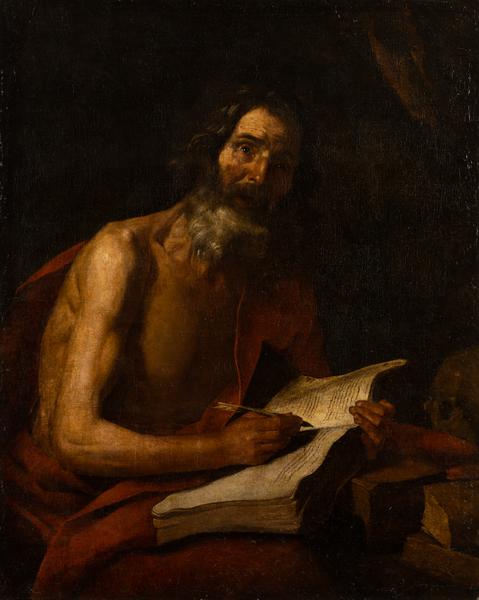
The image of St. Jerome of Stridon occupies a prominent place among Jose de Ribera's hagiographic paintings. The saint was known as a presbyter, exegete, translator of the Holy Scriptures, one of the great teachers of the Church, and the creator of the canonical text of the Bible, who spent four years in the desert near the Assyrian city of Antioch. The iconography of the saint's images is diverse. He is usually depicted as a naked, skinny, and tired penitent with a bandage on his thighs. The artists even pictured him writing a book because that is how the desert penitents were imagined. St. Jerome's attributes include a skull, a dove, stones, a clepsydra, a book, a lion or lion cub, a quill or stylus with a tablet, a church model, a camel (a symbol of endurance in work), and a trumpet (an image of the Archangel's trumpet of the Last Judgment). Jose de Ribera referred to the image of the saint more than once, particularly in the famous paintings "St. Jerome Hearing the Last Trumpet" (1626), "St. Jerome with the Angel of Judgment" (1626), and the image of St. Jerome (1644), the attribution of which requires further confirmation. The painting from the Lviv collection belongs to the widespread iconographic type "St. Jerome in his Cell", in which the saint is depicted in deep solitary reflection, holding a book and a quill, indicating erudition, and a skull and a clepsydra, symbolising the transience of earthly existence. The peculiarity of the figurative and plastic solution of the work is the spirituality and subdued inner drama of the image, reproduced by the contrast of light and shadow (chiaroscuro) and a clear outline of the figure on a black background (tenebroso). A precise rhythm and balance of light accents and deep dark tones provide the plastic integrity of the image.
Legal regulation
Borys Voznytskyi Lviv National Art Gallery