Discovery of Erichthonius
unknown (Flemish School)


Basic information
- ID
- Ж-1704
- Author
- unknown (Flemish School)
- Name
- Discovery of Erichthonius
- Date of creation
- 17th c.
- Technique
- oil painting
- Material
- canvas oil
- Dimensions (height x width, cm)
- 82 x 99
Additionally
- Type
- painting
- Genre
- mythological painting
- Provenance
- Collection of Leon Pininski
- Exposition
- Potocki Palace
Information about author
Object description
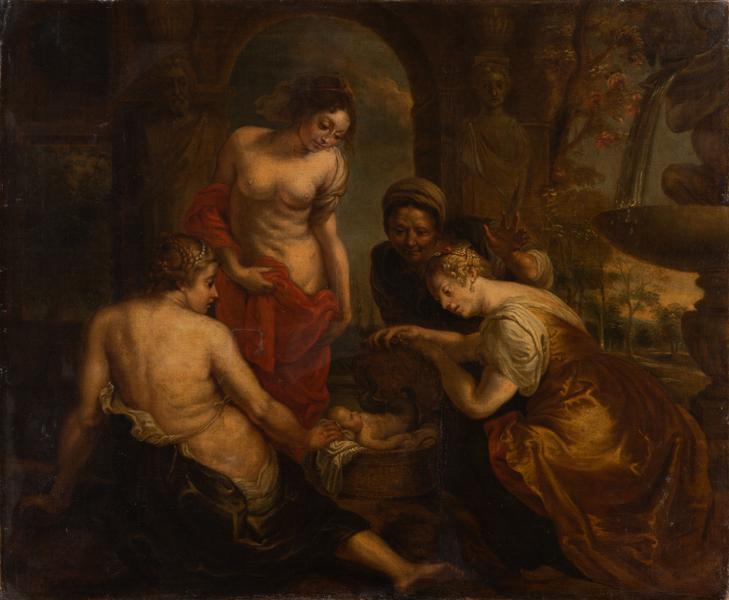
Erichthonius is a character from ancient Greek mythology, mentioned in the "Iliad" and the "Odyssey" as Erechtheus. Erichthonius was a king of Athens, born to the goddess of the Earth, Gaia, and the god of blacksmiths and craftsmen, Hephaestus. Athena concealed the infant Erichthonius in a chest and entrusted it to the care of the daughters of Cecrops – Herse, Aglaurus, and Pandrosus. Athena strictly forbade the girls from looking inside the chest because Erichthonius had a serpent-like body. However, the princesses disobeyed her and opened the chest. Aglaurus and Herse were struck with madness upon seeing Erichthonius and threw themselves from the Acropolis cliffs. Therefore, Athena raised Erichthonius in her temple. Erichthonius is often depicted as a snake-like figure alongside Athena in art and mythology. Such a scene can also be found in the works of Flemish artists Peter Paul Rubens ("The Discovery of the Infant Erichthonius") and Jacob Jordaens ("Erichthonius Discovered by the Daughters of Cecrops"). There is a version that this painting may belong to another Flemish artist, Theodoor van Thulden (1606–1669). Van Thulden created altarpieces, mythological subjects, allegorical works, and portraits. Initially, his style was influenced by the Mannerism of the Fontainebleau School, but later, he was influenced by Peter Paul Rubens, with whom he frequently collaborated. The artist played an important intermediary role, introducing aspects of Flemish Baroque painting into the Dutch Republic. Gradually, van Thulden's works became more elegant, and he evolved towards a certain Classicism.
Legal regulation
Borys Voznytskyi Lviv National Art Gallery