"The Passion of Christ" Iconostasis: The Descent from the Cross, The Entombment, Myrrh-Bearing Women at the Tomb, The Appearance of Christ to Mary Magdalene
unknown




Basic information
- ID
- Ж-4133
- Author
- unknown
- Name
- "The Passion of Christ" Iconostasis: The Descent from the Cross, The Entombment, Myrrh-Bearing Women at the Tomb, The Appearance of Christ to Mary Magdalene
- Date of creation
- early 18th c.
- Country
- Ukraine
- Culture
- Rybotytska School
- Technique
- tempera painting
- Material
- wood tempera
- Dimensions (height x width, cm)
- 108.5 x 78.5
Additionally
- Type
- icon
- Genre
- religious
- Plot
- The Passion of Christ
- Provenance
- Semenivka village, Lviv region
Information about author
Object description
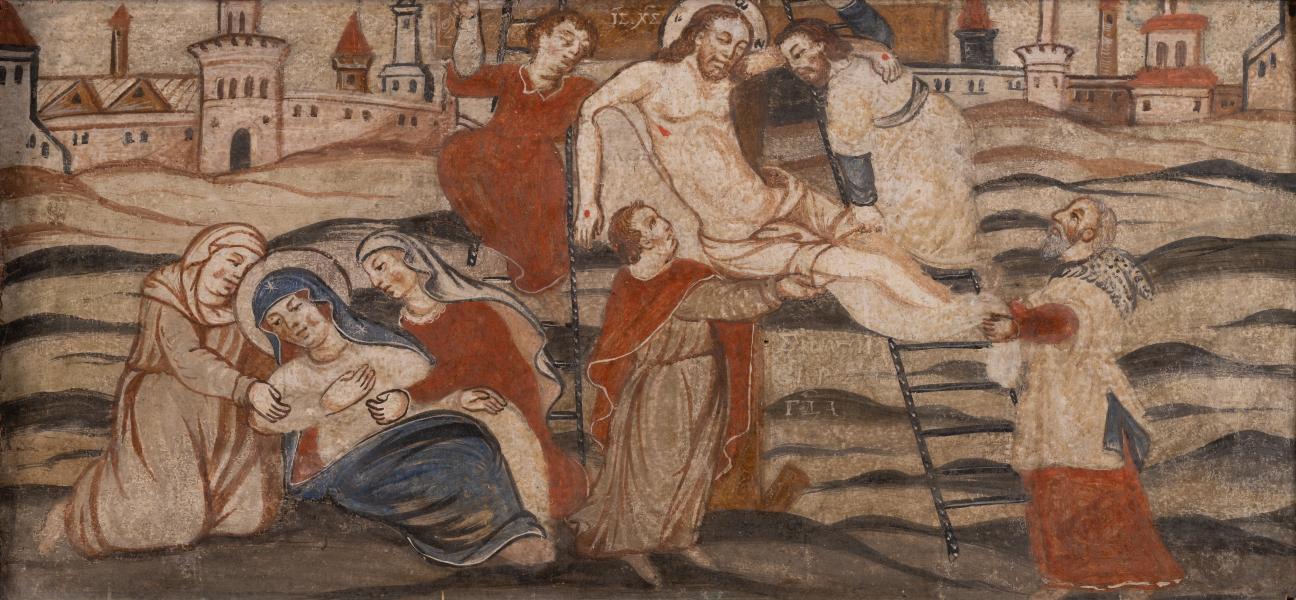
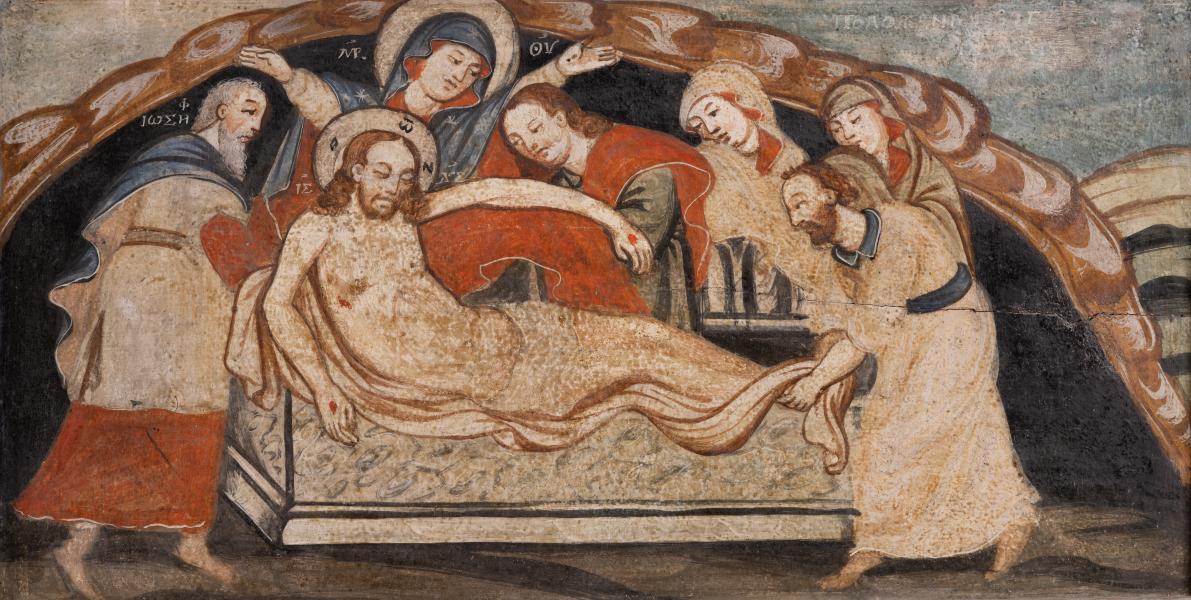
"The Passion of Christ" is an iconostasis of the 17th – early 18th century consisting of a series of monumental multi-plot icons that should be viewed from top to bottom, in rows from left to right. The work's composition is distinguished by a large number of iconographic images with multi-figure scenes: 25 horizontally elongated Gospel scenes that tell us about the last days of Christ's earthly life. The author of the work followed the traditions of the Rybotytska School of iconography, whose painters often addressed the theme of the Passion of Christ based on examples of Western European art and book engravings. The Rybotytska School painters simplified, reinterpreted, and interpreted the iconography of the canonical depictions of the Passion of Christ in their way. The four horizontal images are part of a monumental icon from the village of Semenivka and depict the events of Jesus' descent from the cross, His entombment, the myrrh-bearing women at the tomb, and the appearance of Christ to Mary Magdalene.
The iconographic plot of the Saviour being taken down from the cross takes place against the backdrop of white-walled buildings with red roofs. When creating the architectural staffage, the master was inspired by his observations. The plot composition's centre is the Saviour's image – he is being taken down from the cross, gently held. Joseph of Arimathea is supporting the dead, heavy body of Jesus. Next to it is a scene of mourning full of emotional tension: the myrrh-bearing women kneel beside the suffering Virgin Mary with their heads bowed. Despite the touching simplicity of the reproduced images, they are intensely lyric.
The scene of Jesus being laid in the tomb, borrowed from Western European iconography, takes place in an outlined oval cave. The men put the body of Christ in the coffin while the women mourn. The Virgin Mary raises her hands in despair. The rectangular cavity of the open tomb highlights the body of the Saviour, wrapped in a shroud.
One of the iconographic images dedicated to the Resurrection of Jesus is the myrrh-bearing women at Christ's tomb. When the women came to the tomb in the morning to anoint Jesus' body with incense, they saw only an empty tomb, where an angel appeared and announced the Messiah's Resurrection. The scene is depicted on a mountainous ground, with the city walls visible in the distance near a schematically recreated cave. In the foreground are three somewhat squat female figures laconically outlined. Their rounded, white faces show a blush – a characteristic feature of the Rybotytska School masters.
The fourth fragment of the icon depicts the first appearance of the Saviour after the Resurrection: "When Jesus was risen early the first day of the week, He appeared first to Mary Magdalene..." (Mark 16:9). The scene is shown on a mountainous ground with a schematic architectural staffage. The special attention to detail of the Rybotytska School masters is manifested in the reproduction of the figure of Christ in the image of a gardener – this is hinted at by the hat on His head and the shovel in the Messiah's hand.
The iconographic canonical images are richly decorated and detailed. They have a warm colour scheme with a smooth change of tone based on a combination of olive, grey-blue, and red. The scenes are distinguished by their simplicity, immediacy, and expressiveness.
The iconographic plot of the Saviour being taken down from the cross takes place against the backdrop of white-walled buildings with red roofs. When creating the architectural staffage, the master was inspired by his observations. The plot composition's centre is the Saviour's image – he is being taken down from the cross, gently held. Joseph of Arimathea is supporting the dead, heavy body of Jesus. Next to it is a scene of mourning full of emotional tension: the myrrh-bearing women kneel beside the suffering Virgin Mary with their heads bowed. Despite the touching simplicity of the reproduced images, they are intensely lyric.
The scene of Jesus being laid in the tomb, borrowed from Western European iconography, takes place in an outlined oval cave. The men put the body of Christ in the coffin while the women mourn. The Virgin Mary raises her hands in despair. The rectangular cavity of the open tomb highlights the body of the Saviour, wrapped in a shroud.
One of the iconographic images dedicated to the Resurrection of Jesus is the myrrh-bearing women at Christ's tomb. When the women came to the tomb in the morning to anoint Jesus' body with incense, they saw only an empty tomb, where an angel appeared and announced the Messiah's Resurrection. The scene is depicted on a mountainous ground, with the city walls visible in the distance near a schematically recreated cave. In the foreground are three somewhat squat female figures laconically outlined. Their rounded, white faces show a blush – a characteristic feature of the Rybotytska School masters.
The fourth fragment of the icon depicts the first appearance of the Saviour after the Resurrection: "When Jesus was risen early the first day of the week, He appeared first to Mary Magdalene..." (Mark 16:9). The scene is shown on a mountainous ground with a schematic architectural staffage. The special attention to detail of the Rybotytska School masters is manifested in the reproduction of the figure of Christ in the image of a gardener – this is hinted at by the hat on His head and the shovel in the Messiah's hand.
The iconographic canonical images are richly decorated and detailed. They have a warm colour scheme with a smooth change of tone based on a combination of olive, grey-blue, and red. The scenes are distinguished by their simplicity, immediacy, and expressiveness.
Legal regulation
Borys Voznytskyi Lviv National Art Gallery