Princess Olha
Yaroslava Muzyka


Basic information
- ID
- Рз-194
- Author
- Yaroslava Muzyka
- Name
- Princess Olha
- Date of creation
- 1967
- Country
- the USSR
- Technique
- mosaic
- Material
- smalt
- Dimensions (height x width, cm)
- 129 x 96.5
Additionally
- Type
- decorative and applied arts
- Genre
- history painting portraiture
- Plot
- Portrait
- Provenance
- Yaroslava Muzyka Fund
Information about author
Object description
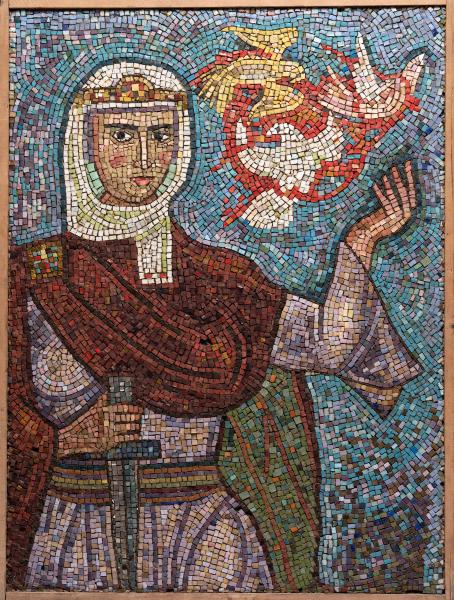
The work is a rectangular polychrome composition with a frontal half-length portrait of the Old Ruthenian Princess Olha. She is dressed in the traditional princely attire of the time: a gold tiara with a white headscarf, a white shirt with a belt and a brown cloak over it. With her right hand, the princess holds the hilt of her sword. With her left hand, she releases three doves with burning straws tied to their feet into the sky. The mosaic illustrates the well-known legend of Princess Olha's revenge on the Drevlians for the death of her husband, Ihor. From every farm in Iskorosten where Prince Ihor was killed, Olha ordered a tribute of three doves and three sparrows to be collected. Burning tinder was tied to the birds' feet. With this, the birds returned to their homes. Thus, the city was burnt.
Portrayed person
- The name of the person portrayed
- Princess Olha, the wife of Kyivan Prince Ihor, son of Rurik, and mother of Sviatoslav, was the first ruler of Rus (945–964) to officially convert to Christianity.
- Lifetime of the person portrayed
- Approx. between 880-920 – 969
Legal regulation
Borys Voznytskyi Lviv National Art Gallery