Back

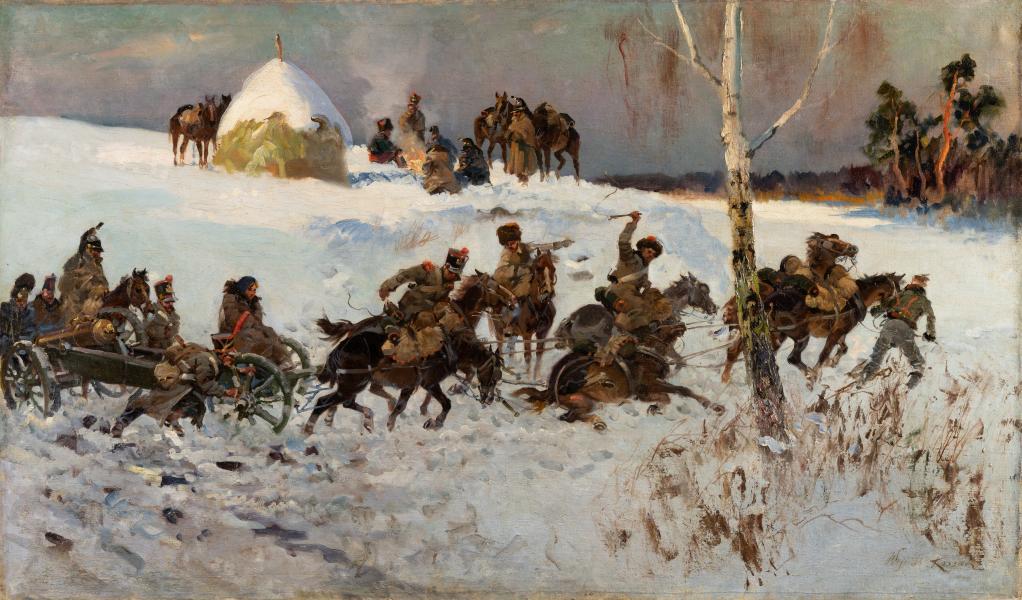
Episode of the War of 1812

Wojciech Kossak

  • Episode of the War of 1812 2
  • Episode of the War of 1812 3
Basic information
ID
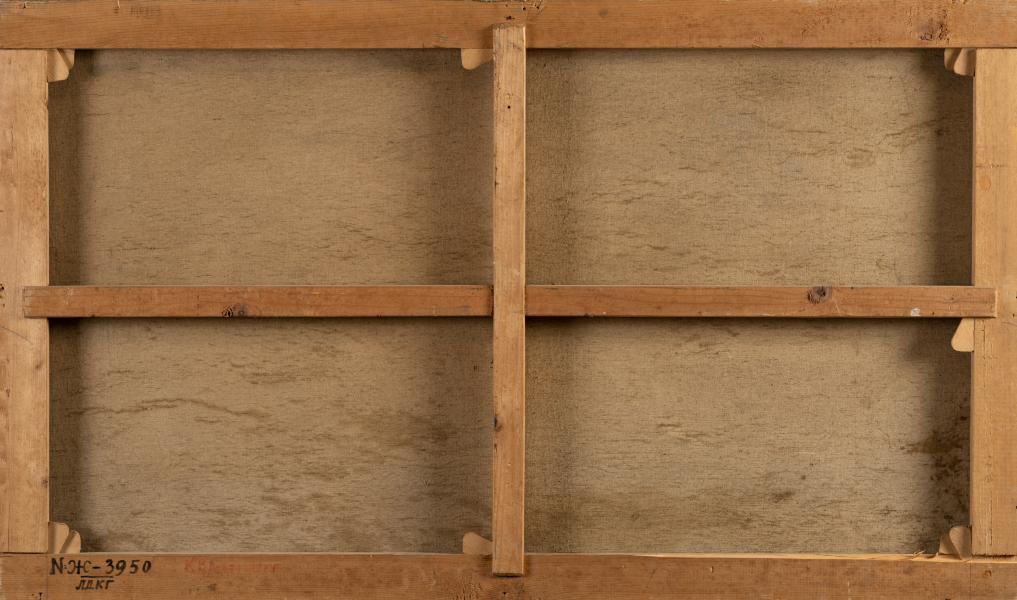
Ж-3950
Author
Wojciech Kossak
Name
Episode of the War of 1812
Date of creation
c.1896
Country
Poland
Technique
oil painting
Material
canvas oil
Dimensions (height x width, cm)
74 x 126
Additionally
Information about author
Author
Wojciech Kossak
Artist's lifetime
1856–1942
Country
Biography
Wojciech Kossak (31.12.1856, Paris – 29.07.1942, Kraków) was a Polish painter, descended from a famous family of artists and writers. His creative personality was shaped by his father Juliusz Kossak (who was his first art tutor and teacher), and later by Józef Brandt. Wojciech studied at the Drawing and Painting School in Krakow (1871–1873), under Władysław Łuszczkiewicz. From 1873 to 1875 he continued his studies at the Munich Academy of Fine Arts in the workshops of Alexander Strähuber, Alexander Wagner and Wilhelm Lindenschmit. After a year of service in the Krakow lancer regiment (1876/1877), Kossak went to Paris to complete his studies at the École des Beaux-Arts with Léon Bonnat and Alexandre Cabanel. In 1884, after his return to his homeland, he married Maria Kisielnicka and settled in Krakow on his ancestral estate, known as Kossakówka. He lived in Krakow from 1907 to 1914, where he actively participated in the city's cultural life. In 1908. Kossak founded and participated in the Zero group: its creative position was the opposite of that of the Society of Polish Artists "Art" (Sztuka). In 1909, he joined the directorate of the Society of Friends of Fine Arts (TPSP). In 1913, he became the head of the organization, a position he held until 1916. After the First World War outbreak, he was enlisted in the Austrian Army, then served as a major in the 3rd Lancer Regiment of the Polish Army until 1918. Despite his military service, he was appointed lecturer of battle painting at the Warsaw School of Fine Arts in 1915. He continued his teaching activity until 1919. After the war, he returned to Krakow but worked frequently in Warsaw, where since 1921 he rented a studio in the Bristol Hotel, where he had the necessary conditions to work on several commissions. He visited the USA several times (1920, 1927, 1928/29, 1930, 1932 and 1934), where he had a reputation as an outstanding portrait painter. He created illustrations for the popular magazines Kłosy, Tygodnik ilustrowany, Biesiada literacka, Świat and Wędrowiec. Wojciech Kossak contributed to four panoramas: 'Racławice', 'Berezyna', 'Battle of the Pyramids', and the 'Somosierra', which remain at the design stage. He was best known for his battle scenes and his depiction of the history of Polish armed struggle in wars and confrontations, elevating the patriotic spirit of the Polish people. A large collection of Wojciech Kossak's works also focus on Napoleonic themes. The artist created portraits of commanders, military weapons, cavalry and artillery attacks.
Object description
One of the sketch variants of the fragment of the panorama "Berezina" (1896), titled "Artillery Retreats". The panorama has not survived in its original form and is known only through scattered segments. In the foreground of the horizontal multi-figure composition, a snow-covered forest edge is depicted, along which six horses pull a large cannon toward the woods. Exhausted horses are ruthlessly urged on by the riders with whips. A tired woman wrapped in a fur coat sits on the gun carriage. In the background, on a low hill near a snow-covered haystack, several soldiers sit peacefully around a campfire. Nearby, the horses are resting. The background in this Gallery work (which is absent in other known variants) reduces the tension of the action and transforms the painting into an everyday scene of army life during the war. The artist subtly contrasts the foreground with the background and plays on the contrast of the states and feelings of the depicted people and animals: noise, clamour, and tranquillity; fatigue and rest; cruelty and care. The artist emphasises this difference with the colour of the snow: it is pure with sunny reflections in the background, where there is calm and silence, and grey, mixed with mud, in the foreground, where there are cries and commotion.
Inscriptions
In the bottom right is the artist's signature: "Wojciech Kossak".
Legal regulation
Borys Voznytskyi Lviv National Art Gallery