Back

Pregnant Woman

Ksawery Dunikowski

  • Pregnant Woman 2
  • Pregnant Woman 3
  • Pregnant Woman 4
  • Pregnant Woman 5
  • Pregnant Woman 6
  • Pregnant Woman 7
  • Pregnant Woman 8
Basic information
ID
С-I-640
Author
Ksawery Dunikowski
Name
Pregnant Woman
Date of creation
1906
Country
Austro-Hungarian Empire
Culture
Contemporary times
Technique
moulding
Material
plaster
Dimensions (height x width x depth, cm)
43 x 56 x 38
Information about author
Author
Ksawery Dunikowski
Artist's lifetime
1875–1964
Country
Austro-Hungarian Empire, Poland
Biography
Ksawery Dunikowski (24 November 1875, Krakow – 26 January 1964, Warsaw) was a Polish sculptor and painter. He was born in Krakow as the son of Mieczyslaw Dunikowski, a railway conductor, and Helena Jaworska, a pianist. According to one of his biographers, it was from his mother that the future artist inherited "a painfully acute sense of the world and musicality, which manifested itself in his plastic art". From Krakow, the family moved to Warsaw, where Ksawery studied at primary and technical schools. As the artist later recalled, his first romantic interest and the desire to paint a portrait of his beloved inspired him to create. At the age of sixteen, the young man went on his own to the studio of the famous Warsaw master, Boleslaw Syrewicz. Later, he was involved in the restoration of sculptures in Łazienki Park and created a number of portraits. Besides studying in B. Syrewicz's studio, he also attended Leon Wasilkowski's studio. Ksawery Dunikowski's first works, "Portrait of a Cousin" and "The Miser", show a tendency towards naturalism. From 1896 to 1903, he studied at the Krakow School of Fine Arts under Alfred Daun and Konstanty Laszczka. Impressionist inspirations are evident in the "Portrait of a Young Woman" (1898), one of the artist's earliest sculptural works. In 1902, Dunikowski held his first solo exhibition. In early 1903, a review of the sculptor's work was published in one of the authoritative Polish magazines. In 1904, K. Dunikowski visited Syria and Palestine. He travelled to Italy, where he got acquainted with Renaissance sculpture, and France, where he studied Romanesque and Gothic plastics. In 1908, K. Dunikowski joined the Sztuka Association of Polish Artists in Krakow. In 1909, he participated in the Chopin monument competition in Warsaw. In 1910, the artist returned to Krakow. In 1911, he won the second prize for his "Madonna" statue. In 1912, he became the head of the Sztuka Association. In 1912, he moved to Paris and from there – to London. At the First World War outbreak, he was in France and joined the National Legion as a volunteer. After being wounded, he returned to Paris, where he worked mainly as a portraitist in a small workshop in Montmartre. The sculptor's works of this period show the influences of Greek archaism, realism, Impressionism, and expressive decorative and stylistic elements. In 1923 (according to other sources in 1922), Ksawery Dunikowski returned to Krakow. In the second half of the 1920s, he took part in the restoration of the polychrome wooden heads in the Ambassadors' Hall of the Wawel Castle, and in four years, he created more than sixty psychologically sharp, emotionally expressive, stylised portrait sculptures. He interrupted his work for a while and resumed it at the beginning of the 1950s. In his portraits of people of different characters, he emphasised the intense work of thought and intellectual and volitional principles. He became famous in Poland as the "Master of the Wawel Heads". In June 1940, K. Dunikowski was imprisoned in the Auschwitz concentration camp. After the war, the sculptor returned to his work. Until 1955, he was a professor at the Academy of Fine Arts in Krakow, and from 1959, he taught at the State School of Fine Arts in Wroclaw. K. Dunikowski's mature and late works are stylistically diverse, from Cubist and highly expressive to Impressionist and emphatically naturalistic sculptural forms.
Object description
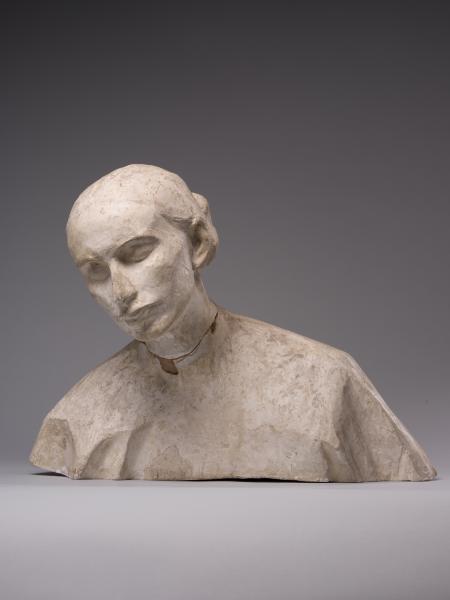
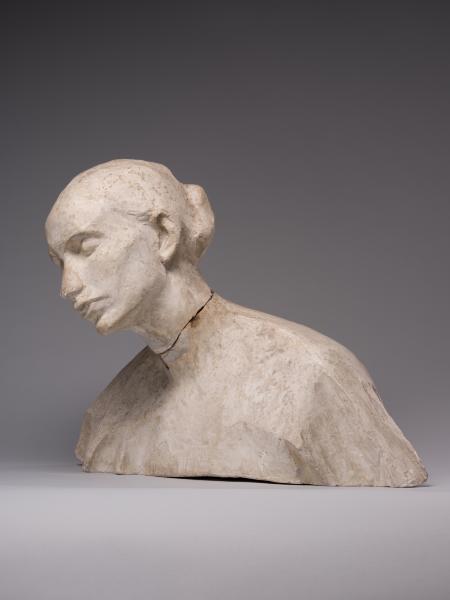
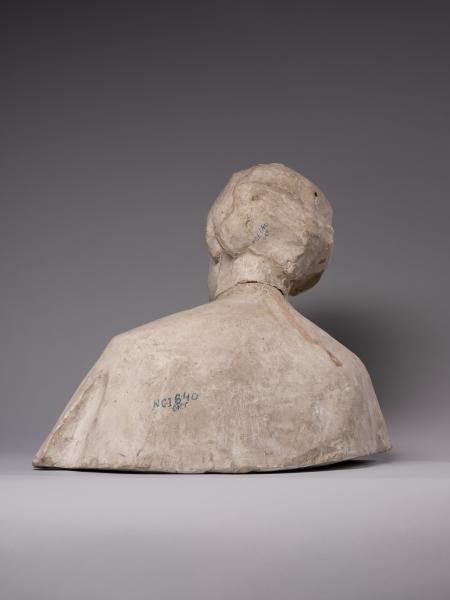
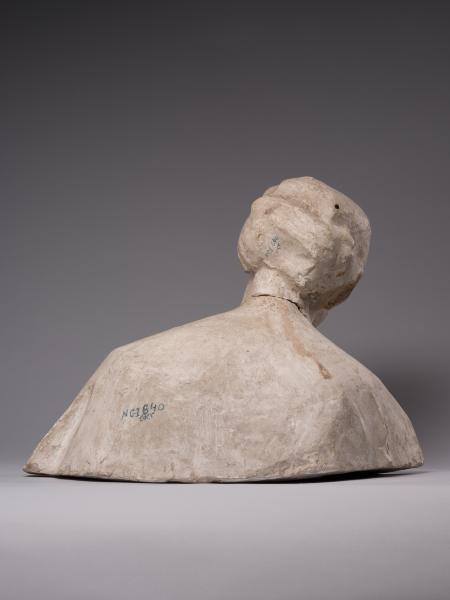
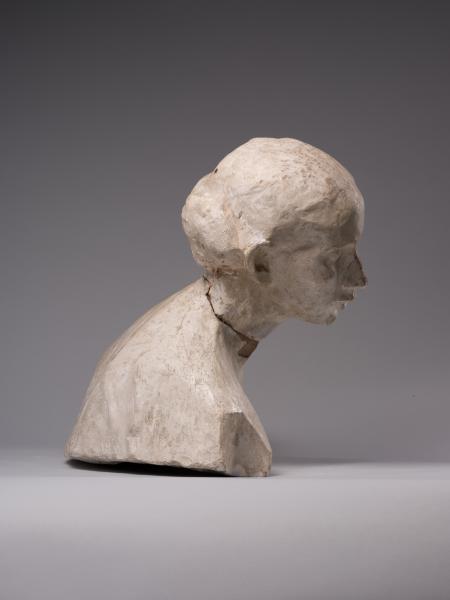
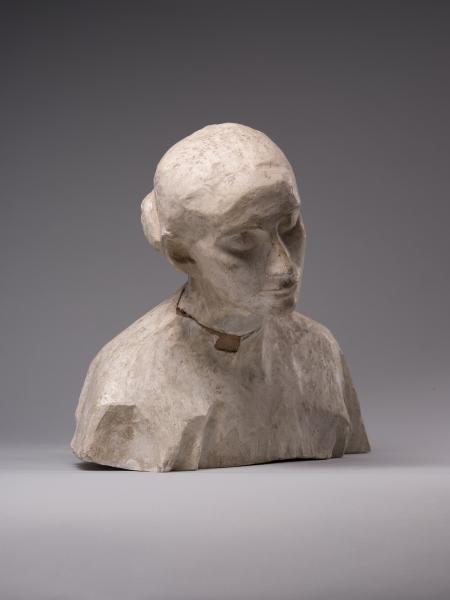
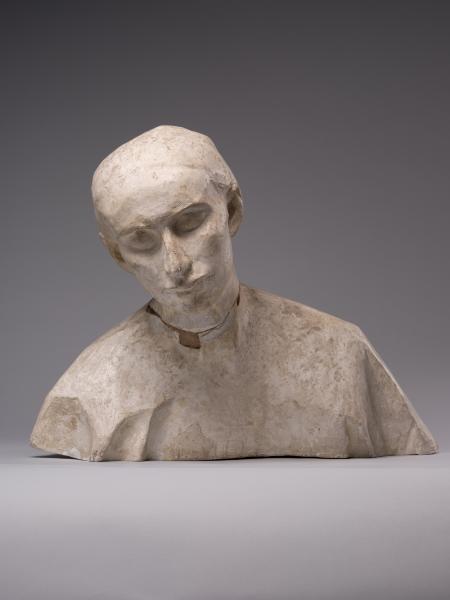
The "Pregnant Woman" bust (1906) belongs to the mature period of Ksawery Dunikowski's oeuvre – when the sculptor was recognised. At the General Exhibition of Polish Art in Lviv in 1910, the work made a great impression on the visitors and received favourable reviews in artistic and critical publications. In particular, K. Sichulski emphasised Dunikowski's desire to express deep ideas and emotions, and M. Treter published a study of the artist's creative work. The peculiarity of the sculpture lies in the ambivalence of the image, which is based on the ideas of pregnancy in traditional Slavic culture. Many people perceived it as the embodiment of fertility, apotropaic magical power and at the same time as a liminal state, close to the brink of life and death, dangerous for the woman, others, and the order of life. This belief is reflected in the semantic proximity of its definitions to the words "burden", "heaviness", "weight", "bearer" (Bulgarian: "bremenna", Polish: "brzemienna", Bulgarian, Macedonian: "teshka", Ukrainian dialectical: "tiahitna", "vazhka"). The derivations of the word from "belly" and "abdomen" (East Slavic: "cherevata") and from the root "trud" (Bulgarian: "trudna", Croatian: "trudnica") are indicative. The contradictory attitudes towards pregnant women are evidenced by the prohibition of their participation in wedding and funeral rites and everyday household activities. There was a widespread belief in the defencelessness of pregnant women against the influence of evil demonic forces. In Dunikowski's expressive work, full of tension, the difficult condition of the pregnant woman is reflected in the bending of the figure under the burden of carrying, the exhaustion of the face, the soreness of the lips and the closed, sunken eyes. Asymmetry, sharp contrasts of light and shadow, geometricisation and generalisation of forms express the artistic idea. Stylistically, the sculpture is reminiscent of the works of Ernst Barlach, which combine expressiveness with the principles of Cubist form.
Legal regulation
Borys Voznytskyi Lviv National Art Gallery