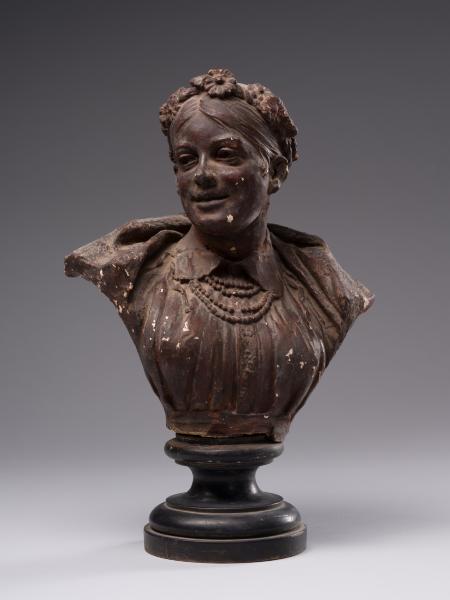
Bust of a Woman
Antoni Popiel


Basic information
- ID
- С-I-1880
- Author
- Antoni Popiel
- Name
- Bust of a Woman
- Date of creation
- 1891
- Country
- Austro-Hungarian Empire
- Culture
- Contemporary times
- Technique
- moulding polychrome
- Material
- plaster
- Dimensions (height x width x depth, cm)
- 35.4 x 23.3 x 15
Additionally
- Type
- sculpture
- Genre
- portraiture
- Plot
- Portrait bust
- Provenance
- Purchased from a private individual
Information about author
Object description
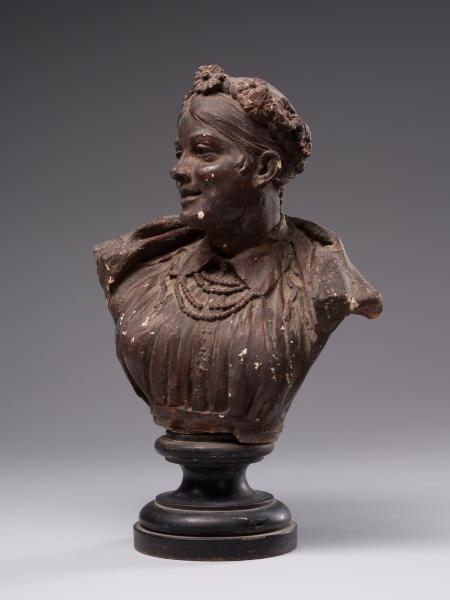
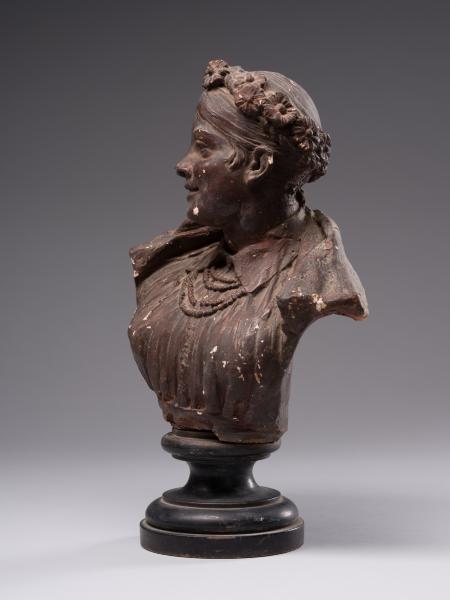
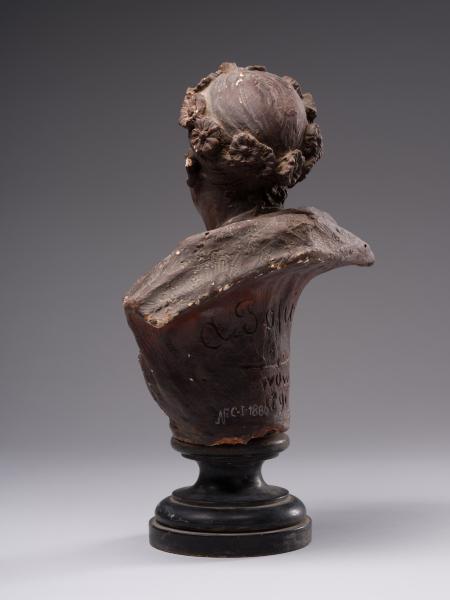
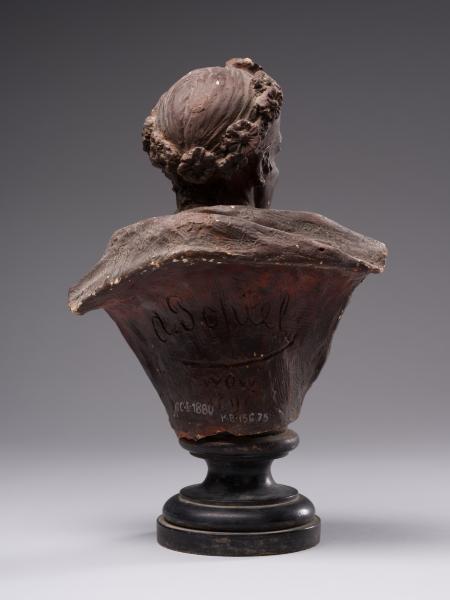
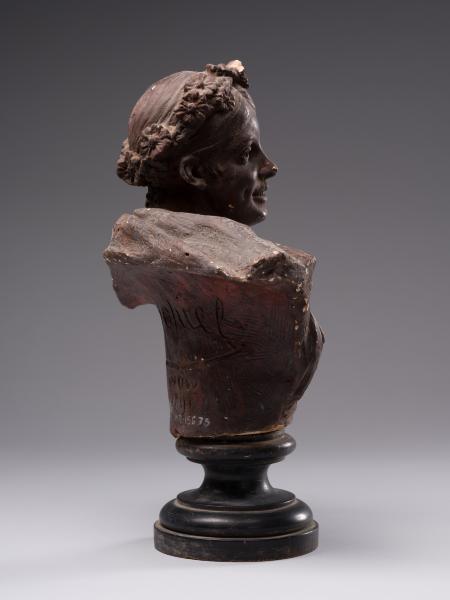
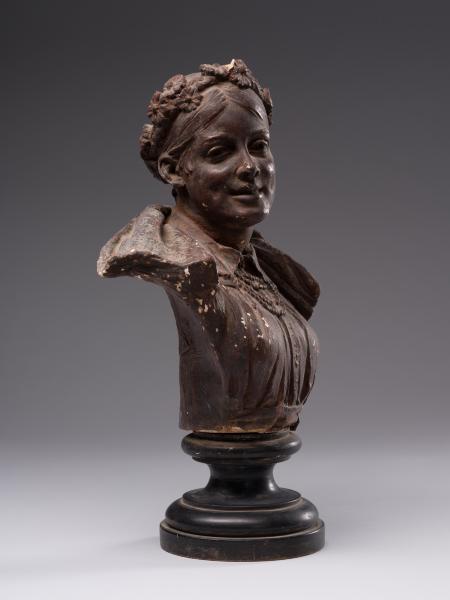
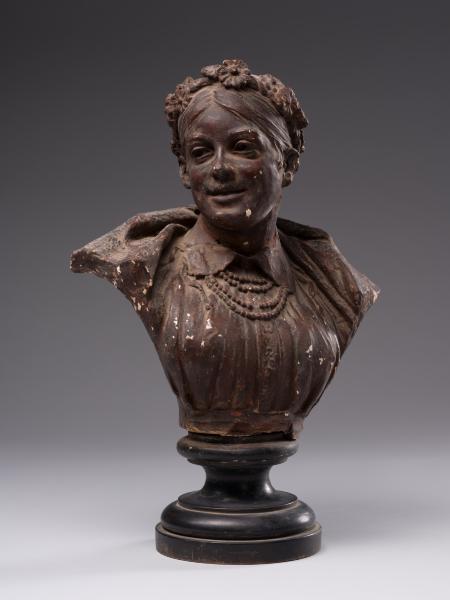
The figurative solution of the "Bust of a Woman" (1891) was inspired by the Romantic idea of renewing culture by turning to folk sources and the aestheticisation of the folk, its perception as a fascinating artistic theme in the art of the turn of the 19th and 20th centuries. The development of ethnography, especially its Lviv community, contributed to the birth of interest in folk life, where the first ethnological centre for studying the ethnic culture of the western regions was founded with the participation of prominent scholars and cultural figures – Kh. Vovk, V. Hnatiuk, M. Hrushevskyi, F. Kolessa, Z. Kuzela, D. Lepkyi and Ivan Franko – and the "Ethnographic Collection" publication began. In the 1860s, Polish researcher O. Kolberg systematically collected ethnographic material from Ukrainian territory. At the end of the nineteenth century, the development of the "Zakopane style" and the customary artists' trips to the village of Zakopane near Krakow contributed to the interest in folk themes. A. Popiel's "Bust of a Woman" is full of lively ethnographic interest in the reproduction of the female folk type and the regional folk system. The picture is characterised by a generalised reflection of an abstract state of happiness and characteristic folk anthropological features. The careful reproduction of the wreath, necklace and other details of folk symbols determines the task of embodying the folk type. Despite its schematic nature, the bust is full of expression, which can be seen in the active, expressive silhouette, the head turning, and the outfit's modelling. The work is probably paired with the "Bust of a Man" (1891). It resonates with other works of folk themes in Lviv sculpture of the turn of the nineteenth and twentieth centuries, in particular by T. Baracz ("Bust of a Peasant", 1879), W. Brzega ("A Man from Verkhovyna", 1901), K. Laszczka ("Bust of a Man from Verkhovyna", 1900), and M. Tarczynowski ("Bust of an Older Man", 1888). The interest in the folk theme in painting can be seen in the works by W. Wodzinowski, A. Grottger, A. Jegerski, A. Kozakiewicz, K. Pochwalski, W. Tetmajer, and W. Szymanowski.
Inscriptions
Signed and dated on the back: "A. Popiel / Lwów 1891".
Legal regulation
Borys Voznytskyi Lviv National Art Gallery