Back

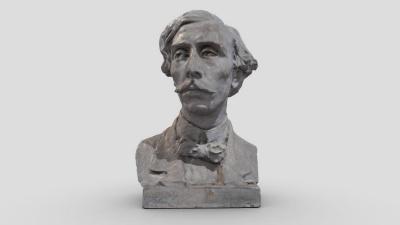
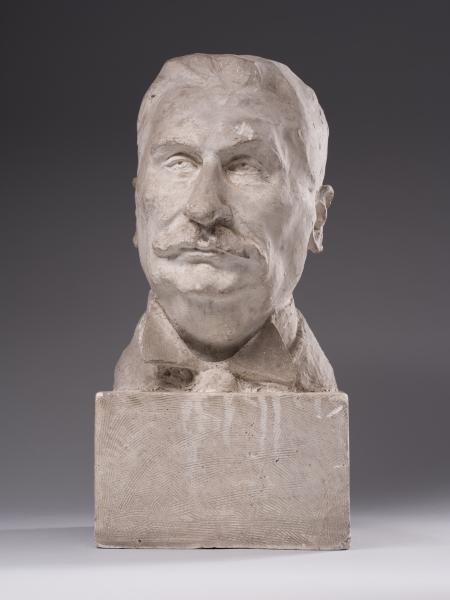
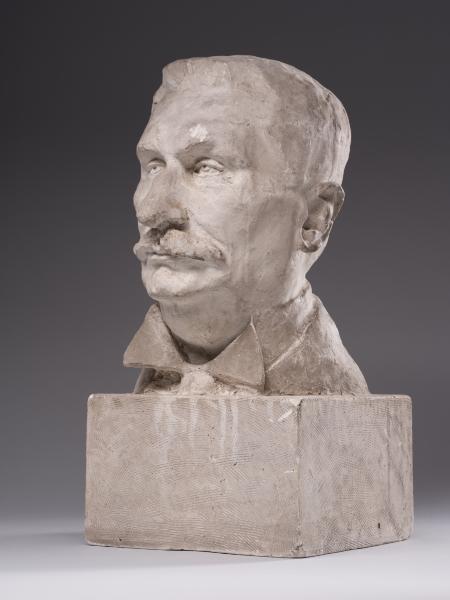
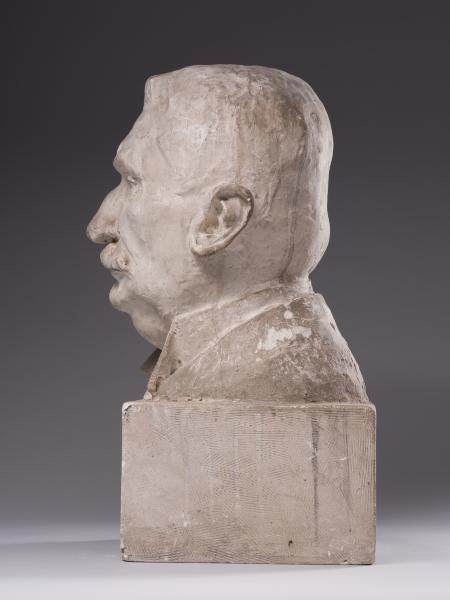
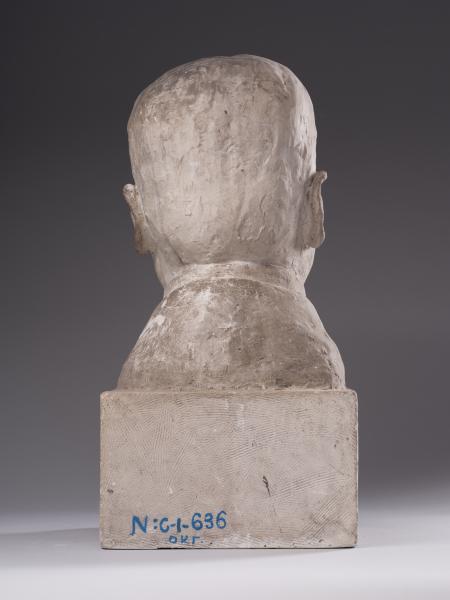
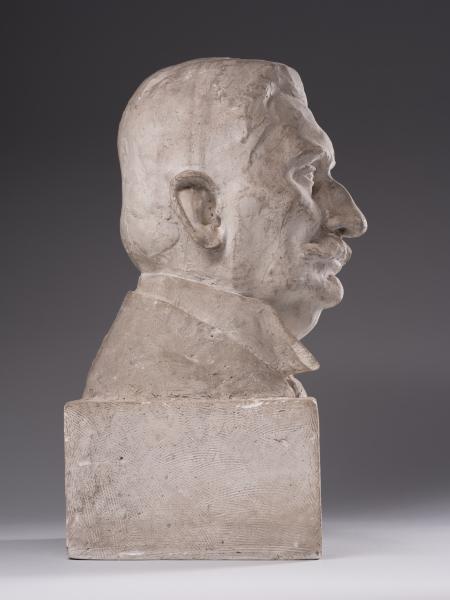
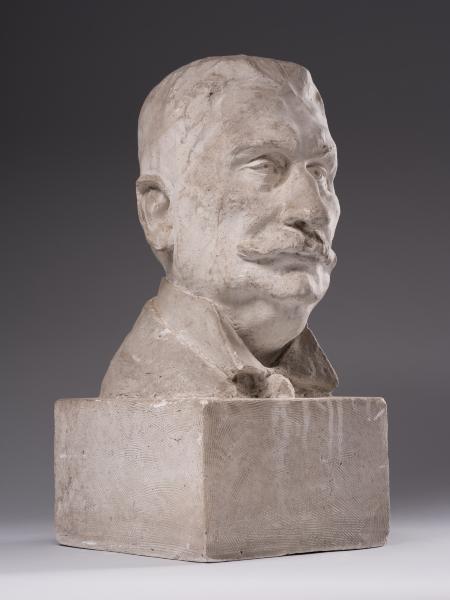
Head of Mr. L. (Zygmunt Lesniewicz /?/)

Kazimiera Malaczynska-Pajzderska

  • Head of Mr. L. (Zygmunt Lesniewicz /?/) 2
  • Head of Mr. L. (Zygmunt Lesniewicz /?/) 3
  • Head of Mr. L. (Zygmunt Lesniewicz /?/) 4
  • Head of Mr. L. (Zygmunt Lesniewicz /?/) 5
  • Head of Mr. L. (Zygmunt Lesniewicz /?/) 6
  • Head of Mr. L. (Zygmunt Lesniewicz /?/) 7
Basic information
ID
С-I-636
Author
Kazimiera Malaczynska-Pajzderska
Name
Head of Mr. L. (Zygmunt Lesniewicz /?/)
Date of creation
1909 (?), according to other sources – c.1911
Country
Austro-Hungarian Empire
Culture
Contemporary times
Technique
moulding
Material
plaster
Dimensions (height x width x depth, cm)
47 x 24 x 29
Information about author
Author
Kazimiera Malaczynska-Pajzderska
Artist's lifetime
1879–1959
Country
Austro-Hungarian Empire, Poland
Biography
Kazimiera Malaczynska-Pajzderska (4 March 1879, Buchach, now Ternopil region – 12 April 1959, Poznan, Poland) was a sculptor and painter, one of Lviv's most prominent representatives of women's art. The artist was born in Buchach to the Hellersperg-Heller family. In 1897 (according to other sources in 1903), she married Marian Antoni Malaczynski. The artist began her studies in 1898–1900 at the Public Drawing and Sculpture Hall of the Lviv Art and Industrial School and continued them in 1901–1905 with S.-K. Ostrowski and A. Popiel at the private school of S. Batowski, A. Augustynowicz and O. Reichan. In 1906 and 1908–1910 (1906–1913, according to other sources), Kazimiera Malaczynska-Pajzderska studied in Paris at the then popular Académie de Colarossi and the Académie des Grandes Chaumières under Antoine Bourdelle and Felix Charpentier. In 1911 (1913, according to other sources), she married, for a second time in Paris, to the art historian Nicodemus Pajzderski. Until 1913 she signed her works as "K. Małaczyńska" or "K. Heller-Małaczyńska".
Her studies in the artistic centres of Europe led her to experiment with forms, inspired by the Impressionism of Auguste Rodin and the work of Antoine Bourdelle, based on an understanding of the ancient heritage. In 1909, she debuted at exhibitions in Lviv with portraits of Lviv President Tadeusz Rutowski, the Polish modernist poet Jan Kasprowicz, the writer Mariia Levytska and other vigorously modelled sculptures. In 1910, she exhibited a portrait of Adamo Didur as Mephistopheles and the composition "Orphans" at the Paris Salon. In the same year, three plaster sculptures by Kazimiera Malaczynska-Pajzderska were exhibited at the General Exhibition of Polish Art in Lviv: a sketch "Orphans", "Male Torso" (probably a portrait of the painter Tadeusz Pruszkowski), and "Young Man Thinking" (1910). At the Autumn Exhibition in Lviv, eight of the sculptor's works were exhibited, including "Bust of Dobrusia Lesnevych", a portrait of the actor Adamo Didur as Mephistopheles, and "Bust of the philosopher Kazimierz Twardowski" (1911). At the exhibitions in Lviv in 1911, Kazimiera Malachynska-Paizderska presented a bust of Wladyslaw Mickiewicz (1911), a portrait of Marusia Horetska of the Mickiewicz Family (1911), a bust of Helena Bielska (1911), and a portrait of the singer Fernandez (1911). Before leaving Lviv for Poznan in December-January 1912–1913, she exhibited two plaster sculptures, "Portrait of Wladyslaw Witwicki" and "Portrait of Mrs P.". The artist's participation in exhibitions at the Zacheta Gallery in Warsaw (1912) and at the Society of Friends of Fine Arts in Poznan (1915) was successful.
The artist is known for her sculptural portraits – female, lyrical, and male, with the expression of intellectual, creative, strong-willed nature. A sign of her individual style was psychologism, the reproduction of changing moods, behind which one can see the essential, impressionist pictorial form, asymmetry of compositions, expressive movement, impulsive, almost painterly surface treatment, echoes of the Secession, modernised classics and the archaic. Plaster, marble, and bronze embodied creative ideas, and the artist created dozens of works, primarily heads, torsos, and busts.
In the works by Kazimiera Malaczynska-Pajzderska, made between 1908–1912, the maturity of her creative style, the accuracy of psychological features and the authenticity of the reproduction of individual characteristics attract attention. The play of light and shade and the sculpture's connection with the environment are ensured by the "painterly" contours, the indistinct linearity, and the natural inclination of the heads. In addition to portraits and three-dimensional compositions, the artist created several reliefs between 1908 and 1913.
In the field of painting, Kazimiera Malaczynska-Pajzderska created oil portraits, floral still lifes, and landscapes of Lviv, Volyn and Italy, influenced by Impressionism.
From 1913, the artist worked mainly in the portrait genre in Poznan. The medal of the General Regional Exhibition of 1929 and the figurative bas-reliefs on the monument to the Sacred Heart of Jesus Christ (1932, 1939) belong to this period.
Object description
According to the attribution in Yurii Biriuliov's monograph "Lviv Sculpture from Early Classicism to Avant-Garde (Mid-Eighteenth to Mid-Twentieth Centuries)" (2015), "Portrait of Zygmunt Lesniewicz" was created in Lviv in 1909 and exhibited at the same time at the debut exhibitions of Kazimiera Malaczynska-Pajzderska, along with thirteen other vigorously modelled sculptures. According to Ihor Khomyn ("Polish and Polish-Related Sculpture of the Nineteenth and Twentieth Centuries in Borys Voznytskyi Lviv National Art Gallery. Catalogue of the Collection", 2020), the work dates from around 1911. According to the Biographical Encyclopaedia by Marek Jerzy Minakowski, compiled from obituaries in Polish newspapers, it is probably a portrait of Zygmunt Lesniewicz (1850–1913), a member of the noble family of the Polkozic coat of arms, a count, a marshal of the nobility, and the owner of Welyka Slobidka (Wielka Muksza). Figuratively, the portrait embodies family dignity, noble restraint, and the principle of noblesse oblige. The plastic characteristics of the work are a static and simplified form in the spirit of modernised classicism, which contrasts with the Impressionist and Secessionist tendencies in the artist's work between 1906 and 1911. The symmetry and closeness of the contours, the straight lines of the necktie and the proud, expressive profile, reminiscent of the minting of Roman coins, give the sculpture a classicist perfection. The clear modelling of the face and the play of light and shadow are the means of figurative expression.
Inscriptions
Signed on the back left: "K. Małaczyńska".
Portrayed person
The name of the person portrayed
Zygmunt Lesniewicz (?)
Lifetime of the person portrayed
1850–1913 (?)
Legal regulation
Borys Voznytskyi Lviv National Art Gallery