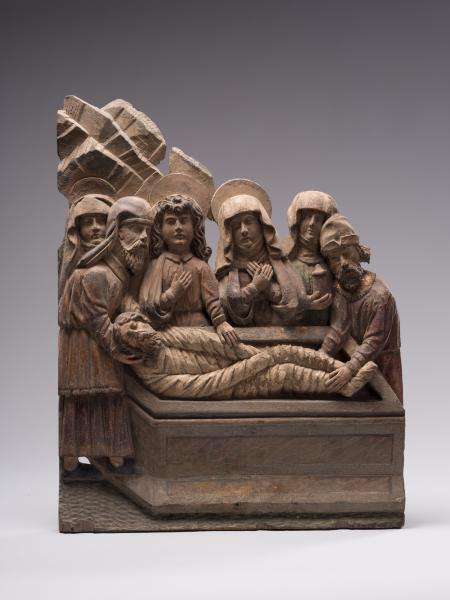
Entombment of Christ
unknown (South Austrian School)


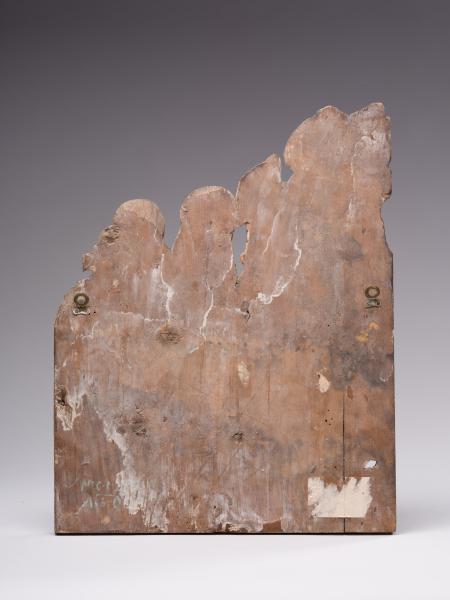
Basic information
- ID
- С-I-237
- Author
- unknown (South Austrian School)
- Name
- Entombment of Christ
- Date of creation
- 16th c.
- Country
- Austria
- Culture
- Late Renaissance
- Technique
- carving
- Material
- wood
- Dimensions (height x width, cm)
- 44 x 35
Additionally
- Type
- sculpture sculpture (relief)
- Genre
- religious
- Plot
- Entombment of Christ
- Provenance
- Collection of Leon Pininski
Information about author
Object description
The composition recreates the biblical story of the "Entombment of Christ". The episode belongs to the Passion of Christ. According to Christian doctrine, after the burial of Christ's body, his soul descended into hell to defeat death and save the righteous of the Old Testament. The burial occurred in the evening, but the Sabbath had not yet come, so it was an hour or two before sunset. All four Evangelists indicate this: Matthew 27:57, Mark 15:42, Luke 23:54 and John 19:42. According to the text of the Gospels, Joseph of Arimathea, a member of the Sanhedrin, a secret disciple of Christ who did not participate in the condemnation of the Lord (Luke 23:51), came to Pilate and asked him to bury the body of Jesus. Pilate was surprised that Jesus was already dead since the crucified were sometimes hung for several days. Still, after checking with the centurion who had testified to his death, he ordered the body to be given to Joseph. Joseph bought a shroud, a long and precious cloth. They took the body, anointed it with spices, wrapped it in the shroud and laid it in a new tomb in Joseph's garden, not far from Calvary. As the sun was already setting, everything was done with great haste, though with great care. After placing the stone on the door of the tomb, they left. The women who had once stood on Calvary watched all this. St. John Chrysostom, followed by St. Theophylact, believed that the "Mary, mother of James and Joseph" mentioned by the Evangelists was the Most Holy Mother of God, "since James and Joseph were the children of Joseph by his first wife. And since the Mother of God was called Joseph's wife, she was rightly called the mother, that is, the stepmother, of his children". However, there is an opinion that it was Mary, the wife of Cleopas, the cousin of the Mother of God. They all sat at the entrance to the cave, as St. Matthew says (Matthew 27:61). Then, according to St. Luke, they returned and prepared incense and myrrh so that after the Sabbath they could come and anoint the body of the Lord according to Jewish custom (Luke 23:56). According to St. Mark, these women, called "Myrrhbearers" bought the fragrances not on the day of the Lord's burial but after the Sabbath, that is, on Saturday evening. According to the Gospel story, the burial of Jesus was attended by the secret disciples of Christ – Joseph of Arimathea, who bought the shroud; Nicodemus, a Pharisee, one of the "leaders of the Jews" who brought a mixture of myrrh and aloe to anoint the body of the Saviour; Mary Magdalene; Mary, presumably the Virgin Mary, or the wife of Cleopas, the sister of the Mother of God. The composition is static, in line with traditional iconography. The influence of Renaissance form-making is noticeable in a certain variety of gestures and the vitality of the faces.
Legal regulation
Borys Voznytskyi Lviv National Art Gallery