In Lavrov
Margit Selska (Reich)


Basic information
- ID
- Ж-5320
- Author
- Margit Selska (Reich)
- Name
- In Lavrov
- Date of creation
- 1975
- Country
- the Ukrainian SSR
- Culture
- Contemporary times
- Technique
- oil painting
- Material
- canvas oil
- Dimensions (height x width, cm)
- 68 x 48.3
Additionally
- Type
- painting
- Genre
- landscape
- Plot
- Landscape
- Provenance
- Handed over by the Exhibition Directorate of the Union of Artists of Ukraine
Information about author
Object description
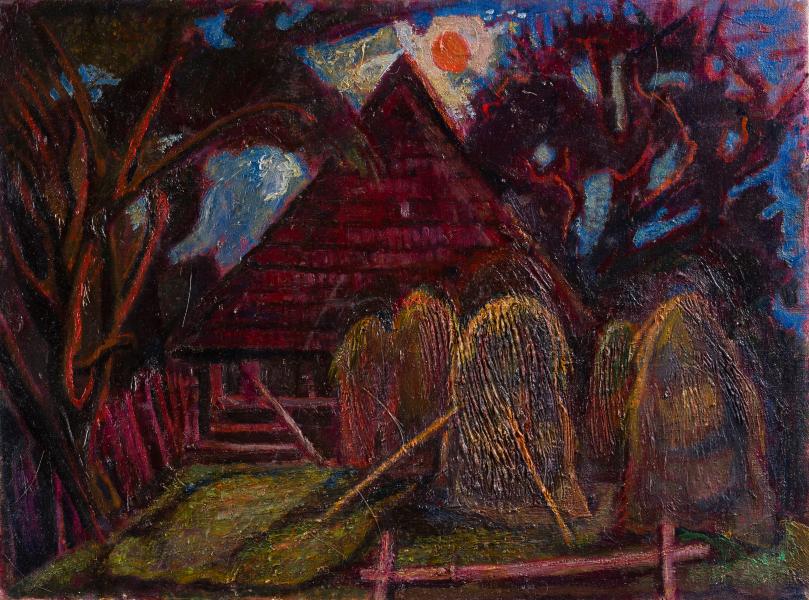
A significant body of M. Selska's work was formed by landscapes that combined subtle mood with the generalisation of empirically available natural forms in the modernist paradigm. A prominent place among them was occupied by the post-Impressionistic ones, characterised by manifesting the fundamental meanings of life through impasto painting on the valuable pictorial surface. The peculiarity of M. Selska's landscape works was the post-Impressionist visualisation of the constant, the perception of mythologies, archetypes, symbols of the folk myth-folklore tradition and the creation of valuable "ideal versions of life" based on the reflection of the whole in the partial. The concept is most fully embodied in the compositionally balanced, closed, decorative, rational, and structural, with conventionally interpreted space and images of peasant farmsteads. Diverse in their artistic solutions, they reflect the axiosphere of folk culture, the idea of the home as a model of the world that acts energetically at a distance, mentally, and accompanies a person throughout their life. Among them – the landscape "In Lavrov", created in the village of Staryi Sambir, Lviv region – the birthplace of the famous Lviv artist K. Zvirynskyi and, according to the legend, the burial place of the son of Danylo Halytskyi Lev Danylovych, after whom the city of Lviv is named. The peculiarity of the landscape is the creation of a harmonious microcosm imbued with a lyrical mood by means of post-Impressionist artistic expression – with an old hut in the honey evening, near a sloping fence, among chimneys and old trees. The "semantic basic text" of the painting, which links it to the semantics of folk culture, is formed by the semantics of the tree – associated with the World Tree, its blossoming or decay – and the stacks, fence and gates – boundary signs of the natural and human-ordered, cultivated world. An essential role in the figurative structure of the painting is played by the spiritualised image of the house – a secret witness of the times. The evocative and moody component of the picture is the setting sun, which consolidates the colour structure of the canvas with a single tone and emphasises it with warm accents. The lyrical and nostalgic mood is created by the colour scheme based on the harmony of rich, deep browns, ochres, blues, oranges, and warm greens.
Inscriptions
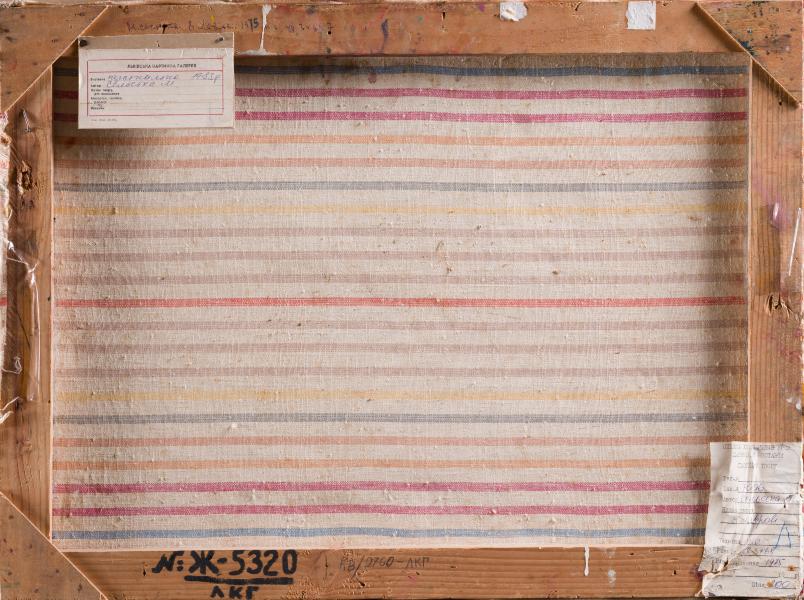
On the back, at the top, is an inscription: "M. Selska 'In Lavrov'", 1975".
Legal regulation
Borys Voznytskyi Lviv National Art Gallery