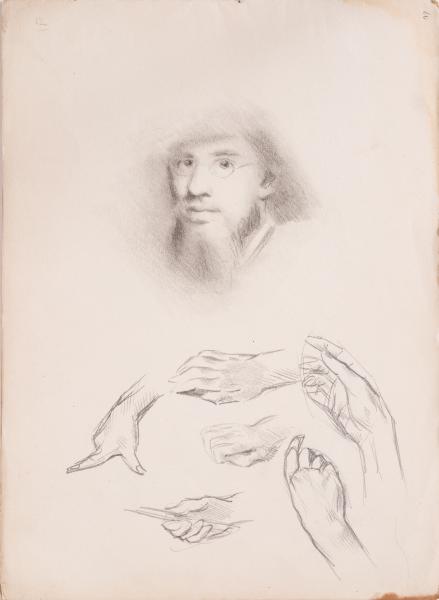
Drawing of a Man's Head Wearing Glasses and Hand Sketches
Yulian Zaiats


Basic information
- ID
- Ф-З-Арх-ЛГМ-5/7
- Author
- Yulian Zaiats
- Name
- Drawing of a Man's Head Wearing Glasses and Hand Sketches
- Date of creation
- 1910s (?)
- Country
- German Empire (?)
- Technique
- drawing
- Material
- paper charcoal pencil
- Dimensions (height x width, cm)
- 29.9 x 21.8
Additionally
- Type
- graphic art
- Genre
- portraiture
- Plot
- Portrait
- Provenance
- Received from Nina Zaiats
Information about author
Object description
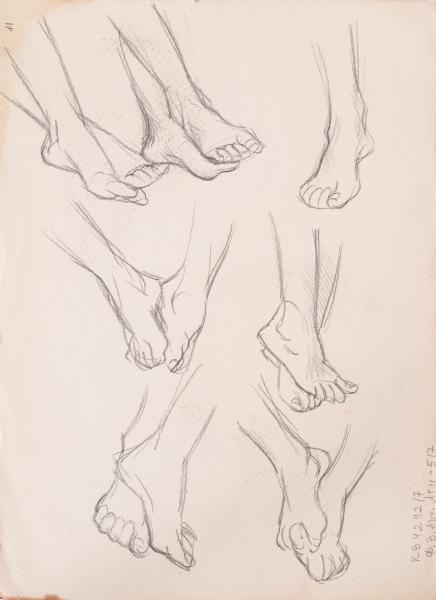
On the sheet, there is a graphic portrait of a young man with glasses and a medium-length beard. The work is done in pencil and charcoal. The bust-length depiction is shown in a three-quarter turn, with an emphasis on the attentive, focused gaze directed at the viewer. The restrained facial expression, which nevertheless has a certain softness, the accuracy in proportions, and the characteristic rounded shape of the glasses, testify to an individualised approach to the work. The light and soft tonal modelling of the face, both in general and in detail, attracts attention with its plasticity, as well as the realistic rendering of the glasses and the structure of the beard, which emphasises careful observation of the model. Overall, the light and shadow construction is soft and restrained, with smooth transitions that form the outline of the face. The hatching follows the anatomical structure of the head, modelling the cheeks, bridge of the nose, cheekbones, and forehead. The hair, moustache, and beard are rendered recognizably, using short, more active strokes that contrast with the smoother tone of the face. Taken together, this demonstrates technical skill and confident mastery of the medium. Below the portrait is a series of training sketches of hands in various angles and positions, as well as an elongated object resembling a stick or a staff. It should be noted that such exercises were traditionally part of academic training, as studying the structure of the hand requires precise movement, a sense of spatial construction, and a keen sense of detail. The sketches are notable for their conciseness and clear contours, with a slight tonal accent on the folds and shadow areas. The images on the front of the sheet combine portrait study and anatomical exercises, representing a holistic approach to drawing: from observing the model to studying the details. The compositional logic, technical perfection, and accurate rendering of the model's psychological traits attest to a mature level of artistic training and likely date from the first third of the 20th century. On the reverse side of the sheet, a series of seven graphic studies of the lower legs is presented, executed in the tradition of academic drawing, likely using pencil or charcoal. The work is of an educational or research nature, focusing on the study of the structure of the lower leg, ankle, and foot, as well as their interaction in various positions. Compositionally, the studies are arranged according to the rhythm of the sheet. Particular attention is paid to the reproduction of light movement. The hatching is mostly linear, with minimal modelling of shadows in the curves of the muscles and under the foot. The contours are confident, plastic, and sometimes accentuated at the anatomical transitions. The author's desire to not only reproduce the external form, but also to comprehend the volume is evident. This series of exercises serves as a model of study, demonstrating thorough preparation, a focus on the plastic analysis of form, and mastery of the human body, from details to the whole figure.
Legal regulation
Borys Voznytskyi Lviv National Art Gallery