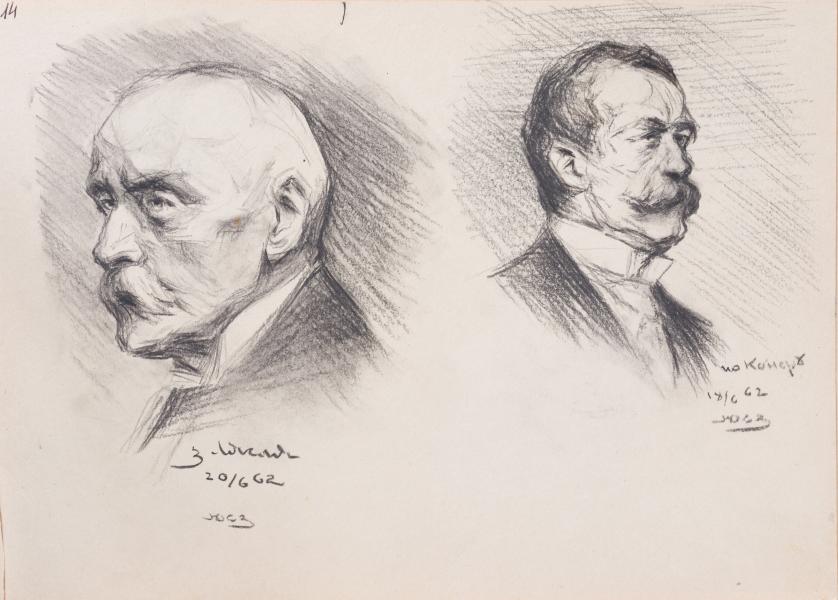
Portrait Drawings of Two Men
Yulian Zaiats


Basic information
- ID
- Ф-З-Арх-ЛГМ-7/14
- Author
- Yulian Zaiats
- Name
- Portrait Drawings of Two Men
- Date of creation
- 13.06.1962–14.06.1962
- Country
- the Ukrainian SSR
- Technique
- drawing
- Material
- paper pencil
- Dimensions (height x width, cm)
- 20.4 x 28.5
Additionally
- Type
- graphic art
- Genre
- portraiture
- Provenance
- Received from Nina Zaiats
Information about author
Object description
The research drawing, based on the works of artists Liasl (?) and Koner (?), represents a careful study of male portrait types characteristic of European academic painting in the second half of the 19th century. The sheet depicts two men, both in bust-length format with perspectives close to profile, allowing the viewer to focus on the character of the facial lines, the shape of the skull, hairstyles, moustaches, facial expressions, clothing and overall silhouette. The first portrait belongs to the mature male type. The elderly man depicted has distinctive age-related features: thinning grey hair with receding hairline, carefully trimmed moustache, serious face with regular geometry. His attire – a classic suit with a collar – emphasises his social affiliation with the educated bureaucracy or academic intelligentsia. His gaze is directed slightly to the side, and his emotional state is balanced, even restrained, which corresponds to the style of official portraits of that time. The artist reproduces the anatomical structure of the face in detail, paying particular attention to the nose, cheekbones, shape of the ears and position of the eyes. The second character is a middle-aged man with thick dark hair, a lush hairstyle and a luxurious moustache. The image contains elements of enhanced representational character: a tailcoat, a white shirt with a high stand-up collar, which was popular in men's fashion in the late 19th and early 20th centuries. The contours of the face are soft but clearly defined; the shape of the nose, forehead and chin is free of grotesqueness, with the artist giving preference to typological accuracy. Both portraits are executed in a restrained academic manner with a moderate chiaroscuro model, a good knowledge of anatomy, and a delicate rendering of age characteristics. These drawings are likely part of a larger research cycle, copies made by the author for deeper study of the European portrait tradition. They likely served as preparatory material for further artistic exploration and original works by the artist himself. Such a practice of copying from the works of masters of previous eras was a common method. This graphic work demonstrates not only loyalty to the sources, but also an attempt to interpret them in his own way: the author does not mechanically reproduce portraits, but rather consciously focuses on the key features of each image, constructing a visual study that combines the academic school of drawing with a deep interest in the socio-historical context.
Inscriptions
From left to right: inscriptions: "From Liasl"; "20/6 62"; Yulian Zaiats' signature; "After Koner (?)"; "158/6 62"; Yulian Zaiats' signature.
Legal regulation
Borys Voznytskyi Lviv National Art Gallery