Drawings of Two Male Heads
Yulian Zaiats


Basic information
- ID
- Ф-З-Арх-ЛГМ-8/5
- Author
- Yulian Zaiats
- Name
- Drawings of Two Male Heads
- Date of creation
- 26.11.1962–28.11.1962
- Country
- the Ukrainian SSR
- Technique
- drawing
- Material
- paper pencil
- Dimensions (height x width, cm)
- 20.3 x 28.6
Additionally
- Type
- graphic art
- Genre
- portraiture
- Plot
- Portrait
- Provenance
- Received from Nina Zaiats
Information about author
Object description
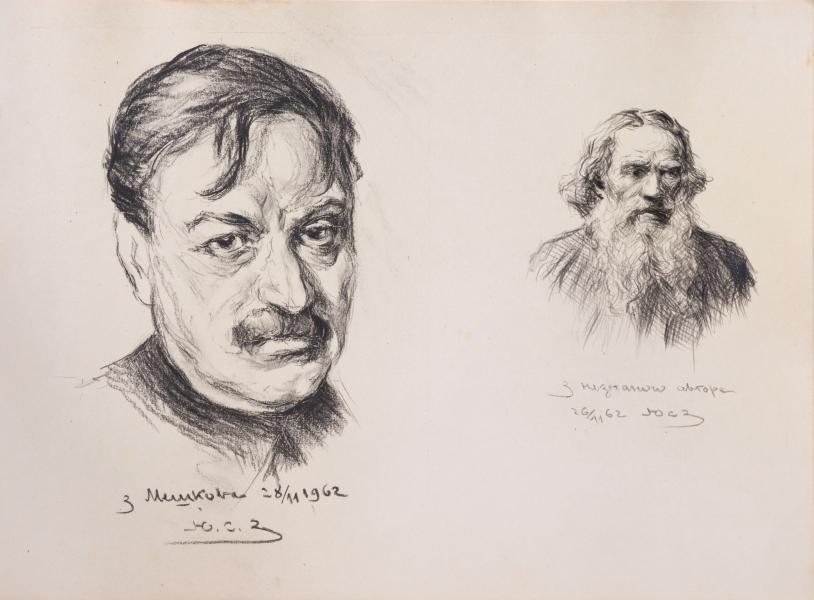
The drawings of two male portraits are distinguished by clearly defined types, reflecting not only the appearance of the persons depicted, but also the cultural and psychological subtext of each image. Both are executed with a deep understanding of facial anatomy and character traits, with Yulian Zaiats' characteristic attention to form, constructive modelling of the head, and the conveyance of individual features. The portrait on the left is a drawing copy of Vasyl Mieshkov's painting depicting Viacheslav Menzhynskyi. The figure is almost facing forward, with a focused gaze directed at the viewer. The face is elongated but sickly, with a defined nose, an indistinct jawline, and a neat moustache, complementing the image of a revolutionary intellectual who, after Feliks Dzerzhynskyi, headed the Joint State Political Directorate. His hair is untamed, his hairstyle chaotic and unkempt, which, together with his collar, creates an impression of dissonance. The author of the drawing carefully conveys the nuances of light and shadow, maintaining compositional restraint and accuracy. The portrait on the right is a drawing interpretation of a probable photograph of Leo Tolstoy in his later years. It is a frontal portrait, almost facing forward, which allows for a more accurate rendering of the face's plasticity and the characteristic texture of the hair and beard. Leo Tolstoy is depicted in simple clothes, with an unadorned shirt collar. His hair is slightly dishevelled, and his bushy beard, which occupies a significant part of the portrait, is modelled with confident lines and soft shadows. His expression is serious, full of calm dignity, inner depth, and almost detachment. This portrait does not so much capture resemblance as it attempts to capture the writer's inner world. Both images are united by their full-length format, but contrast in character: the conventional “formality” of V. Menzhynskyi is juxtaposed with the austere asceticism of L. Tolstoy. Compositionally, the figures are positioned so that they do not interact, each enclosed in its own inner field. This gives the work a tense balance, like a meeting of two types of thinking: the politician-ideologist and the writer-philosopher. These drawings were probably created by studying different approaches to portraiture in painting and photography, or became the basis for the author's reinterpretation of the cultural symbols embodied in the images of both figures.
Inscriptions
In the centre, beneath the images: "From Meshkov"; "28/11 1962"; Yulian Zaiats' signature; "From an unknown author"; "26/11 62"; Yulian Zaiats' signature.
Portrayed person
- The name of the person portrayed
- Viacheslav Menzhynskyi (19(31).08.1874–10.05.1934), Leo Tolstoy (?) (09.09.1828–10.11.1910)
Legal regulation
Borys Voznytskyi Lviv National Art Gallery