Two Drawings
Yulian Zaiats


Basic information
- ID
- Ф-З-Арх-ЛГМ-8/9
- Author
- Yulian Zaiats
- Name
- Two Drawings
- Date of creation
- 11.12.1962–12.12.1962
- Country
- the Ukrainian SSR
- Technique
- drawing
- Material
- paper pencil
- Dimensions (height x width, cm)
- 20.3 x 28.6
Additionally
- Type
- graphic art
- Genre
- portraiture
- Plot
- Portrait
- Provenance
- Received from Nina Zaiats
Information about author
Object description
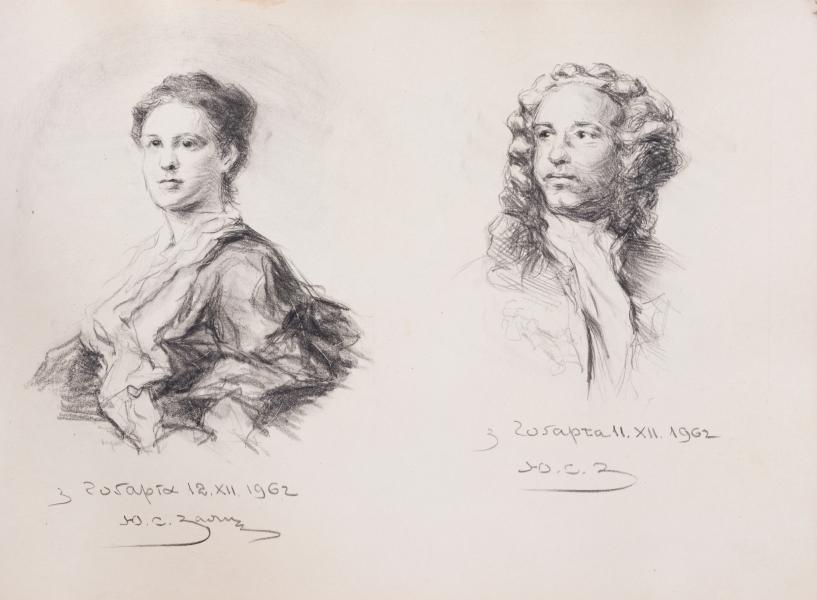
Two drawings by Yulian Zaiats, based on famous portraits by William Hogarth, represent a skilful combination of attention to 18th-century historical painting and a subtle adaptation of the Baroque portrait style to graphic reproduction. Both images are three-quarter-length portraits, but each has its own unique psychological mood, which Y. Zaiats carefully preserved and interpreted. Hogarth's portrait of Mrs Salter (1744) is distinguished by a particular softness in both the treatment of the figure and the expression on her face. The young woman, turning slightly, looks to the side, her gaze a combination of confidence and seriousness. Her hair is styled in a specific way, quite loosely, and her draped dress creates an atmosphere of elegant sophistication of the mid-18th century. In his drawing copy, Y. Zaiats accurately conveys the proportions, gently models the face, and carefully works out the figure. The artist pays special attention to chiaroscuro, using it to enhance the feeling of volume and delicacy of the skin. The portrait of actor James Quin (1739) has a completely different energy. W. Hogarth depicted the famous British performer of tragic roles, including Othello and Macbeth, turning to the left, with his gaze directed to the side, as if he were thoughtfully withdrawn. Heavy facial features, an indistinct neck, and a rich wig give the image a monumental quality. In Y. Zaiats' graphic interpretation, this monumentality is emphasised by dense strokes. Placed side by side, these two works form a striking counterpoint: the feminine portrait lightness of Mrs Salter is contrasted with the serious, almost heroic restraint of James Quin. This combination highlights not only the Zaiats' ability as a copyist-researcher to preserve the original composition and character, while simultaneously revealing his own understanding of the psychological depth and historical context of the images.
Inscriptions
In the centre, beneath the images: "From Hogarth"; "12. XII 1962"; Yulian Zaiats' signature; "From Hogarth"; "11. XII 1962"; Yulian Zaiats' signature.
Portrayed person
- The name of the person portrayed
- Madam Salter, James Quin (24.02.1693–21.01.1766)
Legal regulation
Borys Voznytskyi Lviv National Art Gallery