Crucifixion
unknown



Basic information
- ID
- С-I-1293
- Author
- unknown
- Name
- Crucifixion
- Date of creation
- 18th c.
- Country
- Ukraine
- Technique
- carving
- Material
- wood bronze paint
- Dimensions (height x width x depth, cm)
- 47.5 x 30 x 9.5
Additionally
- Type
- sculpture
- Genre
- religious
- Plot
- Crucifixion
- Provenance
- Sykhiv village, Stryi district, Lviv region
Information about author
Object description
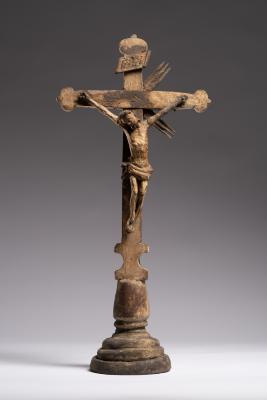
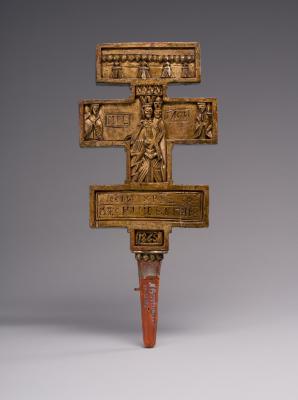
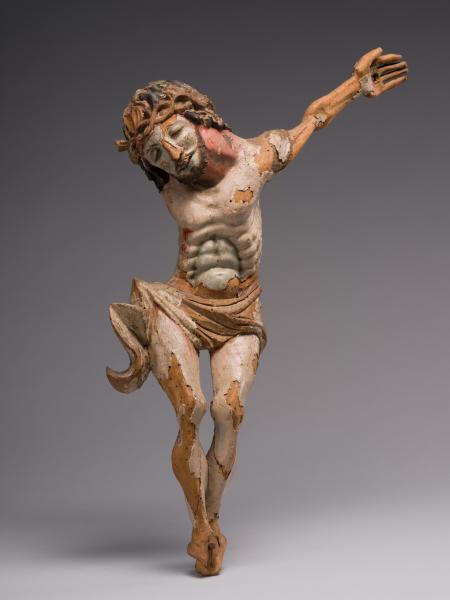
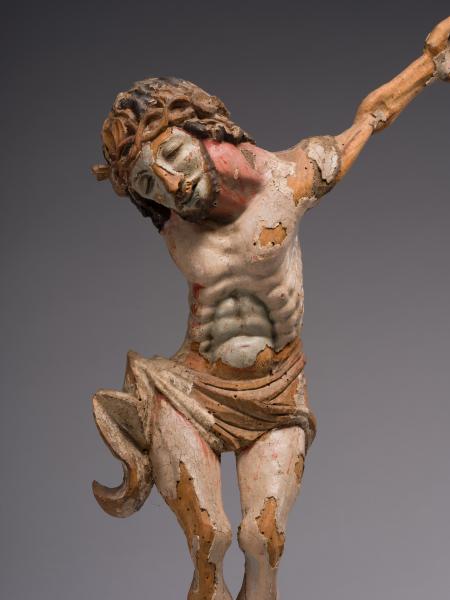
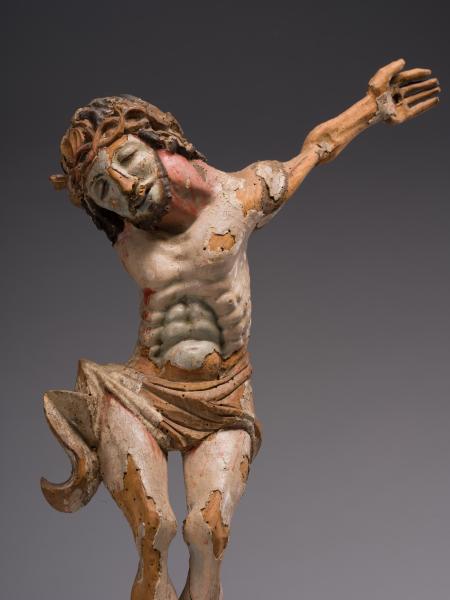
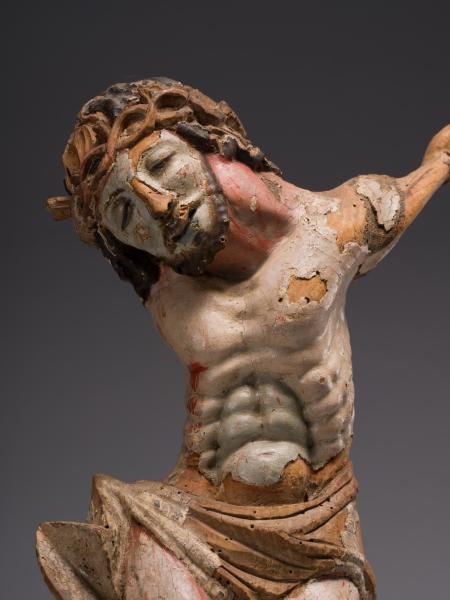
The image of Christ Crucified is a staple of Western iconography, where the Saviour is depicted at the moment of death. His body is tilted to one side, his head is bowed to his chest, and his eyes are closed. The plasticity of the body is distinguished by a generalised but eloquent rendering of anatomical features. The master texturally reproduces the chest with a sunken, relief-carved abdomen. Christ's arms (the right one is missing) are spread wide, his palms are open, devoid of extreme tension, his legs are bent, creating a dramatic effect and visual rhythm. Despite the dramatic nature of the moment, the image is filled with silence and acceptance. Christ's body is covered at the hips by a perizoma, modelled with shallow folds carved with a chisel, the ends of which create an effect of movement, dynamically fluttering. The influence of Baroque expression is evident in the curves of the body, the tension of the muscles, and the dynamics of the drapery. In this work, the author seeks to convey spiritual content rather than to perfectly reproduce anatomical features.
Legal regulation
Borys Voznytskyi Lviv National Art Gallery