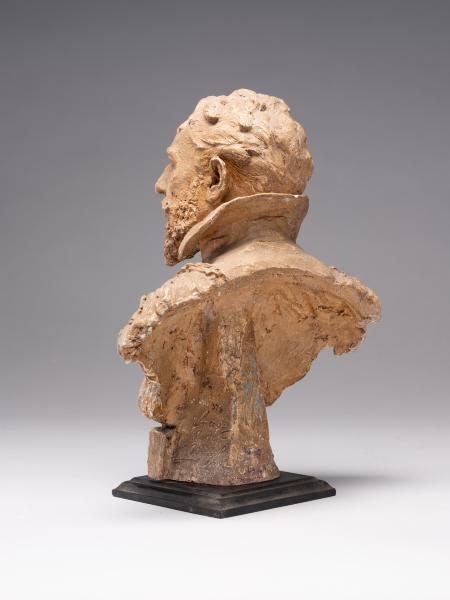
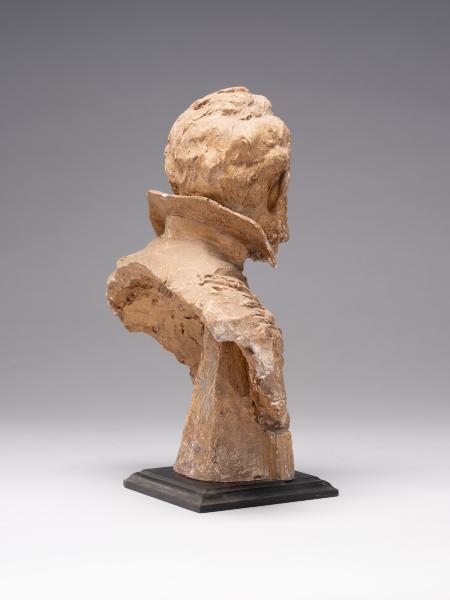
Bust of Christopher Columbus
Franz Weigel
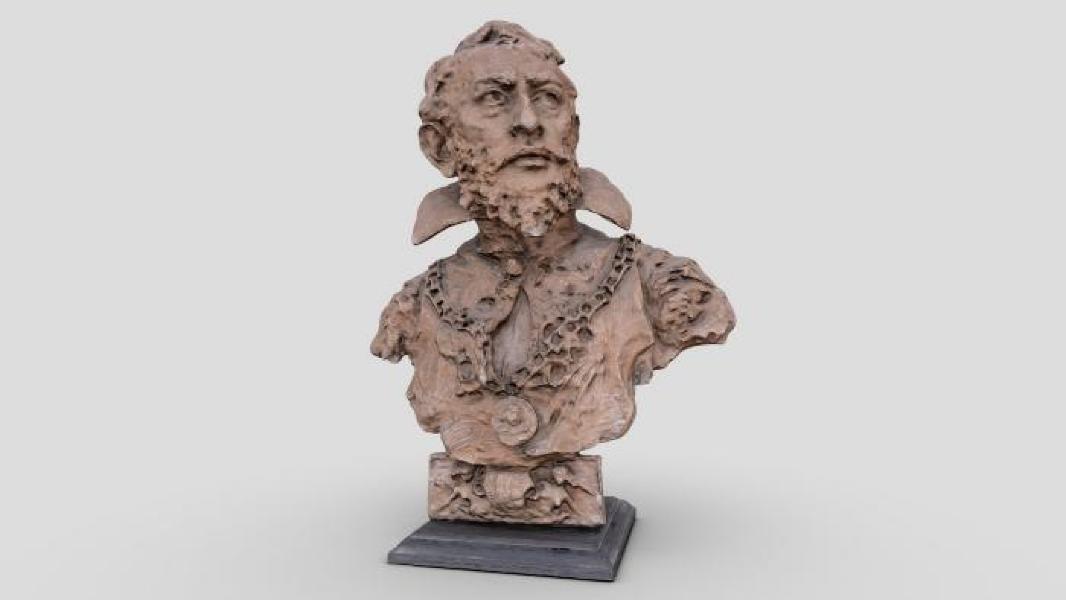


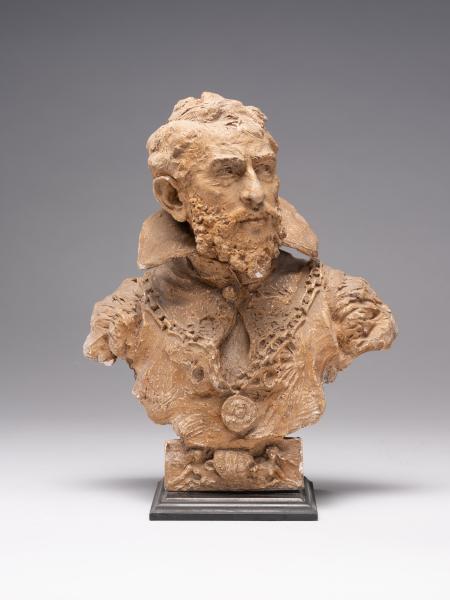
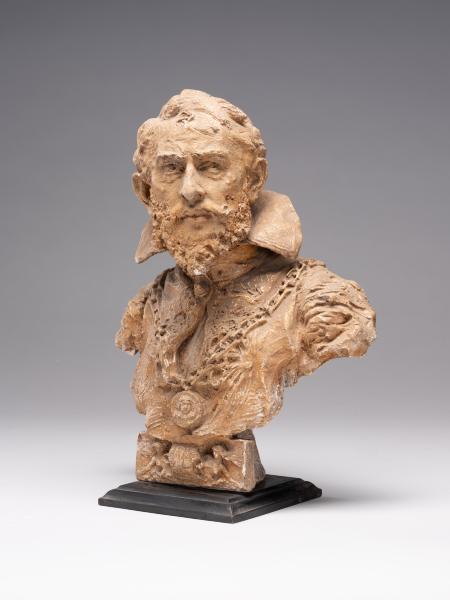
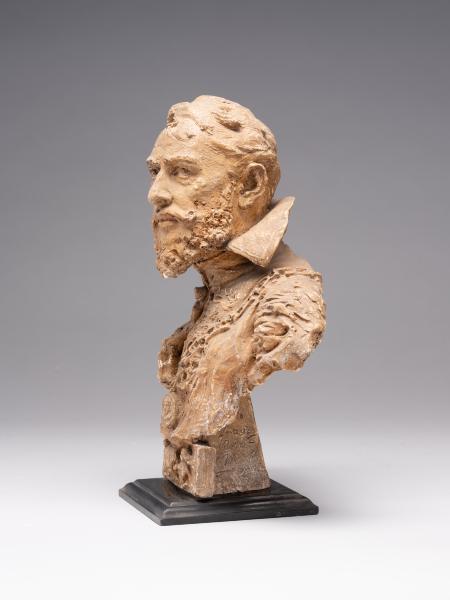



Basic information
- ID
- С-I-581
- Author
- Franz Weigel
- Name
- Bust of Christopher Columbus
- Culture
- Modern times
- Technique
- moulding
- Material
- plaster
- Dimensions (height x width x depth, cm)
- 27 x 21 x 10
Additionally
- Type
- sculpture 3D
- Genre
- portraiture
- Provenance
- the Dzieduszycki collection
Information about author
Object description
Christopher Columbus (Cristoforo Colombo) (between 26 August and 31 October 1451 – 20 May 1506) was a Spanish navigator of Italian origin and the discoverer of America. He was the first traveller to cross the Atlantic Ocean and reach the Caribbean Sea. His activities marked the beginning of the era of great geographical discoveries and colonisation of the New World. He initiated the exploration of Central and South America and discovered all the Greater Antilles. He was born between 26 August and 31 October 1451 in Genoa. His father, Domenico Colombo, was a weaver, winegrower and sales agent. Christopher received an education, studying mathematics, cosmography, geography, and navigation. From a young age, he began to go to sea. At first, Columbus sailed in the Mediterranean Sea. In the 1470s, he settled in Portugal, which was then the centre of Atlantic expansion. He studied geographical works (in particular, Marco Polo's "Book") and maps and came to the conclusion that the rich countries of the East (India, China, Japan) could be reached by sailing west across the Atlantic Ocean. However, he significantly underestimated the size of the Earth and the distance to Asia. For many years, he tried to find a patron to finance his expedition, offering his project to the Portuguese King John II, then to the English and French courts, but was rejected everywhere. In 1485, he moved to Spain. After lengthy negotiations, the Spanish monarchs Ferdinand II of Aragon and Isabella I of Castile agreed to support his plan. On 17 April 1492, they signed the Treaty of Santa Fe with him, which granted Columbus the titles of admiral, viceroy and governor-general of all the lands he discovered, as well as the right to a share of the riches found. The first expedition (1492–1493). On 3 August 1492, three caravels – the Santa Maria, the Pinta and the Niña – left the port of Palos de la Frontera. After stopping at the Canary Islands, the fleet headed west. On 12 October 1492, sailor Rodrigo de Triana spotted land – the island of San Salvador (Guanahani) in the Bahamas archipelago. Columbus landed on the shore and believed he had reached the East Indies, so he called the local inhabitants ‘Indians’. He also discovered the islands of Hispaniola (Haiti) and Cuba. The first European settlement, La Navidad, was founded on Hispaniola. On 15 March 1493, Columbus returned to Spain, where he was welcomed as a hero. Second expedition (1493–1496). Seventeen ships and more than 1,200 people took part in the second expedition. The goal was to colonise unclaimed lands. The Lesser Antilles, Puerto Rico, and Jamaica were discovered, and the exploration of Cuba and Hispaniola continued. Columbus continued to rule the colony on Hispaniola, but his administrative skills proved weak, leading to conflicts among the colonists. Third expedition (1498–1500). During his third voyage, Columbus reached the northern coast of South America (the territory of modern-day Venezuela), but still believed that it was the outskirts of Asia. Meanwhile, a rebellion broke out on Hispaniola against his brother Bartolomeo. A royal commissioner arrived at the colony to investigate the abuses, arrested Columbus and his brothers, and sent them in chains to Spain. The monarchs released the navigator, but deprived him of his monopoly rights to discover new lands. Fourth expedition (1502–1504). The last expedition aimed to find a passage south of the new lands, which, according to Columbus, was supposed to lead to the Indian Ocean. He explored the coast of Central America (Honduras, Nicaragua, Costa Rica, Panama). During the difficult voyage, he lost all his ships and was forced to spend the winter in Jamaica before being rescued. On 7 November 1504, he finally returned to Spain. Columbus spent the last years of his life in vain attempts to restore his privileges and titles. He died on 20 May 1506 in Valladolid. He was convinced that he had discovered the western route to Asia. His ashes were moved several times; it is now believed that he is buried in Seville Cathedral.
Portrayed person
- The name of the person portrayed
- Christopher Columbus
- Lifetime of the person portrayed
- 26.08./31.10.1451–20.05.1506
Legal regulation
Borys Voznytskyi Lviv National Art Gallery