Collection of Ethnographic Drawings
Kajetan Kielisinski

Basic information
- ID
- Г-V-424_133
- Author
- Kajetan Kielisinski
- Name
- Collection of Ethnographic Drawings
- Country
- Kingdom of Poland
- Culture
- Modern times
- Technique
- drawing
- Material
- pencil
Additionally
- Type
- graphic art
- Genre
- genre art
- Provenance
- the Dzieduszycki collection
Information about author
Object description
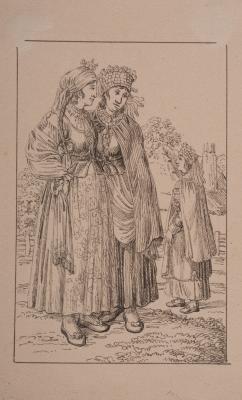
Kajetan Wincenty Kielisiński created numerous etchings and drawings devoted to folklore, life in Polish villages and towns, historical monuments, and landscapes. He was one of the first to develop bookplates in Poland. During his travels to various locations, he collected graphic materials for the publications "Polish Antiquities" and "Folk Costumes". In 1855, Poznań publisher Jan Konstanty Żupanski published "Kielisiński's Album", which collected the artist's scattered works. Kielisiński's graphic works, drawings, sketchbooks, and correspondence were kept in the Kórnik Library of the Polish Academy of Sciences, as well as in national museums (Kraków, Poznań, Warsaw) and renowned libraries (Jagiellonian University, Ossolineum, Warsaw University). The picture shows a young man playing duda. The Duda (also known as the gaida, koza, kozitsya, baran, mikh, dutka) is an archaic folk wind instrument, a type of bagpipe, which is a bag made of goat, sheep or calf skin with a tube inserted into it for pumping air, bass pipes and a pipe with holes (like a flute) on which the melody is played. All the elements of the instrument are clearly visible: the bag (which is pressed by hand), the pipes (including the drone pipe – the longer one resting on the shoulder), and the chanter, which is played by blowing air in through the mouth. The man is dressed in simple peasant clothing, including a long shirt or jacket with wide sleeves, narrow trousers, and simple footwear similar to postoly (traditional leather shoes). The costume looks functional and convenient for travelling or rural areas. On the head, he wears a helmet or hat that resembles a helmet, which is an element of traditional clothing. In the background, you can see a hilly or mountainous landscape with trees, giving the impression that the character is travelling through the mountains. The man is depicted in profile, moving as if stepping forward while playing an instrument. His posture conveys concentration and calm. The lines are clear, thin, and well-crafted. The artist's skill in conveying the texture of fabric, wood, and hair is evident. Shadows are conveyed by hatching. This image has ethnographic or romanticised historical significance. The man is a travelling musician, a typical representative of the folk tradition of playing the bagpipes. The image conveys the spirit of travel, folk culture, and musical life in rural areas. The artistic significance lies in the accurate and detailed reproduction of the folk costume, making it a valuable source for researching and studying traditional culture. In aesthetic terms, we are dealing with an example of realistic drawing, with a special emphasis on the documentary nature of the work.
Legal regulation
Borys Voznytskyi Lviv National Art Gallery